
Overcoming the Ice Dragon of Self-Doubt

In every work of genius, we recognize our own rejected thoughts; they come back to us with a certain alienated majesty. — Ralph Waldo Emerson
How many of your dreams and aspirations lie frozen under the petrifying breath of the Ice Dragon of Self-Doubt?
Stillborn by fear of failure.
Shelved under “I can’t do this.” “I’m no good at…” “What will people think of me?” or “I don’t have the time.”
The most regretful people on earth, said poet Mary Oliver, are those who felt the call to creative work, and gave it neither power nor time.
Why do we do it?
Fear is an adaptive response, an ancient survival instinct untouched by the effects of modern civilization.
To prove it, Charles Darwin, who never experienced the bite of a poisonous snake, went to the reptile house at the London Zoological Gardens. Trying to remain calm, he stood as close to the glass as possible while a venomous viper lunged at him on the other side. Every time it happened, Darwin grimaced and recoiled. In his diary, he writes, “My will and reason were powerless against the imagination of a danger which had never been experienced.”
Despite all our 21st Century knowledge, it seems our brains are still stuck in the Stone Age.
When young, we are further conditioned to fear, and, concurrently become more risk-averse by the messages we receive. Consider this: A UCLA survey recently found the average one year old child hears the word, ‘No!’ more than 400 times a day.
Then, as we age, and life heaps steady dollops of disappointments and regrets on our plates, we become less creative, less daring, and less self-confident. We shift our mental calculations toward what we stand to lose, rather than what we stand to gain and our courage to try new things is sapped by our fears — of loss, rejection, judgment, and criticism.
So, while it seems there is no way to vanquish the Ice Dragon of Self Doubt, there are ways to overcome it.
Acceptance
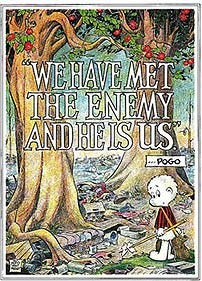
Start by realizing that the Ice Dragon is YOU and will always stir to life the minute you dream of trying something new or imagine a different life for yourself. At that moment, fear is not an intelligent response. It’s either fight or flight. As filmmaker James Cameron said, failure is an option; fear is not.
Besides, it happens to the best of them.
While writing the book that would earn him the Pulitzer Prize, John Steinbeck wrote this in his diary:
“My many weaknesses are beginning to show their heads. I’m not a writer. I’ve been fooling myself and other people. I have very grave doubts sometimes. I am sure of one thing — it isn’t the great book I had hoped it would be.”
Speak to the Dragon
Doubt shuts down half the brain, as revealed by magnetic resonance imaging scans (MRIs). To jumpstart that idle half back to life and turn on your problem-solving powers, challenge your self-doubt by using a technique from cognitive behavioral therapy called thought challenging.
Ask yourself:
· Is there substantial evidence for my thought?
· Is there evidence contrary to my thought?
· Am I attempting to interpret this situation without all the evidence?
· What would a friend think about this situation?
· If I consider what I stand to gain, rather than what I stand to lose, how does it feel?
Reflect on Past Victories
Near the end of my junior year in high school, I was flunking four main subjects and was called into the Principal’s office. Helicopter parenting had yet to be invented, so my parents were not involved one bit in my education. After listing my failures, she paused, staring at me with motherly care and concern which I returned with my own cocktail of adolescent arrogance and disinterest.
“We know your parents are not around much, or might not care,” she said, “so the question is, do you care?”
I was stunned. Her question made me realize for the first time I was alone; that my future rested squarely on my shoulders.
Seeing I had no answer, she went on: “To avoid expulsion and move onto senior year, you’ll have to score above eighty percent on all your final exams. I don’t doubt your capacity… you are bright and intelligent… you just don’t know it.”
Fight or flight?
“I’ll do it!” I said, surprising myself with my newfound resolve and sense of propriety.
“I know you will,” she said, smiling. “Now get out of my office and get to work!”
For the following two months, I shut myself inside my room every single day and burned the midnight oil.
I made it.
Now, every time I doubt myself or falter, I reflect on that victory.
Studies in neurochemistry show that reflecting on past achievements and happy moments is a serotonin booster. Memory allows us to relive an experience which promotes the same amount of serotonin experienced during the actual event.
Further, low levels of dopamine are linked to procrastination, self-doubt, and lack of enthusiasm, while increased dopamine produces actions toward setting and accomplishing goals. The surge of pleasure we feel when achieving goals also comes from dopamine.
Grow LARGER than the Dragon
Recent advances in neuroscience prove that the brain is far more malleable than once thought. Research on brain plasticity demonstrates that experience improves connectivity between neurons. With practice, neural networks grow new connections, strengthen existing ones, and build insulation that speeds transmission of impulses.
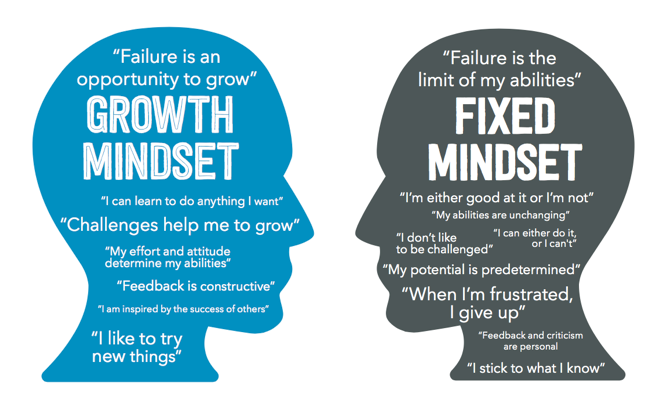
Over 30 years ago, Stanford University Professor Carol Dweck became interested in students’ attitudes about failure. She noticed some students rebounded while other students seemed devastated by the smallest setbacks. After studying thousands of children, Dr. Dweck coined the terms fixed mindset and growth mindset to describe the underlying beliefs people have about learning and intelligence.
In a fixed mindset, people believe their basic qualities, like intelligence or talent, are simply fixed traits. They waste their time documenting their intelligence or talent instead of developing them. They also believe talent alone creates success, and that effort has nothing to do with it.
In a growth mindset, people believe their basic abilities can develop through dedication and hard work — brains and talent are just the starting point. This fuels a desire to learn and a resilience that is essential for great accomplishments.
It was Albert Einstein who once said it wasn’t that he was smart, but that he stayed with problems longer.
A few years ago, I got it in my head that I wanted to draw.
Emerging from the slavish cave of fixed mindset, the Ice Dragon of Self-Doubt hissed “You can’t draw! Stick to what you know.”
It then conjured all the imaginary obstacles I would encounter along the way.
Fight or flight?
I decided to prove him wrong, bought myself a guide and more supplies than I really needed, and got to work. It was excruciating at first. Many times, I felt like giving up. But I kept at it, every day, and as I worked through my initial frustrations, it became easier and less intimidating.
Most behavioral therapies for fear extinction focus on exposure. Therapy for a person with a fear of snakes, for instance, might involve visiting a snake farm repeatedly and taking small steps toward touching one.
Only the unknown frightens men, said writer and adventurer Antoine de Saint-Exupéry. Once men are caught up in an event, they cease to be afraid.
Here’s the result:
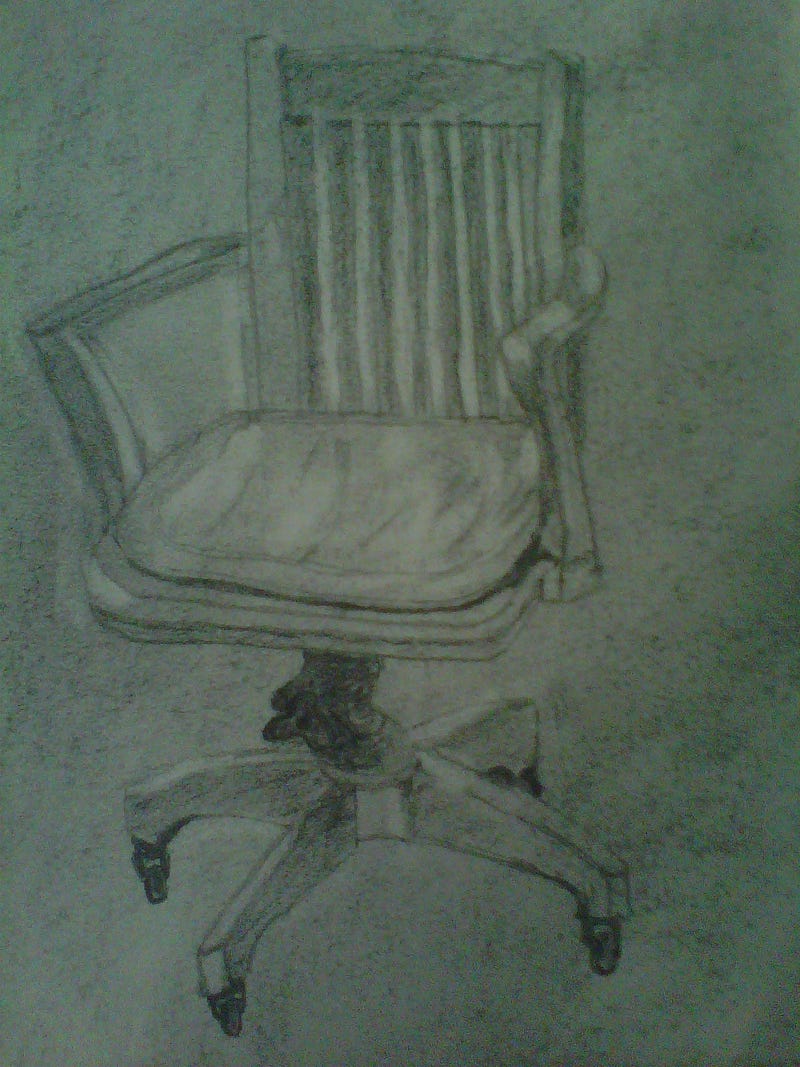
Granted, not a masterpiece, but I’m really proud of it!
Nothing will ever be attempted if all possible objections must first be overcome. — Samuel Johnson
Non-Competitive Mindset
My intention was not to become the next Da Vinci but push myself beyond my comfort zone and learn something new.
Neuroscientist Nick Hobson says competition organizes the mind to perceive social environments as hierarchical in nature — “there’s people at the top and people at the bottom.” This creates a zero-sum perception bias in which my wins are your losses, and vice versa.
As long as your work is original, like my chair, there is no reason why you should entertain false, and ultimately self-defeating comparisons.
Conviction
Psychological certainty is key in shaping thoughts, judgments, attitudes, and behaviors. Attitude certainty, or the sense of conviction with which one holds one’s attitude, has been the subject of considerable research.
In two studies, a team of Stanford researchers primed people to feel either high or low attitude certainty. Afterwards, participants indicated the extent to which they experienced self-doubt in their own abilities. What the Stanford team found was that those who were made to feel greater conviction in their attitudes showed less self-doubt and were surer of themselves and their talents.
I hate inspirational posters featuring soaring eagles and rock climbers (especially the ones grinning at the top of the summit with their arms held high).
But it turns out, they work.
Scientists at Stanford recently discovered the brain pathway that directly links positive attitude with achievement.
Just Jump Over the Ice-Dragon
The inimitable Kurt Vonnegut once said that we have to be constantly jumping off cliffs and developing our wings on the way down.
Three years ago, I jumped over the Dragon and off the cliff to pursue my lifelong aspiration of becoming a writer.
There were so many reasons why it was reckless idea. Had I given them a second thought, I’d still be stuck in my cubicle working nine-to-five.
Reason 1: I had never really written anything before.
Reason 2: Writers rarely make a living wage, especially at my age.
Reason 3: Quitting my job meant giving up the lion’s share of a lifelong pension.
Reason 4: I had neither house nor savings.
For years… decades, actually, I had entertained the thought but never did anything about it. I was afraid and doubted my abilities.
A man who procrastinates in his choosing will inevitably have his choice made for him by circumstance — Hunter Thompson
But there came the time when the anguish of doing nothing was greater than the fear of doing something badly, so I jumped, telling myself I would figure it out along the way.
I also decided to consider my new path as one of an amateur, in the proper sense, as proposed by English author G.K. Chesterton:
“A man must love a thing very much if he not only practices it without any hope of fame or money, but even practices it without any hope of doing it well. Such a man must love the toils of the work more than any other man can love the rewards of it. If anything is worth doing, it is worth doing it badly. An amateur has only one reason for doing something: the genuine fire of unbridled passion.”
I can now say I have not lost wealth, but distractions, which lets me to focus on what I love to do. That I’ve gained my freedom and discovered my purpose in life.
I suppose it’s just a matter of how you choose to narrate your story.
I won’t lie, though. The road has not been easy and continues on a steep incline. Time and again, the Ice Dragon never fails in raising its ugly muzzle. But I’ve grown larger and stronger than the Beast. I have developed wings, like Vonnegut said I would. Day by day, with consistent practice, my writing is improving. The fire of my unbridled passion burns hotter than the icy blast of self-doubt, and there is no way I will not overcome it at every turn.
Memento Mori
Memento Mori is the medieval theory and practice of reflection on mortality.
“You could leave life right now,” said Roman Emperor Marcus Aurelius. Let that determine what you do and say and think.”

If you need but one jolt to dust-off the dreams and aspirations you’ve allowed to remain frozen under the petrifying breath of the Ice Dragon of Self-Doubt, get yourself a life-size skull and set it on your desk. It will remind you that time and tide waits for no man.
For how certain are you that you’ll be alive tomorrow? What are you waiting for?
A ship is safe at harbor, said John A. Shedd, but that is not what ships are built for.
There is no time for anything but meaningful acts if we live with death as our eternal companion. — Carlos Castaneda’s ‘Teachings of Don Juan.’
As you prepare to jump off the cliff, keep this in mind: No daring is fatal.
For proof: you’re reading this now.
Read the chapter on the Deadliest Dragons in my book for boys.
Join my online community and receive the entire Dragon Series delivered to your inbox, as well as a treasure-trove of letters containing the insight of some of the world’s greatest writers and thinkers with my recipes for applying their wisdom to your own life.