
Overcoming My Own Expectations of Fatherhood
I spent months worrying about my ability to be a good dad. Those fears died the moment my daughter was born.
As my wife started hour two of pushing out our first child, I gazed out of the window. I was on my knees next to her in a small bathroom in the birth center, and through a crack in the blinds I saw a plane leaving a thin wake across the light-blue sky. It struck me that the passengers on that plane, thousands of miles up in the air, had no idea what my wife — and to a much lesser extent, I — had been going through for the past 15 hours of labor. In that moment, in the midst of perhaps the most significant event of my life, I felt small.
Those long minutes inside the bathroom brought back a lingering fear I’d had since I found out I was going to be a father: a fear that I was not, and would not be, good enough to be a dad.
Throughout my wife’s pregnancy, several friends and family members, armed with imperfect information, told us that we were going to be “great parents.” Their prediction seemed to be based on little more than the fact that both of us worked at elementary schools — my wife, Carly, is a speech therapist and I teach fifth grade — and generally tolerated, and sometimes even enjoyed, the presence of children. In their eyes, it seemed, I would be an acceptable father because I could teach my kid how to divide using partial quotients.
That logic was flawed, of course, if a bit flattering. But the reality was I felt inadequate to bring a child into the world. I didn’t regret anything, and I was undoubtedly excited, but the realization struck me — slowly at first, and then suddenly, like a bag of bricks dropped onto my stomach — that my responsibilities were going to multiply, that our relatively comfortable life was going to change irrevocably, and that I simply did not measure up to what I thought a dad should be.
Carly is what I would call a “baby person.” She already knew things like the importance of tummy time and which bottles were best to feed with and at what age babies reach developmental milestones. I did not. I resented the caricature of the bumbling, clueless dad who put diapers on backwards and I did everything I could — read books, watched videos, talked to Carly in the hope that bits of knowledge would seep through my skull through pure osmosis — to avoid fulfilling it. But I was years behind; no amount of reading I did was going to catch me up in time for her (we found out our baby’s gender about halfway through) arrival.
And that was just for the first year-plus of her life. What was I going to do when she got older? I always thought my peak as a parent would be ages five through 12, but I began to have doubts about those years, too. As the son of two educators raised in rural central Florida, I was painfully aware of my shortcomings compared to the stereotypical picture of manhood. While other kids went hunting with their dads, I was rereading From the Mixed-up Files of Mrs. Basil E. Frankweiler. In high school I could explain, in detail, the role of ATP synthase in cellular respiration but couldn’t tell you where, or what, the transmission was in my car; I still can’t. As a sophomore in college I once went on a daylong journey to meet, and write a story about, Michael Jordan’s high school basketball coach, but I couldn’t tell you how to begin building a successful investment portfolio. My own dad was (and is) a wonderful father, a blend of the old-school and modern, but I thought he was an exception, an ideal I would never reach.
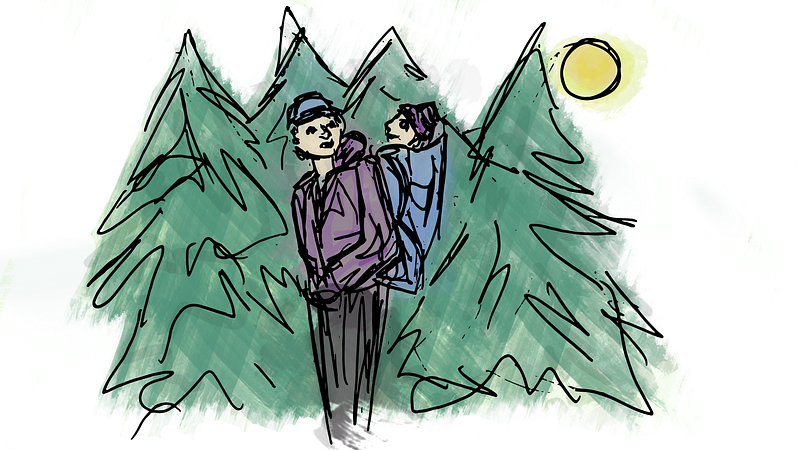
In short, I fell short of my own — and perhaps, society at large’s — expectations of manhood. And those same doubts began, like a once-faded scar, to creep back as I prepared to be a dad. How was I going to protect my daughter when I’d never punched someone in my life? What would she think if she called me because her sink was leaking and I couldn’t tell her how to fix it? How was my public-school teacher salary going to provide for her? These questions persisted, for nine-plus months, and I never answered them. Sure, I would read to her and make sure she understood her math homework and carry her on my chest as we hiked through the mountains, but to me these were trivialities; I never got over the feeling that I lacked something essential for fatherhood.
And then she was born.
It’s uncanny to know the exact time — to the minute — that your life changes forever, that some part of you dies and you begin your life anew, a clear before-and-after demarcation of your life.
It was 2:46 p.m. on March 8 when our daughter emerged, a mass of gray slime and ear-splitting cries, as my wife sighed, “I did it, I did it…” through clipped breaths and the midwife placed her delicately on her chest. And it was in that moment — I can see it, hear it, feel it so clearly it’s almost eerie — that I knew some part of me, the part that worried for 41 weeks and three days that I wasn’t enough of a man to be a dad, was gone forever, dying as our daughter entered the world. I knew then that I was enough.
It’s been more than five months since that day. I still sometimes second-guess my decisions as a father, but I have not once doubted my worth to our daughter. There is not a single correct way to be a dad, I realized; what matters is that you love your child fiercely, in whatever form that takes.
I flew to Florida recently. As the plane took off and I peered out of the window, I wondered if there was an expectant first-time father kneeling somewhere down below, worrying about his ability to become a dad. And I wanted, desperately, to find him to tell him that he is good enough.