
Our Unstable Universe: Why the False Vacuum Could Be Our End
The possible demise that comes without warning
Even before the Higgs boson was discovered almost exactly seven years ago, it had already been nicknamed the God particle. This is because the latest addition to our Standard Model of particle physics also signaled to us the existence of the Higgs field — a substance that’s invisible and yet pervasive across all of space. We inhabit it even now, surrounded by its non-zero energy that assigns particles their mass. Photons, electrons, quarks, and all other elementary particles that make up our world get their mass from their interaction with the Higgs field. The greater the resistance the particle faces while moving through the field, the greater the particle’s mass will measure. A neutrino, for example, has an easier time moving through the Higgs field than a tau lepton and so its mass will measure to be less than the tau. The mass of particles is a huge factor in determining our laws of physics. It dictates how everything interacts, and what chemistry can take place in the cold, murky expanse of space.
It seems, then, that we should be grateful to the Higgs boson for having the properties that it does. Its mass allows for life — ours, and that of stars and milky, roiling galaxies. Any change in the boson’s mass could mean that atoms would shrink or nuclei would dissolve, leaving hydrogen the only element permeating space. But it’s this same number that puts us in a dangerous situation. Not only does it give rise to one of the biggest catastrophes in all of physics, it tells us that what we think of as a steady and lasting universe could disappear at any moment. Gone in a fraction of a second. And, well, we would also be powerless to stop it.

Everything in the universe wants to be stable. To do this it must move from higher energy states to what are called “ground states”, in which it has the least amount of energy possible. Any object with a lot of energy wants to shed that energy in order to become stable. The elementary particles mentioned earlier are created when there are excitations (or waves) in quantum fields. The quantum fields are said to be in their vacuum states when they are at their lowest energy possible. If all the quantum fields in space are in their vacuum states and therefor cannot lose anymore energy, the universe is stable. The fundamental particles retain their same properties and our laws of physics prevail. And though measuring energy and vacuum states in the quantum fields is quite an involved process, scientists believe most fields are in their stable vacuum states.
All of them except for one.
The Higgs fields is thought to be in a metastable state, meaning that while it’s not currently undergoing any changes, it’s also not predicted to be at its lowest energy level. It’s a false vacuum with a lot of potential energy. The threat on which everything we know has come to rest.
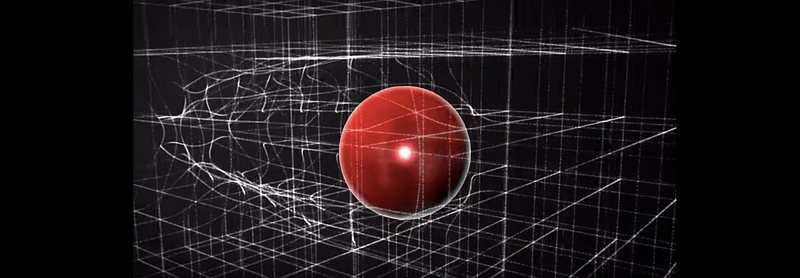
Scientists at CERN have discovered a second possible state for the field, one they’ve named the ultra-dense Higgs field. And it certainly would be dense — billions of times denser than it is today. If even just one point in space were to collapse into this lower energy level, it would trigger the spread of vacuum decay everywhere, sending a punishing sphere of the true stable vacuum to consume the entire universe. We wouldn’t even be able to watch our end approach since it would be moving at the speed of light. Space would be releasing its potential energy, throwing everything within the sphere into new and unrecognizable laws of physics. A world so strange would emerge that we can’t even begin to imagine it. Likely it wouldn’t be welcoming to life.
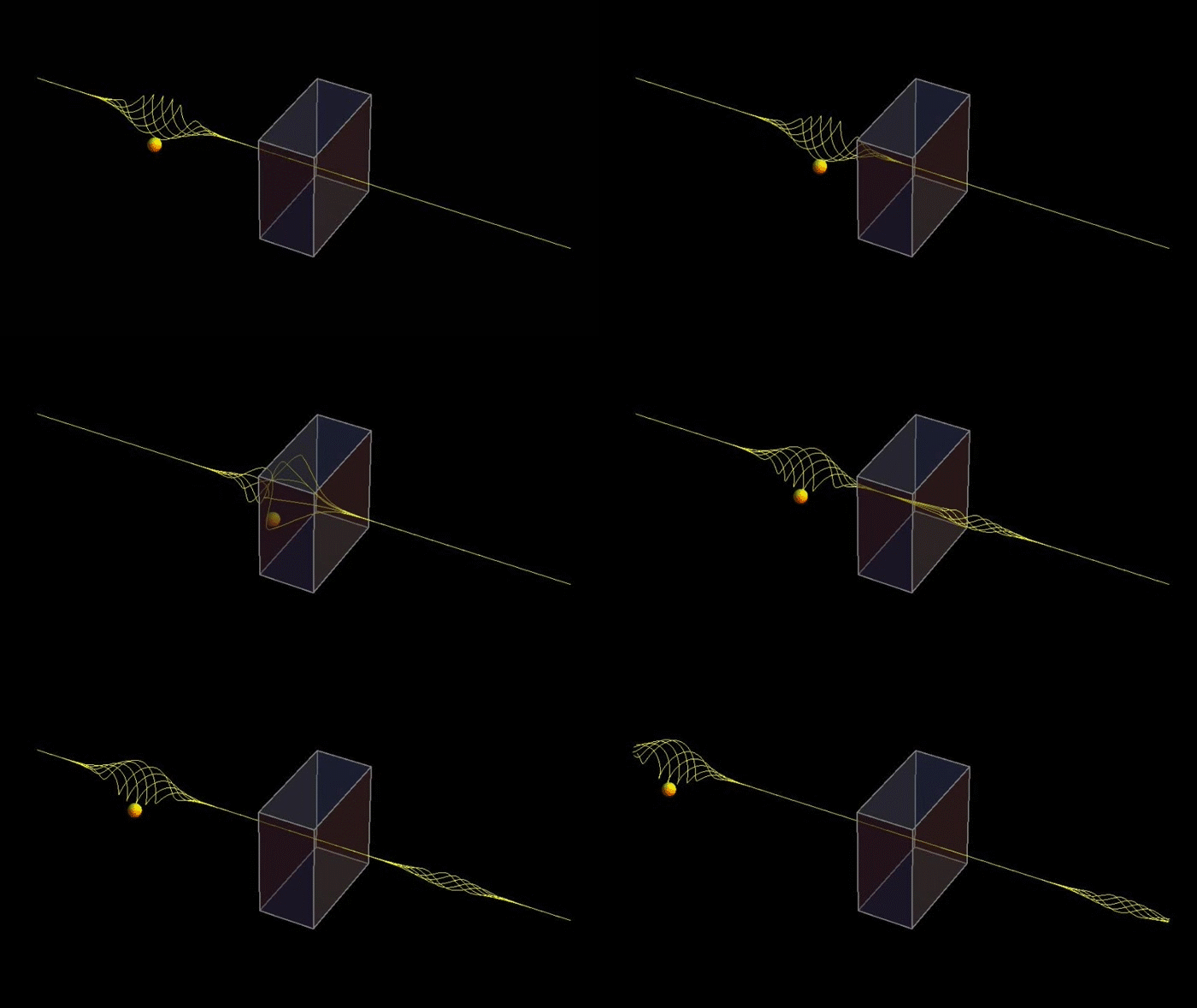
There is an energy barrier separating the two states and keeping us safe. In fact it would take an enormous amount of energy to cause a phase transition, and that’s part of the reason why some physicists don’t believe vacuum decay is much of a threat at all. But there is another way in which the transition would occur, one which has already been observed in several systems. It’s called quantum tunneling and it’s a problem when it comes to advancing familiar technology like smartphones and computers. These electronics rely on transistors that are stored on chips. Over the years the transistors have gotten increasingly smaller with the spaces between them decreasing as well. Thin enough transistor barriers (around a nanometer or so) are subject to quantum tunneling where electrons can cross the barrier even if the transistor is off. This same process is what would cause the Higgs field to transition between states despite there being a boundary between the two.
How likely is quantum tunneling? It’s a rare sight. While it will happen, it won’t do so until around 10¹⁰⁰ years from now when the sun will already have scorched the Earth or humanity will have gone extinct from any number of other phenomena. And even then, that prediction only holds true if our Standard Model is correct. If parts of the universe have already begun to decay and expand into spheres, they may never reach us (or take billions of years to arrive in our Solar System) due to the expansion of the universe. There is even a theory that vacuum decay has already taken place and our current reality is the true stable state of the Higgs field.
The balmy summer of 2012 was a great one at the Large Hadron Collider. Detectors watching particle collisions between protons found the mass of the God particle in the settling debris. Of all the numbers that could have been measured, the Higgs boson lies at just the right amount for us to be left in such a critical and uncertain position. It tells us that there are discrepancies between our theories and observations, that our perceived handle on reality may only be that — nothing more than a perception. And perhaps the name is an adequate one. If the Higgs boson really will overthrow all of existence at some point in the future then it does, like any god, have a very divine place in the world.