avatarJames Finn

Free AI web copilot to create summaries, insights and extended knowledge, download it at here

7237

Abstract

ing the media world in a fairly unique and trusting way for months now. Most public figures in his position have people advising them on media strategy, what to say, and what not to say — how to frame things so you are not misquoted. Which interviews to take on and which to refuse. Moreover, probably not to allow two solid days behind the scenes to someone who you think may have an agenda.</p><p id="2ef6">As far as I can tell, he doesn’t have this and has embraced and is fully living out his own dictum — “speak the truth and let the pieces fall where they may”.</p><p id="21b3">So far speaking the truth has worked out well for him — he was lucky that Channel 4 News put up the Cathy Newman interview unedited — a decision I’m sure that they quickly regretted. <b>This New York Times piece feels different </b>— that it will solidify impressions of him on either side.</p><p id="6328"><b>“Bad faith changes everything”</b></p><p id="cf22">As Eric Weinstein, Bret’s brother, and another member of the unofficial ‘intellectual dark web’ said — “bad faith changes everything”. It’s possible to have any kind of discussion with people you disagree with so long as they are approaching it in good faith — as soon as they are not, they’re just looking to boost their position, look good in front of others or advance their career within their tribe — as Peterson alleged Cathy Newman was — then true exchange of ideas is impossible.</p><p id="c6f9">I would argue that this journalist is indeed acting in bad faith. Some of the misrepresentations cannot be put down to simple misunderstanding.</p><p id="7c74">The piece of the interview that has been seized upon is this:</p><blockquote id="f129"><p>“Recently, a young man named Alek Minassian drove through Toronto trying to kill people with his van. Ten were killed, and he has been charged with first-degree murder for their deaths, and with attempted murder for 16 people who were injured. Mr. Minassian declared himself to be part of a misogynist group whose members call themselves incels. The term is short for “involuntary celibates,” though the group has evolved into a male supremacist movement made up of people — some celibate, some not — who believe that women should be treated as sexual objects with few rights. Some believe in forced “sexual redistribution,” in which a governing body would intervene in women’s lives to force them into sexual relationships.</p></blockquote><blockquote id="8111"><p>Violent attacks are what happens when men do not have partners, Mr. Peterson says, and society needs to work to make sure those men are married.</p></blockquote><blockquote id="005a"><p>“He was angry at God because women were rejecting him,” Mr. Peterson says of the Toronto killer. “The cure for that is enforced monogamy. That’s actually why monogamy emerges.”</p></blockquote><blockquote id="f00b"><p>Mr. Peterson does not pause when he says this. Enforced monogamy is, to him, simply a rational solution. Otherwise women will all only go for the most high-status men, he explains, and that couldn’t make either gender happy in the end.”</p></blockquote><p id="4fb7">The framing of it makes it sound like he’s advocating for some kind of “government/state enforced” monogamy — which is malicious. He — as anyone who has been listening to his lectures will tell you — is making a more subtle point.</p><p id="924a">That monogamy is an evolved trait to stabilise societies — it’s “enforced” only as a social rule. Many societies in the past have had polygamy or other situations where a small number of men had access to many women (as do many animal societies), and that proved to be unstable and a bad long term solution to social harmony.</p><p id="7529">So in this argument, the reason that monogamy evolves (and is socially enforced) is to avoid the kind of situation where you end up with too many bitter young men wanting to tear things down. Which — whether you agree with his reading or not — seems to be happening.</p><p id="c544">And he also argues — that one of the consequences of the sexual revolution of the 60s is that it has loosened sexual behaviour. When that happens, and there are less social and physiological downsides (pregnancy is not inevitable) — and more sex is being had — the spoils go disproportionately to the most attractive men.</p><p id="7716">He is arguing that there are deeper reasons for the morality that we evolved over our history, and that there are consequences to the kinds of lifestyle experiments that we saw start to accelerate in the 1960s. This is what the essence of Peterson’s message is about.</p><p id="fb0d">You can disagree with Peterson, but many people are recognising that this fits their experience of the world — hence his popularity. That the increasingly boundary-less world we’ve created is not working and we need a reintegration of these traditional values.</p><p id="ad84"><b>Ideological fixation</b></p><p id="89ce">Personally I agree with Peterson that much of our culture and media is in the grip of an ideology that styles itself as open, inclusive and tolerant, but actually has a shadow side of intolerance towards those that don’t share their values.</p> <figure id="3404"> <div> <div> <img class="ratio" src="http://placehold.it/16x9"> <iframe class="" src="https://cdn.embedly.com/widgets/media.html?src=https%3A%2F%2Fwww.youtube.com%2Fembed%2FaMcjxSThD54%3Fstart%3D1511%26feature%3Doembed%26start%3D1511&amp;url=http%3A%2F%2Fwww.youtube.com%2Fwatch%3Fv%3DaMcjxSThD54&amp;image=https%3A%2F%2Fi.ytimg.com%2Fvi%2FaMcjxSThD54%2Fhqdefault.jpg&amp;key=a19fcc184b9711e1b4764040d3dc5c07&amp;type=text%2Fhtml&amp;schema=youtube" allowfullscreen="" frameborder="0" height="480" width="854"> </div> </div> </figure></iframe></div></div></figure><p id="731c">One of the sacred cows in this is the belief that the only reason that men and women don’t have equal representation in many industries and top jobs is because of discrimination, not differing choices. This was famously the subject of the clash with Cathy Newman.</p><p id="fc16">If these activists (and the liberal left generally) has to accept that there are measurable differences in temperament, values and life choices made by men and women, and that some of them are likely tied to biology and evolutionary history — then the entire edifice of this ‘gender ideology’ movement starts to shake. We would realise that it would be irrational to expect 50/50 representation in many jobs, for example.</p><p id="8022">And realise that this is not just a social movement — this ideological framing — it’s a big industry. There are charities, organisations and groups that are funded on the basis of this that have huge impact on the media conversation, and business practice.</p><p id="e742">So left-wingers who are usually concerned about the impact of money on ideology and political decisions from corporate interests, might wish to look at the fact that these are major financial interests as well. It is not possible for this entire industry to look at the data accurately.</p><p id="b543">I would also frame it in this way that might resonate

Options

with left-wing thinkers. Why are you using capitalist metrics like pay to decide on whether women have achieved equality? Isn’t that just another version of the ‘patriarchy’ controlling your minds? How has “the man” persuaded you that equal pay is the right metric to look for equal respect and value?</p><p id="b245">What makes women actually fulfilled and gives genuine meaning in life? Is it the same as for men? I doubt it, and I personally know many women who made that realisation too late in life to easily have a balanced life that included children.</p><p id="5cc1">But anything that argues against leftist ideology is attacked and smeared. For example the infamous ‘Google memo’ was a case in point, being described as an ‘anti-diversity screed’ throughout the media despite the author, James Damore, specifically making suggestions that would increase the representation of women in tech. This article from the Atlantic — from a writer who doesn’t agree with Damore’s conclusions — gives good context to its misrepresentation: “To me, the Google memo is an outlier — I cannot remember the last time so many outlets and observers mischaracterized so many aspects of a text everyone possessed.”</p><p id="3999">Liberalism as an ideology, with those inside and outside the tribe. Those outside the tribe, like Peterson — deserve scorn, derision, and even misrepresentation.</p><p id="11cc">Another hard to explain mischaracterisation, if the journalist had any familiarity with Peterson’s work is this:</p><blockquote id="33b8"><p>“Mr. Peterson illustrates his arguments with copious references to ancient myths — bringing up stories of witches, biblical allegories and ancient traditions. I ask why these old stories should guide us today.</p></blockquote><blockquote id="f195"><p>“It makes sense that a witch lives in a swamp. Yeah,” he says. “Why?”</p></blockquote><blockquote id="69ec"><p>It’s a hard one.</p></blockquote><blockquote id="0ac8"><p>“Right. That’s right. You don’t know. It’s because those things hang together at a very deep level. Right. Yeah. And it makes sense that an old king lives in a desiccated tower.”</p></blockquote><blockquote id="fc08"><p>But witches don’t exist, and they don’t live in swamps, I say.</p></blockquote><blockquote id="e8f8"><p>“Yeah, they do. They do exist. They just don’t exist the way you think they exist. They certainly exist. You may say well dragons don’t exist. It’s, like, yes they do — the category predator and the category dragon are the same category. It absolutely exists. It’s a superordinate category. It exists absolutely more than anything else. In fact, it really exists. What exists is not obvious. You say, ‘Well, there’s no such thing as witches.’ Yeah, I know what you mean, but that isn’t what you think when you go see a movie about them. You can’t help but fall into these categories. There’s no escape from them.”</p></blockquote><p id="3287">He is deliberately framed here as an old crank, an eccentric who believes in dragons and witches. Yet throughout his lectures he has made clear he is talking psychologically, archetypally and mythologically.</p><p id="67f0">In this view they exist in our mythology in a very real way as representations of psychological realities, for example that the dragon is the mythological representation of the ‘unknown’. Throughout our history if you ventured out into the unknown you could die — but there was no other way to discover new information or new rewards.</p><p id="cc2a">So the dragon is a composite predator of all the animals that used to prey on humans — a cat/snake/bird — and of course in mythology dragons have gold (or virginal women in captivity). The deep psychological story is that by confronting the unknown, you can achieve riches. He’s made that abundantly clear in every lecture.</p><p id="2105">What is becoming ever clearer (and again is something Peterson points out) — the death spiral of the print media is speeding up polarisation — in even the most reputable organisations such as the New York Times start to produce clickbait such as the Jordan Peterson article.</p><p id="4e32">Perhaps the New York Times have decided to take a leaf out of the book of the 4chan culture, and provocateurs like Milo Yiannopolous who made whole careers out of provoking the left into overreaction. In this case — the NYT have placed this article behind a paywall (I’m told) — so to read it, outraged Peterson fans will have to subscribe to the paper.</p><p id="255f">Then to unsubscribe — I know because I just checked — you cannot unsubscribe online, you have to call them. This seems at least unethical.</p><p id="5aaf">The most dangerous part of this whole enterprise is that Peterson has now become pretty much the singular focus of the ramping up of the culture wars — the lightning rod, if you will. Articles like this add hugely to the polarisation he warns about.</p><p id="46ed">On one side you have literally tens of thousands of people (mainly, but not all men) who have had their lives changed, and many claiming actually saved, by listening to Jordan Peterson’s words. On the other side you have a mix of hard core ideological opponents to him, and a vast middle ground who don’t know him well — but are almost certainly thinking that there is no smoke without fire.</p><p id="6c75">He has argued frequently that we are in an increasingly polarised world and that individual actions can have serious consequences, if we don’t act with integrity, or we sacrifice our morality and conscience in any way.</p><p id="c074">This journalist spent two days with Peterson in his house, she seemingly has some familiarity with his work, and yet chooses to characterise him in this way.</p><p id="9c1a">The treatment of Jordan Peterson is speeding up the irrelevance of the mainstream media at an increasing rate. Too many people are aware of his work and who he is and what he believes for the hit pieces to stick.</p><p id="3463">In the language of the internet subculture — the treatment of Jordan Peterson by the mainstream media is showing up their ideology, and Red Pilling an entire generation.</p> <figure id="41f6"> <div> <div> <img class="ratio" src="http://placehold.it/16x9"> <iframe class="" src="https://cdn.embedly.com/widgets/media.html?src=https%3A%2F%2Fwww.youtube.com%2Fembed%2FYDxl1stMTCU%3Fstart%3D193%26feature%3Doembed%26start%3D193&amp;url=http%3A%2F%2Fwww.youtube.com%2Fwatch%3Fv%3DYDxl1stMTCU&amp;image=https%3A%2F%2Fi.ytimg.com%2Fvi%2FYDxl1stMTCU%2Fhqdefault.jpg&amp;key=a19fcc184b9711e1b4764040d3dc5c07&amp;type=text%2Fhtml&amp;schema=youtube" allowfullscreen="" frameborder="0" height="480" width="854"> </div> </div> </figure></iframe></div></div></figure><p id="8453">For more documentaries and interviews, check out the <a href="https://www.youtube.com/channel/UCFQ6Gptuq-sLflbJ4YY3Umw?view_as=subscriber">Rebel Wisdom Youtube channel</a>.</p><p id="0b51">My personal website: <a href="http://davidfuller.tv/">http://davidfuller.tv/</a></p><p id="a4b2">And please consider <a href="https://www.patreon.com/rebelwisdom">supporting us on Patreon</a>.</p></article></body>

Our Queer Life Was Not a Travelogue

Love and ashes, spirits soaring to the sea
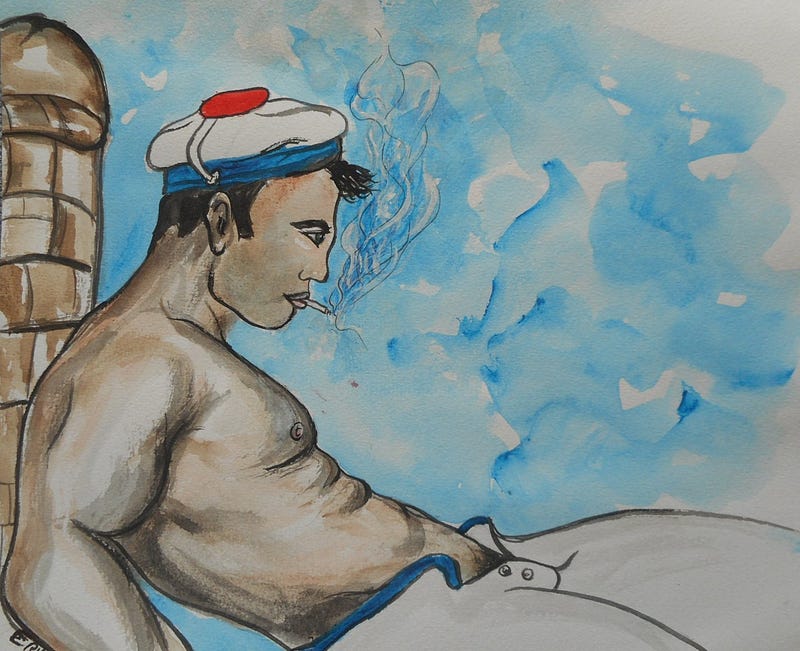
Acrylic painting on paper by Erik-H based on Jean Genet’s classic ‘Querelle de Brest’

Lenny, as I start to figure out what to do with Dad’s ashes, I flash back to the moment when I poured yours out into the steel-grey Hudson, just where sweet water churns into the brack of New York Harbor. Part of your spirit fled with mine that day to take one final journey.

Most of the globe is water, isn’t that right?

Where I live now, it’s all fresh. Rivers, streams, marshes, and ponds everywhere. That’s what Dad loved, the Great Lakes waiting in every direction we might choose to drive. So different from how you and I experienced the world.

Odd that you never learned to drive. Dad didn’t understand that.

It’s not so odd for a native New Yorker, but how you loved it when I got my NY license and we could rent a car for the weekend. Bodies of saltwater always beckoned. Is that usual, driving to the water?

You and I took it for granted.

Something about us compelled us to seek the sea. Fire Island, the Hamptons, Provincetown, the Jersey Shore. It wasn’t just the boys in speedos, was it? It wasn’t just tea dances and tipsy antiquing in fabulous shops run by faded old men with silver hair and lavender voices.

Ocean called to us.

Waves marching in on relentless tide whispered to us of horizons, dreams, and impossible distances. Making love, the rhythm of endless surf filled us with saline magic.

Remember when we first met, and I told you I’d always wanted to live on the water? That I yearned for Ocean? You took me by the hand and walked me over to the Hudson, back when 23rd Street was still dangerous, and the High Line was haunted by junkies and hustlers.

You pointed downriver and said, “Look! You can almost see it.”

Our life together was so much more than a travelogue, but how we answered the call of that distant surf! You, who had rarely stepped foot outside the borough where you were born, decided near the end of your life that you had to see what lay beyond the vanishing point of those marching waves.

How happy I was to be your guide!

Our life was not a travelogue, but it might almost be a recounting of bodies of water. The Atlantic, the Pacific, the North Sea, and the Mediterranean. It wasn’t idyllic. I’ll never forget those horrible hours when you tried and failed to soothe me as a storm tossed our ferry like a toy in the English Channel. I didn’t know how agonizing seasick could be until that day. I’ll never forget our bickering as we breathed in the tang of the San Francisco Bay. Our first serious argument.

Remember the day we arrived in Brest and all I wanted to do was seek out the best seafood and Muscadet? You laughed and made me read you the raciest passages from an ancient copy of Querelle de Brest you’d picked up at an outdoor book stall. I’d never heard of Jean Genet’s novel of murder and seaport anal sex, but you’d seen Fassbinder’s film and wanted to know how Genet’s prose held up.

We never did figure it out since my French was horrible then, but the story reminded us of the Hudson and the terminus of Christopher Street where we were gay bashed.

“Ah those knock-out body fluids: blood, sperm, tears!” For Genet, that famous line refers to murder most foul, sexual opprobrium, scandal, and despair.

For us? The night we fought those Jersey street toughs transformed into a story. A mere story. Our fear and pain, our shaking bodies, our outrage morphed into heroics for our friends, entertainment at dinner parties. I still tell that story, you know. I’ve even written about it, published words setting sand into stone. I think you’d enjoy reading it, recognizing the truth but knowing liquid truth is impossible to pour.

Sitting in that shabby cafe in Brest not so long after, smelling the rot of the port, we knew the truth you and I, without needing to talk about it.

Days later, trilling our fingers through the cool waters of the salty canals of Bruge, we forgot all about Genet’s darkness. Bellies full of mussels and the crispest of white wine, we let the sun lull us to sleep in a boat full of gay men on holiday.

Remember the boat we took down the Rhein to Cologne? We guzzled sour sweet riesling and dreamed of Lorelei, of the grotesquery of false love and deadly romance. I read to you from Poe, Annabel Lee.

Cologne Cathedral spires. Modified from royalty-free photo.

It was many and many a year ago, In a kingdom by the sea, That a maiden there lived whom you may know By the name of Annabel Lee; And this maiden she lived with no other thought Than to love and be loved by me. And so, all the night-tide, I lie down by the side Of my darling — my darling — my life and my bride,¹

I don’t know why I associated that poem of doomed love, of cruel denial and death, with the ancient tales of the Lorelei mermaid luring sailors to their doom. But as the scent of the Rhein filled our nostrils and the spires of that famous cathedral rose before our eyes, I whispered the last verse to myself.

And so, all the night-tide, I lie down by the side Of my darling — my darling — my life and my bride, In her sepulchre there by the sea — In her tomb by the sounding sea. ¹

I already knew I would lose you too soon, that I’d still be young when you left. I didn’t want any sepulchres to haunt me, to curse me with Poe’s own melancholy and despair.

So one fine day, after I’d clutched your ashes quite long enough, I opened the urn and let them fly free in the wind. They scattered over the Hudson, into the harbor, swirling and rushing on that current so much faster and more powerful than it looks.

I watched until I knew parts of you had joined the sea. I soared with you back to Dover, Ostende, Nice, and Marseille. I joined you on Alcatraz, the cliffs of Big Sur, the Seine, and St. Tropez.

I heard your laughter, basked in your gaze and gloried in the knowing that you had rejoined the stardust from which you were born. Our life was not a travelogue, but it was filled with wonder and journey, love of Ocean and sea.

Today, as I plan for a ceremony fitting for Dad’s last remains, the beauty of that final moment with you gives me strength. He didn’t love the sea, but the sweet inland waterways of North America.

He spent much of his life fishing, which you didn’t understand. You didn’t know that for him, fishing wasn’t about the fish. He never kept them. It was about being on or in the water, unifying with nature and the universe.

He never left North America, never yearned to like you and I did. So I’ll put him back his way, in marshes, streams, rivers, and ponds, just a little at a time.

As I do, I’ll remember you both, join with you both, soar with you both, love with you both.

In a life that is so much more than a travelogue.

James Finn is a former Air Force intelligence analyst, long-time LGBTQ activist, an alumnus of Queer Nation and Act Up NY, an essayist occasionally published in queer news outlets, and an “agented” novelist. Send questions, comments, and story ideas to [email protected].

This story is a response to Prism & Pen’s writing prompt Bodies of Water.

Other stories so far —

¹ From Annabel Lee by EdgarAllan Poe

LGBTQ
Love
Relationships
Grief
Creative Non Fiction
Recommended from ReadMedium