
The Closest Star to the Earth
The life-giving Sun.
British spelling
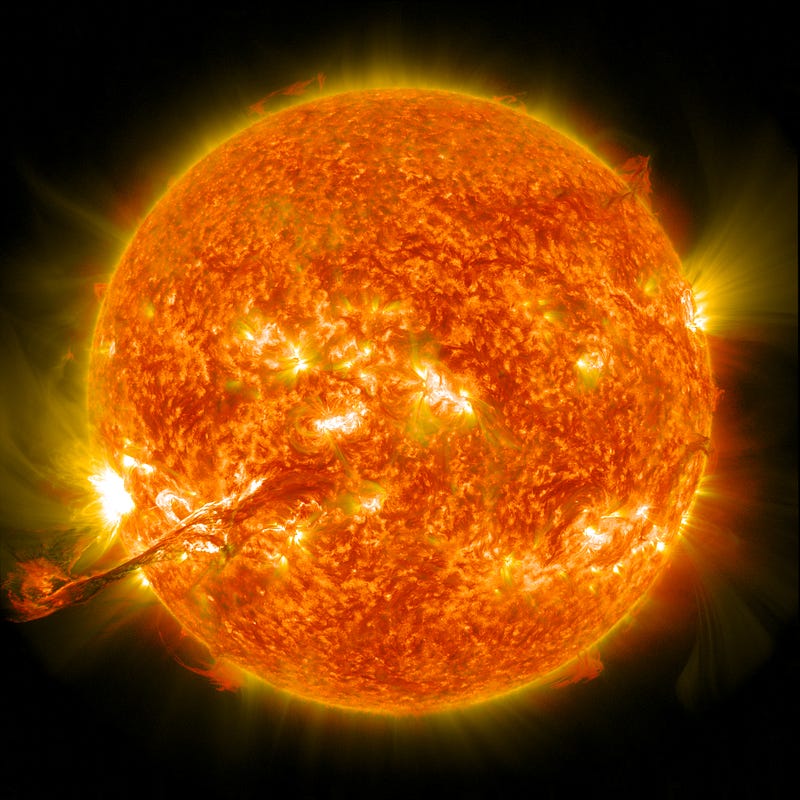
Our local star, the Sun.
The nuclear reactions taking place in the sun’s core are fusing 600 million tons of hydrogen into 596 million tons of helium every second. The missing 4 million tons of matter is converted into pure energy, and some of that energy is the light and heat we see and feel on the Earth.
Our middle-aged Sun has ample fuel left and will continue to burn hydrogen for an estimated 5 billion years or more.
Roughly 1.5 million tons of mass are being lost from the sun every second. That massive weight loss is the result of the solar winds streaming away from its surface.
This is another way of describing how much mass is leaving the Sun; the Sun loses the equivalent of one Earth mass every 150 million years.
Since the time of the sun’s birth, it has lost about 30 Earth masses, all due to the solar wind. To us, it seems like a lot of mass, but the sun has a mass 333,000 times that of the Earth.
The sun accounts for 99.86% of the total mass in the solar system.
Two forces are keeping the sun in a stable condition, one being the fusing of hydrogen to helium, creating the force that is pushing outwards from the core, and the other being gravity, which is pulling inwards. This stability will last for a very long time to come.
The sun has a diameter of 1.39 million kilometres and a core temperature of over 15 million degrees Celsius. It mainly consists of 70% hydrogen and 28% helium; the remainder of the mass is made up of carbon, nitrogen, oxygen, and a few other elements.
In its lifetime, the sun will fuse heavier elements, from helium right up the periodic table to carbon and oxygen. Larger-mass stars will be able to fuse heavier elements, which will end with iron. The Sun is so big that 1.3 million Earths would be needed to make up its volume.
Heavier elements than iron are created at the time of supernova explosions when large stars come to the end of their lives.

The distance between the Earth and the Sun is approximately 149.6 million kilometres, or one astronomical unit.
To put that distance into perspective, light leaving the sun travels at 1,080 million kilometres per hour and takes just over 8 minutes to reach our planet.
The end
You may find some of my easy-to-understand stories about the universe and life interesting and educational. Enjoy


