
Our journey from Startup to IPO, thanks to Amazon!
Amazon is everything to everyone and startups see them as a perfect eCommerce partner to scale their business. Are there any hidden costs to this marriage? Read our startup to IPO success story.

Amazon has the highest number of online customers and sales, bar none. While the world was cowering under the pandemic, Amazon was soaring with reported earnings of $96.1 billion in Q3 of 2020. Their North American sales went up by 39% to $59.4 billion, while their international sales grew 37% to $25.2 billion. So does this make them a perfect partner for startups to scale and grow to IPO heights? We’ll share in a minute.
With millions of products and billions of customers, the Amazon platform is a coveted place to launch any product. So obviously, when we launched our first consumer product in 2015, besides selling on our company website, we also launched it on Amazon. Win, Win! Not yet.
It’s 2021 and we have 3 healthcare products in the market and our Amazon sales account for 90% of the revenue (woohoo!). Though this sounds impressive, there’s a catch, the profitability has been steadily declining. Every year, Amazon finds clever ways of eating a larger piece of our pie.
So why do we still partner with Amazon? Like any messy marriage, it’s a tricky question we’ll try to answer with these facts.
Amazon is undeniably the largest e-commerce platform.
Amazon sells over 350 million products and draws over 2 billion visitors. No other eCommerce site comes close to the online traffic and sales that Amazon commands.
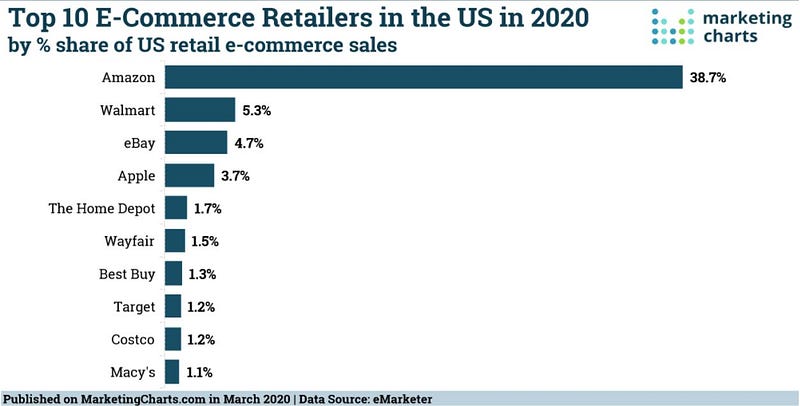
Their gigantic cyberspace presence is enough to lure any business. However, before you plunge into the Amazonian river, here’s what you should know.
1. No matter how unique your products are, there is bound to be plenty of competition
Amazon is massive, and everyone wants to sell on their platform. Regardless of your product uniqueness, there are several hundred competitors for the same category of products. When this happens, the price war is inevitable.
Unless you clearly establish your brand outside Amazon, their platform simply places you neck-to-neck with competitors where the end game of the ‘BUY NOW’ button is based on PRICE.
As a premium Omega-3 brand manufacturer, we use a unique concentrated fish oil extract and no competitor uses our high-quality raw material. But on Amazon’s website, all Omega-3 products look-alike to the ‘price centric shopper, and their purchase decision is purely based on the lowest price.
Online customers rarely consider quality as a differentiator, leaving us feeling like we are selling our Ferrari in a Flea market.
2. Amazon has a low barrier to entry but a high cost for sales
Establishing a seller profile for your products on Amazon is super easy. Their automated system guides you through every step. They can flawlessly integrate with your website (multi-channel fulfillment), provide product storage, shipping (Amazon Fulfillment), and an array of advertising options.
Once you’re comfortably settled and the honeymoon period is over, the real cost of doing business emerges. Their 15% referral fees, shipping charges, storage & handling fees, returns, refunds, and monthly advertising costs, heavily dent your bottom line.
3. Amazon is purely customer-centric, not seller friendly
Anything and everything Amazon does on their platform is to appease the buyer. Buyers often return a product damaged, falsely claim to have never received it, or return it for no reason but Amazon is always, always on their side. As sellers, you simply learn to accept their 100% Customer Satisfaction policy even if you have proof to show them that a customer is taking advantage.
4. Watch out for their ever-changing platform and policy changes
Their behemoth website goes through constant upgrades and policy changes leaving sellers with the responsibility to keep up.
One incident stands out for us. As new sellers, we set up a promotional Free Sample code for our products to be given at discretion, to select people. While setting up the Free Code Promotion we forgot to click a tiny disclaimer box that said, “Do not display this coupon code on our seller’s page.”
This small mistake resulted in our Free Code going viral, within minutes! Before we could retrace our steps, hundreds of shoppers had used the code to buy our product for FREE. Though it only took an hour for us to catch the mistake, it was too late, Amazon had already begun shipping our products (an irreversible process) leaving us with hundreds of dollars in loss and shipping charges. To add insult to injury, none of those sneaky ‘Free Product Code’ Buyers ever translated into repeat business.

5. It’s all about price. Period.
9 out of 10 people shop for low prices on Amazon. So, if you have a quality brand, find creative ways to distinguish it from other me-too products. With only a few seconds of a buyer’s attention, even the most well-crafted product description, glamorous photos, or product videos fall short in front of a low-priced competitor item.
What’s worse, when buyers click on your product page, Amazon conveniently displays a variety of similar products, right next to your product listing for comparison. As a high-quality brand, you are left with little room to distinguish your products from low-quality ones.
6. Getting customers to leave a review is like pulling teeth
Amazon has tightened its security policies around customer reviews and testimonials. Now, Sellers cannot directly solicit reviews from their customers. While this policy favors buyers looking for authentic reviews, it leaves the Sellers in a conundrum of not getting enough reviews for their products.
7. Darn the unwarranted page delisting!
It’s a nightmare to open our Amazon Seller Central Account to find a notification stating that your product listing was taken down due to a Policy Violation. A common occurrence even for the highest performing sellers on Amazon. It translates to your product page being suppressed on their website and restoring it may take days/weeks of calling the Seller Support Hotline.
Generally, the delisting stems from a system error on Amazon’s end or a nasty competitor flagging your product to undermine your sales. In either case, recovering your product page is a frustrating process, bringing down your sales and sanity in equal proportion.
8. Good luck with getting your seller service issues resolved!
The Seller Support team is trained to ward off seller issues with cookie-cutter response scripts. These scripts are religiously repeated at every level, till you finally get through to a Supervisor who may (if it’s your lucky day) have the tools to solve your issue. It’s not uncommon to exchange hundreds of emails with their seller support team before an issue is finally resolved. In our case, there have been several instances where we had to appeal to the highest authority, Mr. Jeff ‘AMAZON KING’ Bezos to get an amicable response on our seller problems. (Yes, he does read his emails.)
9. The click-bait high cost of Advertising
The ultimate tool in the Amazon arsenal is called Amazon Ads. It starts off with a false impression that your Ad dollars are bringing more customers to your page but as you dig deeper into their complex Ad Campaign Tool you realize it’s a ‘dollar-guzzling-machine.’ Often, you end up spending more money on their Ads than in finding the customers to buy your products.
If you resort to halting or pausing your Ads, the traffic to your page miraculously declines and your brand disappears to the 10th page.
Why did we say “I DO”?
Like you’ve figured, we haven’t gone IPO yet and at the rate, our sales are going, it’ll be a while before we do.
So why are we still married to Amazon?
As a small company with high-quality products, when most retailers turned their back on us, Amazon gave us a platform to showcase our goods alongside legacy brands. This makes Amazon a perfect partner for startups in the early stages (IPO — Initial Purposes Only) but not an ideal platform for business growth.
Till the time Amazon finds competition from another Seller-Friendly website, manufacturers, and brand owners like us will continue to bite the bullet and abide by their rules. If the pandemic prolongs, more buyers will resort to online shopping, adding more to Amazon’s revenue helping them maintain their indomitable e-commerce status. While startups like us will continue feeding their bottom line with the hope of keeping our brand alive.


