
Our Human Schrodinger's Experiment
Torn between two options and refusing to choose either.
“How we behave toward cats here below determines our status in heaven.”
— Robert A. Heinlein (author, Red Planet)
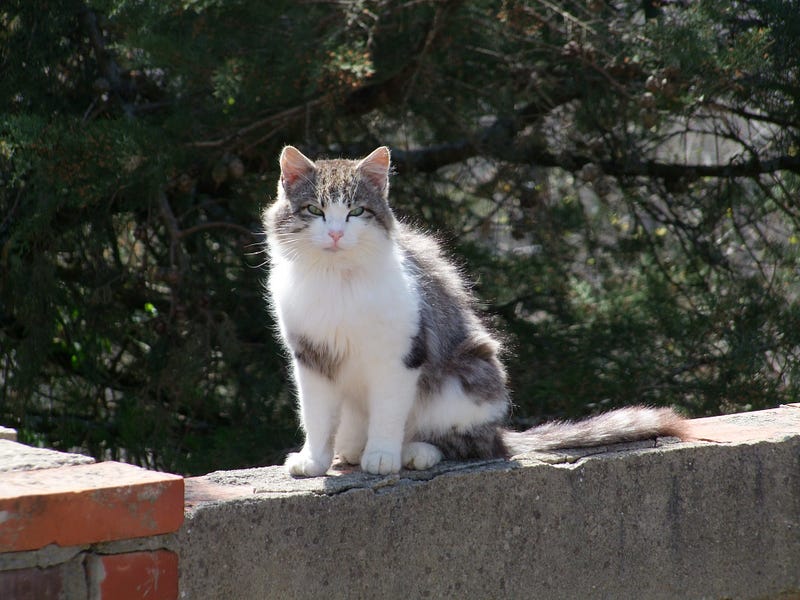
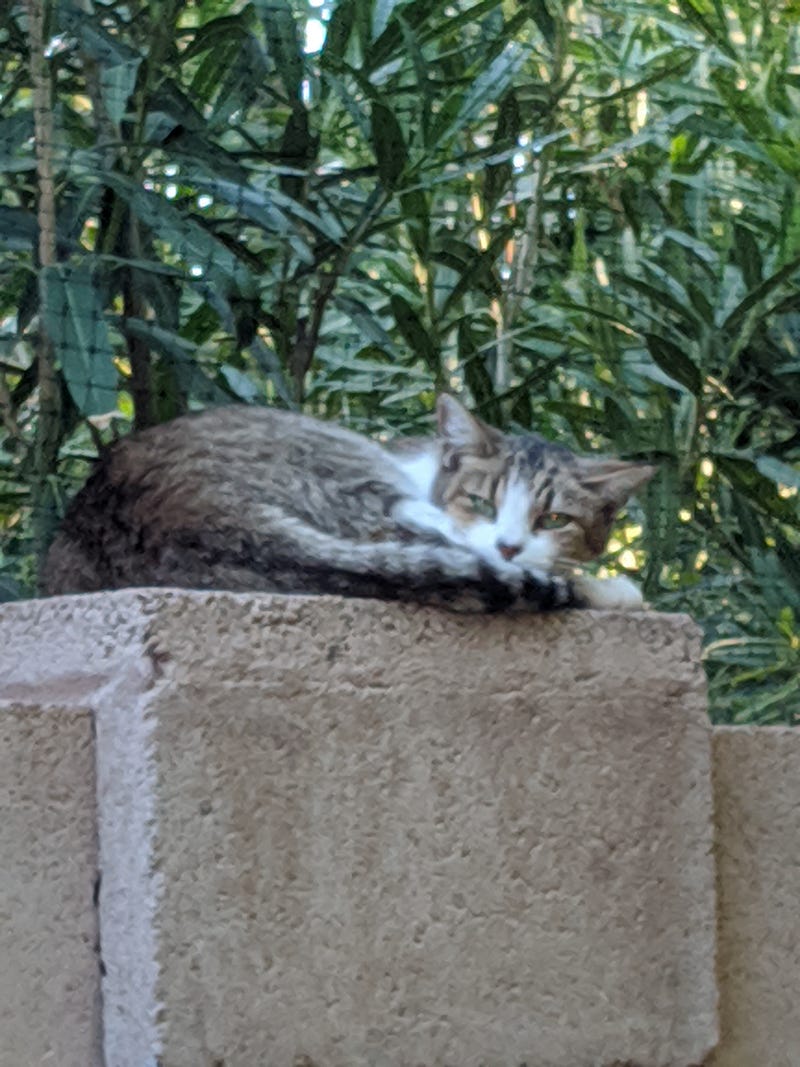
A feral cat is currently curled up on top of my garden wall. It is not officially inside my yard. Nor is it officially outside my yard.
The cat is conducting Schrödinger’s cat experiment for my amusement. Or not really because, you know, cats don’t do science. It is done to them.
What to do? If the cat were to jump into my yard, my husband would expect me to chase the cat away. The local feral cat colony uses our yard as a giant litter box.
One cat’s mess we could handle without complaint. Twenty or thirty cats urinating and defecating in the yard is a different matter.
A neighbor puts the colony count at thirty. My own observations over the last year put it at closer to twenty. It only feels like thirty when you are cleaning cat poop out of a flower bed.
What is the answer? We have a motion-sensitive sprinkler that discourages lingering when a cat is nailed by it. As there is only one in our yard, the savvy street-smart felines avoid it and get on with their business.
You may have noticed I am not pausing to chase the cat to the other side of the wall. Instead, I sit on my patio, reveling in the shade during our lovely autumn temperature of 87F. In the Phoenix, Arizona area, this is a form of heaven.
While I was typing, the cat shifted position. Still, in the same area of the wall, the cat’s tail is now curved in the opposite direction. He or she is no longer watching me. I don’t seem to be a threat.
I wish I knew the cat’s name. My husband has advised against becoming too familiar with these cats. Naming one would be a step too far for marital harmony, I am sure.
He is the one tasked with yard work, after all. Aside from my famous brown thumb, my back and knee issues make grubbing around in the garden difficult. I am not on flower bed poop scoop duty.
I have accused my husband of being mean to the cats. Generally when he has looked up from watching television to notice a cat lazing in our grass. When this happens, he rushes outside to chase the cat over the fence.
I didn’t realize I had hurt his feelings until last week when he looked at me and said “I would never hurt these cats. All I am doing is escorting them over the fence, so they don’t use our backyard as a public bathroom.”
This is accurate. I know he would never do a single thing to harm one of these cats.
The conversation caused me to search Amazon for a solution. A highly rated powder was suggested. Using scent, the powder was supposed to discourage feral animals from lingering.
Once the package arrived, we were alarmed by the warnings. The powder uses things like chili powder to discourage feral cats and wildlife.
The caution warnings on the package were the problem. The powder should only be spread when you wear a mask and gloves. You should not inhale any of the irritating powder.
We left the package on a workbench in the garage, without much comment. After a week, I asked what he thought about it.
“I can’t do that to the cats.” He said.
I saw him cleaning up cat poop yesterday, without comment. Later in the day, he chased another cat out of the yard.
No, he is not mean to the cats. He refuses to cause them harm or any real discomfort.
Meanwhile, the cat on our wall is sleeping peacefully and I can’t bring myself to disturb it.
I am imagining our retirement stretched out before us. Annoyed by the cats, yet unwilling to do anything substantial to remove them from our yard.
Our own version of Schrödinger’s cat experiment.
If you liked this, you may like: