
Our Fascination With Murder
The murder story of Shannan Watts and her children by husband Chris Watts is #1 on Netflix
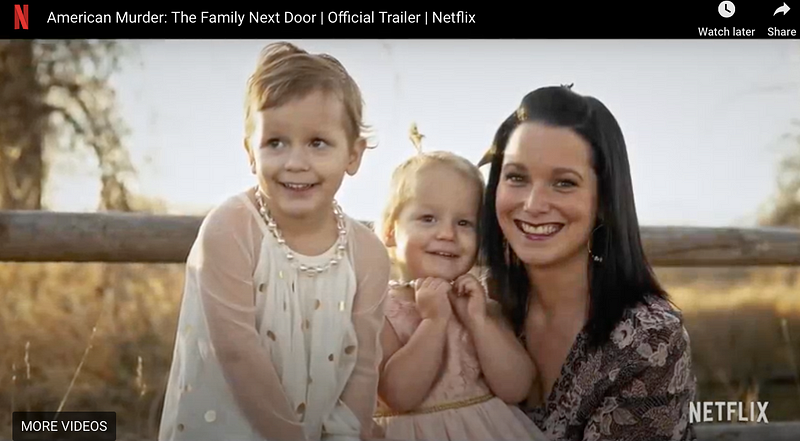
The murders of fifteen weeks pregnant Shannan Watts and her daughters Celeste and Bella took place in mid-August 2018. For two days, plastered all over the news was the story of a missing pregnant woman and her two little girls. The “distraught” husband gave multiple press conferences and on-air appearances and pretended to care.
The story of what happened and the timeline of the events taken from Chris Watts’s final interview, witness statements, digital and physical evidence, and social media — has been made into a Netflix movie called “American Murder: The Family Next Door.”
According to Greta Heggeness of Purewow.com, “although the movie premiered on Netflix this week (9/30), it’s already skyrocketed to the number one spot on the streaming service’s list of most-watched flicks.”
Why are we so fascinated?
I wanted to understand what makes us so fascinated with violent crime — that a movie about this murder would skyrocket to number one on Netflix so quickly. Many writers and experts, including those cited in the referenced articles, discuss our fascination with these types of stories.
Most of us can’t fathom a situation getting to the point of murder in our own lives. Yet, neither did the people in the stories. These stories make us uncomfortable for that reason; we can’t even picture it.
Further, usually, the only one remaining to explain what happened is the actual murderer. From prison, murderers are less than candid with the real truth, even with nothing to lose by sharing it.
It seems most of us are trying to understand crime on several levels. In “12 Reasons We Love True Crime According to the Experts,” Erin McCarty attempts to answer the question. It’s not one specific element — but many that cause us not to be able to turn away. The twelve reasons McCarty lists are (see the article linked for more detail explaining the reasons):
Because it’s normal (to a point)
Because evil fascinates us
Because of the 24/7 news cycle
Because we can’t look away from a “train wreck”
Because it helps us feel prepared
Because there might be an evolutionary benefit
Because we’re glad we’re not the victim
Because we’re glad we’re not the perpetrator
Because it gives us an adrenaline rush
Because we’re trying to solve the mystery
Because we like to be scared — in a controlled way
Because the storytelling is good — and comforting
And the part about feeling prepared, especially for women, is especially poignant. In a Los Angeles Times article by Megan Abbott,
“While men are four times more likely to be homicide victims, women comprise 70% of victims killed by an intimate partner, twice the rate of men.”
Chris Watts’ alibi story quickly fell apart as friends and a neighbor’s security system very early on contradicted him.
Former ATF and FBI body language expert Janine Driver saw photos of Chris Watts’ speaking on the news. She said,
This was the first time in my decades of decoding body language that I prayed this was a battered woman and that Shannan Watts and her two little girls were in a shelter somewhere. Because what I saw in that man’s facial expressions and body language was not good.
Within hours of Driver’s statement, Chris Watts confessed to murder.
Janine Driver does not believe that Chris Watts entirely told the truth in his February 2019 prison interview with law enforcement, where he describes in detail how he committed the murders. Driver,
…thinks he’s still lying. There are changes in pronouns that drop and disappear. Now when our pronouns disappear, it’s saying we don’t want to be connected to what we’re telling you. Lies can happen here, and just really intense, sad stuff can happen here. I think the big question is, not whether the play by play of what he’s telling is true, but I think the big question is — is this guy a monster or not? Driver goes on to say that Watts seems more upset that he was caught. She further says, he himself in the interview said something along the lines of he didn’t think that he would get three life sentences and spend the rest of his life in jail.
Janine Driver uses this case as an example of an excellent takeaway for all of us:
It’s a sad case, and it goes back to can you decode the verbals and the non-verbals? Because if you can, you can get ten steps ahead of the liars in your life, the master manipulators, the people that are taking you down and dropping you to your knees because you are blind-sided when you are betrayed. Be careful. Understand that when people get angry, and fight or flight happens, crazy things can happen. Make smart decisions, be safe; keep yourself safe. My name’s Janine Driver. God bless you.
So, is our fascination with true crime a form of self-preservation? That’s a high possibility. Only you can know why you watch. For me, I’m trying to understand how someone can just “snap.” I find it terrifying and can only handle these stories in small doses. But I still wanted to know what happened. Every detail.
Jennifer Friebely is a New York-based content writer covering stories from personal development, marketing, and productivity to politics and music to whatever idea strikes. She has a 30+ year background in marketing and advertising and holds a BA in Political Science. Email her at [email protected].


