
The Dictionary Served Her Like A Holy Bible
Our Class Never ‘Snuck’ Anything Past This 6th Grade English Teacher

Once upon a time, I was a student in “Unit C.”
It was the early, experimental 1970s.
The school wanted to try a new name besides 5th or 6th grade.
(Far out, man!)
A highlight of that year was Miss Smith.
She was young, happy, and new at the school.
This teacher made verb tenses fun.
But one thing made Miss Smith tense herself.
Students couldn’t help themselves.
“’Sneak’ is a present-tense verb,” she’d begin.
“Past tense? We talked about this.”
‘Drunk’ Didn’t Count With Her
Giggles would swirl throughout the classroom.
“SNUCK?”
Miss Smith stared at the floor. Then the ceiling.
With the smallest of smiles, she chose her words carefully.
“Class, if the word isn’t in the dictionary, it isn’t a word. And SNUCK is wrong. The word is SNEAKED.”
In an earlier round of this debate, I pointed out the verb trifecta known as “drink, drank, drunk.”
Nope. Just because another word loved “u,” too, that evidence wouldn’t hold up in Word Court.
Neither was quoting a comic book using snuck.
What Miss Smith never revealed to inquiring young minds was that snuck started sneaking into published writings more than 100 years ago.
But tradition kept slamming the grammar door in the face of snuck.
These Two Word Gangs Were Ready to Rumble
This debate my teacher invited us into was REGULAR (formal or traditional) versus IRREGULAR (common or casual) verbs.
Currently, arguments are still smoldering on the Internet about which s-word is the best word.
Some academics place the blame at the feet of the British. Supposedly, snuck is more objectionable in the United Kingdom.
Not everyone agrees with that assertion, however.
Take a look at the words from Reader’s Digest. After all, the magazine claims the title of “A Trusted Friend in a Complicated World.”
RD says:
“Snuck is widely accepted in academic, journalistic, and casual contexts, while sneaked is used less frequently and is more jarring to an American-English ear.”
The magazine agrees with the Random House Dictionary, which says that the frequent use of snuck means the word can no longer be considered “non-standard.”
The idea of a frowned-upon word budging its way into official usage isn’t a new one.
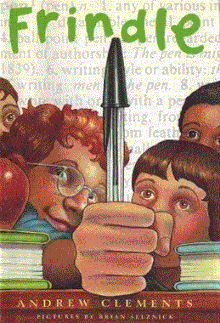
In 1996, former teacher Andrew Clements wrote a middle-grade novel called Frindle.
The book remains in print today, with more than 6.5 MILLION copies sold. Frindle has been published in 16 languages around the world.
The plot revolves around a boy named Nick who has invented a new word. All the other fifth-graders like this new word, but his English teacher does not.
Nick’s English language teacher (like my Miss Smith) believed that a word was not real or official unless the dictionary said so.
By the story’s spectacular conclusion, Nick’s idea has spread far beyond his classroom.
For me, I’m sure my teacher spent the rest of her career standing up for sneaked.
If you’d like to be a real-life Frindle star, here are some suggestions from me, based on my five decades of wrestling with words.
1. Use your word in context. In writing, or even speaking, try to define the word within your sentence.
2. Quote your word. In fiction or non-fiction, if someone else uses the word you favor, use that quotation.
After all, you’re just passing along what you believe you saw or heard.
And even the pickiest grammarians know it’s not nice to “shoot the messenger.”
3. Stage a word battle. Is your word better: for instance, is easy to pronounce? Is it easy to spell? Does the word benefit from “onomatopoeia?”
What’s that? When a word sounds like the action it’s describing.
Consider the act of throwing up: to vomit.
This mishap may also be known as puke. Many who’ve endured that problem might agree that puke sounds like vomiting itself.
The last tip might be the best.
4. Use your word online. Want to see how quickly your version of language can spread? Leave it in a comment.
Then, when critics challenge you, say with a straight face and no laughing:
“But I saw it on the Internet.”
Just leave me out of it. Miss Smith never failed me, but I don’t want to take chances.
Tom Owens is a daily occurrence on Twitter at @domorebemoreNOW, where he rails against soul-sucking jobs. To help support his snarky sense of humor, consider subscribing to Medium via https://medium.com/@domorebemoreNOW/membership, so Tom will get a tiny reward.