
Otherwise, don’t put it there.
Anton Chekhov on plants and payoffs. (The Commonplace Book Project)
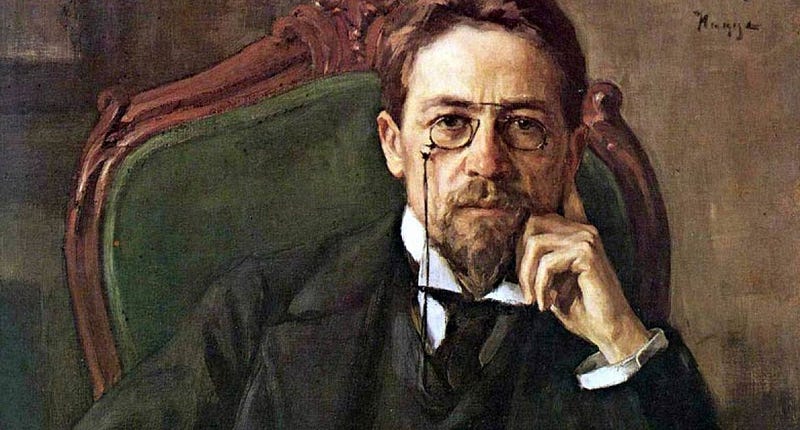
The Commonplace Project is a daily post based on Ray Bradbury’s advice to aspiring writers: read a poem, a short story, and an essay every day for 1000 days. These posts start with a quote and go wherever the rabbit hole leads. Follow The 1000 Day MFA so you don’t miss a thing.
“If in the first act you have hung a pistol on the wall, then in the following one it should be fired. Otherwise don’t put it there.” — Anton Chekhov, also known as Chekhov’s Gun.
There was another quote that I wanted to use today, in celebration of Anton Chekhov’s birthday.
Don’t tell me the moon is shining; show me the glint of light on broken glass.
I’ve seen that line, just like that, attributed to him so many times. And it’s such beautiful advice. Such a lovely way of saying: Show don’t tell.
But he didn’t say it. At least not that way.
Here’s what he did write, to his brother.
“In descriptions of Nature one must seize on small details, grouping them so that when the reader closes his eyes he gets a picture. For instance, you’ll have a moonlit night if you write that on the mill dam a piece of glass from a broken bottle glittered like a bright little star, and that the black shadow of a dog or a wolf rolled past like a ball.”
Not quite as Pinterest-ready, but still beautiful advice. The simplest way to show the difference between showing and telling.
Chekov’s gun is also good advice. And it’s something isn’t it? To say something that becomes so ingrained in the ethos of writing that you only need to hear “Chekhov’s gun” and if you’ve been writing for any length of time, you know what it means.
Don’t plant something in the first act of your story that doesn’t pay off before the story ends. It hardly even needs further discussion.
Chekhov is most well known as a playwright and a short story writer. My favorite is called The Lady With The Dog.
Vladimir Nabokov (Lolita) was a huge fan of Chekov. I really enjoyed this excerpt from a lecture Nabokov gave on him.
I heartily recommend taking as often as possible Chekhov’s books (even in the translations they have suffered) and dreaming through them as they are intended to be dreamed through.
I bought a used DVD of The Sisters, an adaptation of a Chekhov play, starring Maria Bello.
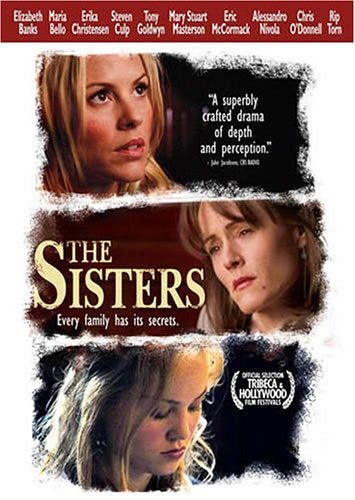
Chekhov was a physician and considered himself a doctor before a writer. He said, “Medicine is my lawful wife, and literature is my mistress.” I was interested to learn that he didn’t make much money at his profession — he treated the poor for free an often volunteered his services.
He showed the first signs of the tuberculosis that would eventually kill him in 1886 and continued to practice medicine until 1898, which his health forced him to retire. It’s alarming to imagine a doctor with an infectious disease — someone should definitely turn that into a short story.
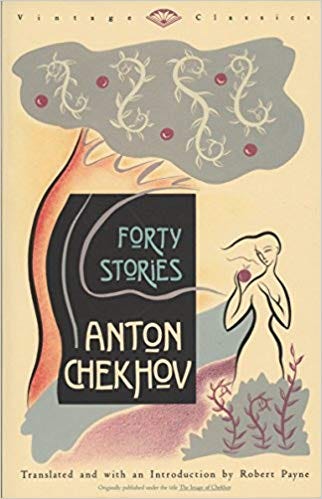
If you’re looking for a collection of short stories, to help you with the 1000 Day MFA (read a short story, a poem, and an essay every day for 1000 days — advice from Ray Bradbury) you could definitely do worse than a collection of Chekhov stories. This one has a gorgeous cover. I’ve added it to my reading list.
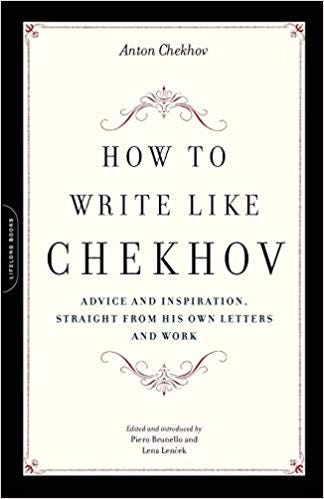
This book looks interesting, too. A collection of Chekhov’s writing advice, pulled from his work.
Today’s Poem:
Chekhov by Howard Moss
We have the whole evening ahead of us, We think, our eyesight starting to weaken, We must have missed the houselights growing dim, But how could that moment have escaped us when The roots of the paper trees struck water And transformed themselves into the real thing — This nervous wood at the edge of a small, Provincial town whose still lifes waken To find that they’re portraits after all And subject to the risk of animation?
Click the title for the full poem.
Here’s my secret weapon for sticking with whatever your thing is.
Shaunta Grimes is a writer and teacher. She is an out-of-place Nevadan living in Northwestern PA with her husband, three superstar kids, two dementia patients, a good friend, Alfred the cat, and a yellow rescue dog named Maybelline Scout. She is the author of Viral Nation and Rebel Nationand the upcoming novel The Astonishing Maybe. She is the original Ninja Writer. Follow her on Twitter and Instagram.


