
Ostracism: How the Ancient Greeks Handled Uncool Politicians
Have you ever been asked politely to leave?
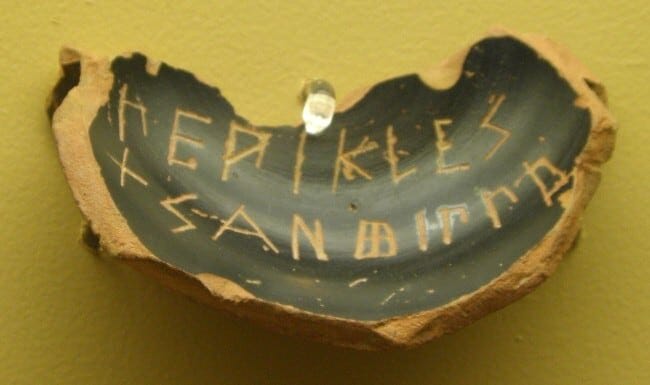
I think we’ve all found ourselves, at one point or another, in a situation where we were asked to leave, sometimes politely and sometimes not politely. There are also some jobs where no matter what you do, you’re not going to please everyone, like the job of being the president. Today’s story is about one of the processes in the early days of democracy in ancient Greece that figured out their own solution to this problem.
If we think of the word ostracized today, it has connotations of giving someone the cold shoulder or not letting someone hang in your clique anymore. And you don’t do it as a formal thing, it just sort of happens. In ancient Greece and Athens, this was essentially a borderline codified solution to keeping demagogues from rearing their ugly heads in politics. There was a rule built into Athenian society that allowed them to exile a fellow citizen for 10 years if it was decided unanimously that they were a disruption.
If you spend your 10 years in the figurative quarter, and you’re still alive, then maybe you can come back and be a little better behaved. New York Daily News described it as an unpopularity contest. There’s no trial or investigation.
Historian, James Sickinger of Florida State argues that this was a way to get rid of demagogues, potential tyrants, and people who could damage or subvert the new fragile idea of democracy. This was something that arguably subverted the law because you were not guilty of a criminal offense.
It was not specifically about a crime, more about going against norms and things that enough people agreed were disruptive.
This only required a vote of 6000 individuals in the entire society to have someone ostracized, and again, according to historian James Sickinger, this happened at least a dozen times between 487–416 BC.
This idea took place soon after the Athenian forces won the Battle of Marathon against Persian forces in 490 BCE, and they were trying to curb the power of any rising tyrant. Historians believe that this is partially due to the fact that their old tyrant, Hippias, had been thrown out years earlier. And when he was thrown out, he went with the Persian fleet to the Battle of Marathon and hoped that when the Persians won, he would be reinstalled in power in Athens.
Once a year, everybody would get together and decide whether or not to ostracize people. So first, there would be a popular assembly of Athens, the ekklesia. And during the ekklesia, about 6000 male citizens would vote whether or not to proceed with ostracization by just raising their right hand. If a simple majority voted yes, they met again in the Agora two months later. Then, the voting was supervised by a council of 500 people and the nine highest officials in the land who are known as the Archons.
It would be strange to imagine that the 6000 people all got along together on everything but when it was time to vote, the vote was unanimous. This is something that Athens figured out way before the US.
So, they took this piece of broken pottery, and they scratched the name of the person that they wanted to ostracize onto that piece of pottery. There were election officials who would collect these pieces of broken pottery and make sure that nobody was trying to rig the vote. If there was a minimum of 6000 votes cast, then the officials would announce which person had amassed the most votes, and then that person was exiled.
You still get to keep your citizenship and your personal property is not confiscated, at least according to the letter of the process. I don’t know how much that actually held true in real life, because if someone’s gone for 10 years, does your family stay on your estate and look after your property? There's no way to know for sure.
After the votes are turned in and everything counted, these things which are called ostraka were thrown in the street. People who have been conducting excavations in Athens have found about 11,000 examples of these broken pottery votes. And this is like a window into the power politics of the day.

I’m sure you must have put this together already but the term ostracized came from the term for this pottery, which was a very durable baked pottery called ostraka.
There were some examples of abuse of this system. One example of potential abuse of the system was in the unearthing of 190 pieces of this ostraka pottery in a well near the Acropolis of Athens. A single name was written on all of them but it was clear that it was done by just a few people’s handwriting, and they must have rigged it in some way.
The first actual ostracism wasn’t held until 487 BC when a guy named Hipparchus that was related to Hippias became the first person who was successfully exiled through the process of ostracism. And I think in the next two years, there were a couple more people. Historians largely believe that these three guys, Megakles, Callias, and Hipparchus, were all found guilty or thought to be guilty of supporting Persia.
So, if you look at this, and you think about the relatively snarky nature of people, you might assume that all of the prominent power players and politicians in Athens, were at some point, targets for ostracization, or ostracism. Even the legendary Perikles was a candidate for this treatment. We know that when they held these votes, they often concentrated on just like two or three people who might get kicked out. But some people, according to the shards of pottery, also got really big votes for ostracism.
Sickinger suggests that writers from this time tend to focus on just a few big names, but if you look at these shards of pottery, you’ll see there were a lot of people that didn’t make it into historical records.
He learns all of this from archaeological digs. Historian Sickinger had this to say ;
“Writers from antiquity focus on just a few big men.” He adds; “History was the history of leading figures, powerful individuals, generals, and politicians, but others were maybe not quite as prominent, but clearly prominent enough that dozens or hundreds of individuals thought them worthy of being ostracized.”
We know that even though it only took 6000 votes to ostracize someone, we’re talking about a population that dwarfs that number. So, the issue would be if enough people were not on board with the ostracization of their guy, then maybe they’d follow him. And then that would be a coup that could be staged.
There are serious political concerns here but I would be remiss if I didn’t share some of the funny roast and disses, and things that were written about people when they were up for an ostracism vote which was cataloged by Stephen Brenne.
Some feature nasty epithets: “Leagros Glaukonos, slanderer;” “Callixenus the traitor;” “Xanthippus, Ariphron’s son, is declared by this ostracon to be the out-and-out winner among accursed sinners.” Others took jabs at the personal lives of the candidates. One ballot, cast in 471 B.C., was against “Megakles Hippokratous, adulter.” (Adultery was then a prosecutable offense but also may have been used as a political attack.) Another declared “Kimon Miltiadou, take Elpinike and go!” Brenne explains that a noble-born war hero (Kimon) was suspected of having an incestuous relationship with his half-sister (Elpinike.) The mention of her name is one of the few instances where a woman’s name appears on an ostrakon.
According to Brenne, some of these comments may reflect personal grievances against candidates, that were perhaps used in what you would think of as a campaign leading up to one of these votes.
There were also some examples of Athenians casting their votes, not for a specific human citizen, but casting votes to ostracize famine. And according to Sickinger, it’s kind of tough to tell whether this was sincere, or whether this was sarcastic because some Greek cities did have rituals where they would pick typically an enslaved person, making them a scapegoat representing hunger, and then drive them out of the city. So, it’s a little bit faster and looser than a lot of voting today, but we do know that the end of ostracism occurred around 417 BCE.
There was a guy named Hyperbolos who wanted to exile one of his two great rivals but instead, his rivals teamed up and got him voted out of the city. And this political maneuvering apparently made enough people disgusted, that they decided collectively to end ostracism. And after that point, even though it was still legally possible to do this, nobody was ostracized. It was still on the books until the fourth century BCE.
In an op-ed at New York Daily News, Steven Ruddy says the process of ostracism holds advantages over the American system of impeachment because he notes that the Athenian process of ostracizing someone was based on policy often, and people might not agree on everything but they kind of went across whatever their faction lines where one would hope.
But with this, I think we can see the very serious and progressive roots of a phrase that a lot of us are kind of misusing in the modern day.
Sources
