
Orthorexia: How Pursuing A ‘Healthy’ Lifestyle Almost Killed Me.
According to the Oxford Dictionary, to be ‘healthy’ means ‘to be in a good physical and mental condition.’ Why then, is our perception of ‘health’ and what it means to live a ‘healthy lifestyle’, so far removed from its actual meaning?
Unfortunately, we live in a society wrapped up in diet culture, a society that can very much be described as being ‘fatphobic.’ People presenting themselves in a body size which is larger than the ‘ideal’ are subject to, extremely uncalled for, discrimination. This causes people to attach labels to each other based on how much they weigh. People are determined as being healthy or unhealthy based on their relationship with gravity. Surely you can already see why this is such an unreliable measurement?
To highlight just how much we stereotype people in line with their weight, I want you to ask yourself this: if you were presented with person A, someone in a smaller body eating a bowl of salad, and person B, someone in a larger body eating a doughnut, who would you perceive to be healthier? I can confidently guess that the majority of you said that person A would, unquestionably, be the healthiest. What if I then went on to tell you that person A had been living with an eating disorder for most of their life, and that salad is the only food they allow themselves to eat, and that person B is enjoying a doughnut after their third gym session of the week? Would you still perceive the smaller person to be healthier? Probably not. My point being: we cannot judge a person’s health on their external appearance, though, as is the case with most things, this is often easier said than done. Unlearning a narrative we have been told for most, if not all, of our lives, takes a great deal of time. It requires us to challenge the subconscious part of our brain that associates health with a particular size.
I am only now realising that in my own quest to be healthy, I was actually becoming increasingly unhealthy.
When I was in what was undoubtedly the unhealthiest period of my life, I indisputably fit the stereotype of optimum health, with my toned stomach being labelled as ‘#fitnessgoals.’ The issue with this was that no one could see what was really going on behind the ‘inspiring’ Instagram posts.
Running up to 40 miles a week, my bones were becoming weaker by the day (I was diagnosed with osteopenia, the onset of osteoporosis, at 17), my heart rate was dropping dangerously low and, perhaps most notably, my mental state was rapidly depleting.
I would turn up late to sixth form because I had to wait for my Dad to go to work before I could go for a run, and once I was out, I couldn’t stop. I would even threaten to commit suicide if I wasn’t allowed to run. That is how addicted I was. If I couldn’t exercise, I couldn’t see a point in living, let alone eating. It was the only thing that mattered to me.
6-mile runs became half marathons, all ran on an empty stomach before breakfast. Upon my return I would eat only ‘safe’ foods- fruit, vegetables and little else. My ‘fear food’ list however was extensive.
And, it wasn’t just the act of running itself that I was ‘addicted’ to, I was consumed by every aspect of it, every waking minute was either spent running, or thinking about running. My room was covered in race numbers, photos of athletes pinned to my walls, medals hanging up, trophies lining my shelves, books about running and ‘healthy’ eating, athletics weekly and runners world magazines taking over my bookcase, workout gear taking over my wardrobe, trainers, spikes, racing flats taking over my cupboards- my whole identity was centred around running. I was ‘Lisa the Runner’ (with an eating disorder). No personality, but at least I could run 5km in 19 minutes! Never mind the fact that I was losing friends, ruining relationships with my family, destroying myself in the process…
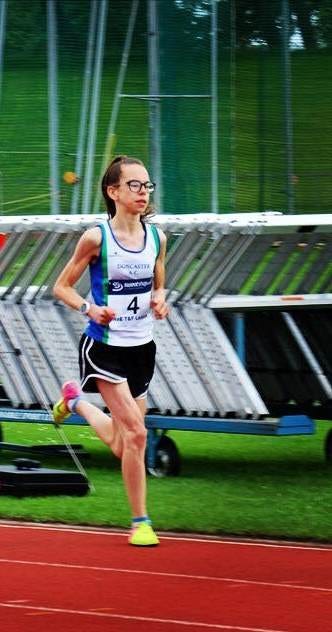
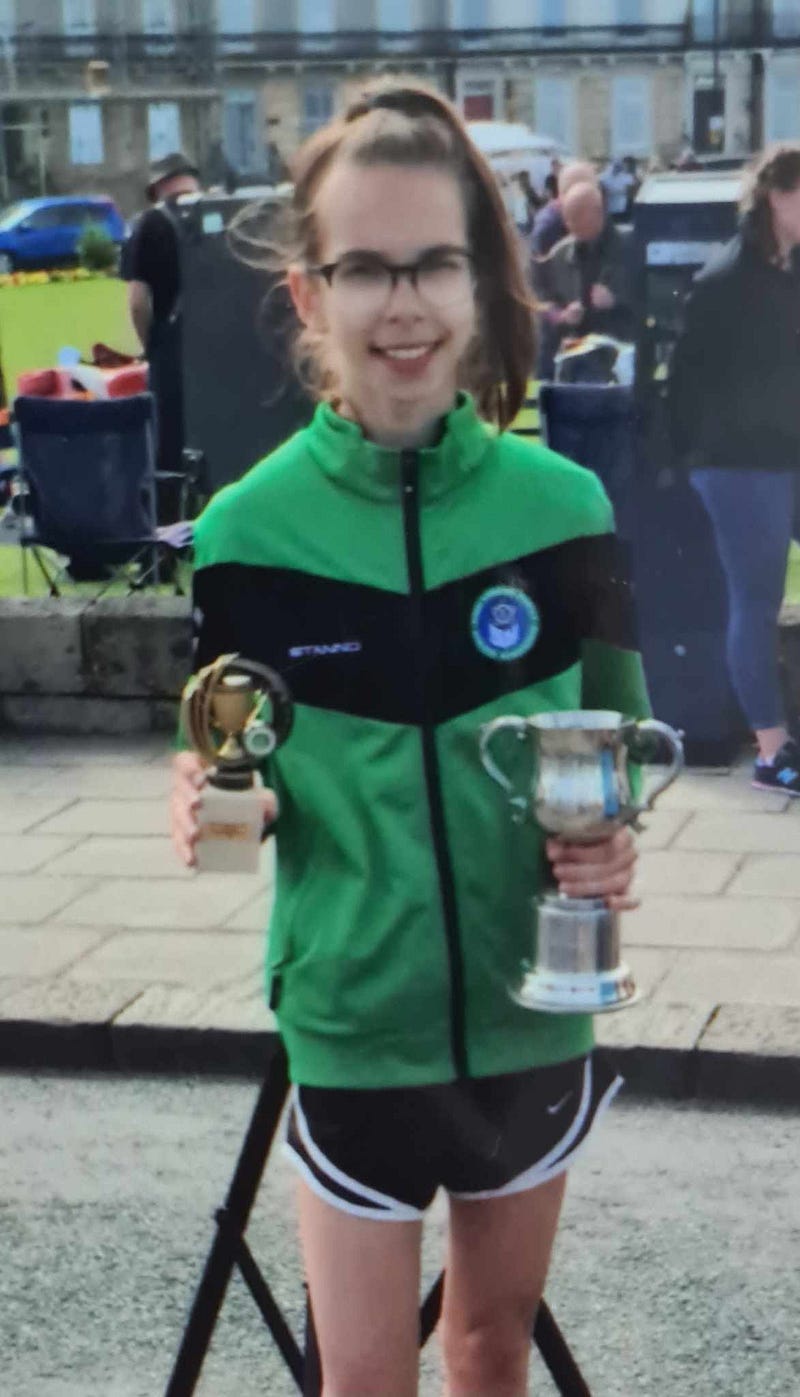
The reality is that, whilst my weight loss appeared to be ‘working‘, (as I lost weight my times did improve), it was in no way at all sustainable. My dangerously low weight combined with my low heart rate and ‘off’ blood test results, all things which were, according to the nurses and psychiatrist involved in my care, becoming more worrying by the week meant that, inevitably, something had to give. It was either going to be a case of me stopping running, or me stopping living, I now realise, the latter being something which, undoubtedly, ‘could’ve been’, had I not been sectioned — sent to a psychiatric care unit and forced to stop running when I was there. And this? Looking back on all this? It haunts me, for I don’t think that I would’ve made it to 22, or even 17, for that matter, because I was never going to stop running wilfully.
Running was, quite literally, my everything– an addiction, holding the genuine belief that I couldn’t not run. If you’d have asked me to explain why I felt like I had to run, as I was once asked by my grandma, I would’ve been unable to answer. It was a belief that had become so ingrained in my head, so deep rooted in my whole being, that I felt it was beyond words.
So intense was my ‘need‘ to run that it took the decision (to continue running or to completely stop) being taken out of my hands entirely, through being sectioned at the age of 16, for me to realise that, actually, I could carry on without it, but I couldn’t carry on with it.
Sectioned at 16
July 2018: Vivid memories of coming home from sixth form at lunch time, walking through my back door to be met by my psychiatrist and nurse, and a group of people I hadn’t met before, all sitting in my living room. They were here to carry out a Mental Health Act assessment to determine if I was of sound mind to refuse treatment. (turns out, I wasn’t).
I remember standing in my garden, begging my mum to let me run away, while inside, my psychiatrist called for an ambulance. I was to be detained under section 3 of the Mental Health Act. My dad, as the oldest parent, was given a document to sign, a document that meant he had to, essentially, ‘give up’ his rights as a parent.
Going back inside to say my goodbyes. To my family. My home. My freedom. Then being taken away, by ambulance, to a completely unknown place.
Anorexia Nervosa is an illness characterised by a need for control. I went from running to give me that, to having no control. No say over what would happen to me. No say over my body. No say over my life.
I had doctors waking me in the early hours with needles, sticking cannulas in my arm, hooking me up to drips, taking blood, sticking pads to my chest- emergency ECGs- heart rate at 28bpm. Machines constantly beeping. Bed rest, fortisips nutridrinks, threats of being tube fed. Mind constantly whizzing. And eyes constantly watching, in case I tried to leave.
The doctors and nurses, although trying their best, did not understand eating disorders, let alone the largely unheard of ‘Orthorexia’, therefore I ended up losing more weight whilst in hospital.
After 3 weeks on bed rest in my local hospital, a week before my 17th birthday, I was transferred to a specialist eating disorders inpatient hospital, Riverdale Grange in Sheffield, where I would stay for 7 months.

It was the 1st February 2019 when I was finally discharged.
Recovery
Whereas I spent my whole adolescence — between the ages of 14 and 17 — clinging on to my eating disorder, using it as a sort of ‘safety blanket’, something which I turned to when life felt ‘too much’ and I needed to numb the pain, I now spend my adulthood tackling all of that pain head on.
No longer do I have the ‘safety blanket’ of Anorexia, for, I am in recovery now, the very nature of which is full of unknowns.
Chaotic sometimes, confusing most of the time, a far cry from anything remotely resembling “safety”. Recovery is something that I have to choose, every day, every meal, every time that disordered voice tries to creep back in (which, if I’m being honest, is more often than I’d like to admit).
You see, I never wake up without feeling uncomfortable in myself/in my body, because, in many ways, I hate my body now.
When I was admitted to hospital, I was very underweight. Whilst I had specific areas that caused me to feel discomfort, my body image actually wasn’t too bad. I didn’t think I was fat, I just didn’t realise how thin I was. I would body check in mirrors, lifting up my shirt to check my abs were still there, not because I believed that my stomach was too big, but because I feared my stomach getting too big. It’s why I sustained Anorexia for as long as I did, because I was more scared of losing my toned body, than I was of dying — to such an extent that, I genuinely think that if someone had given me the ultimatum, when I was in hospital, of:
‘You can either keep running which will maintain your thigh gap and your abs but will kill you because, your body can’t keep going’,
or:
‘You can stop running and stay alive, but your thighs will touch and your stomach won’t be completely flat anymore. There will be rolls when you sit down and it will feel uncomfortable but you will be alive, not dead’,
then I’d have chosen the former. Not out of ‘vanity’ (the biggest misconception about eating disorders), but out of a deep rooted need for control, the idea of letting go of it (the control I’d been so tightly gripping onto with regards to my body) was torturous, too much for my head to even think about, let alone act upon. That’s why I had to be sectioned. Because I couldn’t bear to not run anymore, to gain weight, even though those were the two things which I so desperately needed to do. I needed to stop running. I needed to gain weight.
Although medically I am allowed to run again, I know that due to my predisposition to over exercise, running is not an option for me. I cannot trust myself, perhaps in the same way that an ex-alcoholic cannot trust themselves to drink alcohol again, despite them promising they will do so ‘only in moderation.’ Because of this, I have quite literally had to ‘find myself’ again. My whole identity before was based around running. It is what everyone knew me for. Rediscovering myself was, and still is, hard.
Who Am I?
The trigger behind my eating disorder was running. I joined an athletics club but never felt good enough. Despite turning up to every session and giving my everything, I was still coming last in races. I decided that the only way I would ever improve, was to change my diet. And doing so did help me improve, in the short-term. I was winning races, placing in the top 50 in the UK at 3K on the track, competing in the European cross country trials. I had finally cracked that sub-20-minute 5K I had so desperately been pining for. My running finally felt as though it was starting to come together, when in fact, my whole life was falling apart.
My condition was considerably worsened by social media. Following lots of professional athletes on Instagram, I would obsessively look up to what they were eating and how many miles they were running. Even though they were at least a decade older than me, I wanted to do at least what they were doing, if not more.
My coach was unaware of the struggles I was facing because I was seen as just being a ‘dedicated athlete’- he [my coach] held the hope that I would be the first athlete of his to make it to the Olympics- Paris 2024/LA 2028.
Redefining Health
As someone who is now, thankfully, in eating disorder recovery, I have to get up every single day and redefine what I have believed to be ‘healthy’ for so long.
The fact is that, health is not running half marathons on an empty stomach, and nor is it cutting all fat and sugar from ones diet.
Health is feeling good.
Health is knowing that I can eat whatever I want to eat, whenever I want to eat it, for food is neither good nor bad, food is just food.
Five years on, I can now acknowledge that fact: the fact that food is just food — a necessity that we all need to survive — whilst also appreciating that food is enjoyable. It connects people and it actually tastes so good. I don’t need to deny myself that.
Friday night fish and chips. Post hike sandwiches and cakes in the Peak District with my Dad. Saturday night pizza. Time spent with my family where I can actually be present with them (because I’m not starving and miserable).
And, as food is just food, exercise is just exercise. Not exercising doesn’t make me ‘lazy.’ Having a day off when I feel tired, or when I’m just ‘not in the mood’ for it, is healthier than forcing myself to stick to an extremely regimented exercise schedule, whereby ‘off days’ are not allowed.
Embracing Freedom
A lot has changed in those five years. I might not be ‘there yet’, and, I might never get ‘there’ (where even is ‘there?’) but, if someone had told 16 year old Lisa, when she was alone in that room, her first night in hospital, chest heavy, sectioned, what she’d be doing at 22, that she’d still be here, alive, then I don’t think that she’d have believed them.
And, that excites me because in another five years from now, I’ll be 27.
27!!
What will I be doing then? Will I be saying the same things at 27 as I’m saying now?
‘If 22 year old Lisa could see what she’d be doing at 27, she wouldn’t believe that it was possible..’
When/if, (you can’t take anything for granted in life), I reach 27, my only hope is that I will be more affirmed in my identity, happier with myself and who I am as a person.
Alive.
Still making it my life’s purpose to destroy the thing that tried to destroy me — Anorexia. Still writing silly little poems, and still, despite the ups and downs (my head is still very messy and full and I still don’t really know what I’m doing here), holding onto the hope that: I do have a bright future, and that; it is possible for me to find happiness. One day at a time. I will get there — and it will be so worth it when I do.
And so, although being sectioned was the hardest thing that I have ever experienced, it was also the very thing that saved me. Not just literally, physically (though, it is true that I probably wouldn’t be alive today had I not been sectioned), but also mentally, too. You see, even if I had been able to keep running at the level I was at back then, at the weight I was, with no damage to my physical health, mentally, I’d be in pieces. I’d be unable to say yes to anything outside of running. I’d miss out on so much, so many memories would be left unmade…
If I died, people would be able to say; ‘she liked running and she won a few races’, but that would literally be it. Because I was made to stop running though, now I can say yes to things. Now I can enjoy food. Now I can make memories. I like to think that, now, people will have more to say about me when I die than, ‘she was a decent runner when she was 16.’ Because, whilst I did feel ‘lost’ without running for a while (you could even say that I ‘grieved’ it for a time), what I have now is worth a million times more than being able to run fast. Now I have the freedom to do whatever I want with my life. To be whoever I want to be. And that truly, is so freeing.
❤