
Organize Your Writing Life To Increase Productivity And Focus
The euphoria of S.M.A.R.T. goals and organizing

I have always been a focused person, but I was going with the flow when I first started writing on Medium. Now, the flow is lifting me in the air.
Along with schools opening and the holidays quickly approaching, the workload isn’t going to get easier for any of us. So, what better time to devise a plan and set goals?
Why do we need a plan?
All this time, I was writing without a schedule, trying to squeeze it in between meals and pretty much any chance I got. Overwhelming.
We need a plan to focus on our goals. We need a plan to prevent us from getting side-tracked and increase our productivity. As time is not a luxury, we must set our goals while accounting for obligations in other aspects of our lives.
The more serious you are about making and executing your plan, the more you will focus and succeed.
The General Manager in me always thinks of S.M.A.R.T. goals. The acronym stands for specific, measurable, achievable, realistic, and timely.
S.M.A.R.T. goal — I will make a detailed plan to outline and organize my writing life to maximize productivity and allow stress-free time for other duties. My plan will be done by September ninth. I will share my goals with my readers and family.
*Is it specific? Yes, it states what I will do and when. *Is it measurable? Yes, it’s either I write it, or I don’t. *Is it attainable? Yes, it’s one plan with enough time given. *Is it realistic? Yes, I’m not trying to become a millionaire overnight. *Is it timely? Yes, I gave myself enough time to complete the goal while taking into consideration other obligations.
Take a minute to set a S.M.A.R.T. goal about devising your plan. Write it down.
What is the purpose behind the goal?
Is your goal to focus on increasing your followers this month? Publish five articles a week? Or is it as simple as creating a plan and following it?
The reason for my goal is to be transparent in my plans for my readers regarding content, publishing, and social networking. If you are wondering when I will publish my next article, I want you to have an answer.
Another significant reason for my goal is to set expectations for my family and me — no surprises. We have to be smart about our time and use it efficiently.
Reflecting on why you want to achieve a goal will keep your actions in line with your plan. What is motivating you to keep your goal? Write it down.
If you don’t have kids, this may mean you have to set your writing around work obligations (like the ones that pay more than Medium), family visits, activities, or a passion besides writing.
If you have the opportunity to write on Medium with no other obligations, then great— you can schedule around your regular sleep and wake times! You still need a foundation.
The rest of the article will dive into content, publishing, social networking, setting time-frames for interaction on social media, and organization. I will set S.M.A.R.T. goals for each category except the organization. You will be doing the goal-setting there.
There’s something really sexy about a plan. If you don’t already have a pen and paper, grab them.
There is no time for cut-and-dried monotony. There is time for work. And time for love. That leaves no other time. — Coco Chanel
Content
Now I love this aspect of the business — the creating. I can share love, empathy, kindness, gratitude, and helpful information through stories, poetry, and personal essays to inspire and influence growth.
I plan on writing for twenty-three hours weekly (more on figuring out that number later). I will write the content on early mornings before the children are up and at night when they go to bed. I intend to also write on the days my husband is off from work.
Figure out when you will have time to write. Use your work, spouse’s, school, or Netflix schedule to see your weekly window of opportunity. Write it down.
S.M.A.R.T. goal — Write and edit for twenty-three hours every week while the children are sleeping and when Chris is off from work. Use a timer and log hours for accountability.
Publishing
Before setting up a schedule for sending your work to publications, you must have the plan for writing content first. For example, since my content will be written during the week, I can submit to publications on Fridays and Saturdays (except for poetry). Based on your obligations, this can be entirely different.
The important thing is to figure it out.
We have no control over when editors review and publish the articles. Answer any editing inquiries and correct any requests on the same day they are received. Editors work hard to help us, and we want them to know they aren’t wasting their time reviewing and giving us advice on our work.
When you plan your content out in advance, you now have control over when you will send your pieces to publications and account for longer wait times.
For example, if you know that a specific publication takes longer to review your article, you can plan to write that article first and send it out early while you publish other pieces. Planning to expect a longer wait time will help curve any anxiety and stress you may feel.
S.M.A.R.T. goal — Submit articles to publications on Fridays and Saturdays. When sending out articles to larger publications, write and submit to them earlier than pieces that will be published sooner (i.e., a week in advance).
Social Networking
According to Derek Halpern on Socialtrigger.com, we should apply the 80/20 rule for building an audience. He say’s, “It is smarter to find another 10,000 people to consume what you’ve already created as opposed to creating more.”
While you pour your heart out into your content, it is critical to apply more tenacity into marketing your work. Use the 80/20 rule to gain a following. Write the rule down.
*How to calculate the hours for writing content? There are 112 waking hours in a week (assuming you sleep eight hours like you should — like I should). When considering Derek’s advice, we times 112 by twenty percent, which equals 22.4 hours — let’s round to 23 and BAM! There’s our number.
Depending on how much we actually sleep and daytime obligations, this number can increase or decrease. Figure out the details and come up with your number.
By utilizing 23 hours weekly for content, we leave the other eighty percent free to build an audience. Log your hours and commit.
Posting your articles to social media I will post three different pieces to three different groups daily. I limit myself to three groups to account for reading and supporting other writers’ articles in those groups. Three groups daily is doable. Give yourself time for quality interactions.
How many groups can you handle daily? Write it down.
Don’t commit to a goal you can’t handle. It is always an easier road to take on more work, but backing out of a commitment doesn’t give off a good impression.
S.M.A.R.T. goal — Post three different articles to three different groups daily.
Limiting interaction on social media to a specific time-frame
Since my time on Medium, I have answered immediately to any comments, messages, or private notes. I genuinely enjoy interacting quick because it leads to efficient dialogue and helps build relationships.
However, lately, I have been messing up by not having a limit or set times to interact. I have to reel this in as it takes my attention away from my children’s waking hours. I value family time and my children are my top priority.
What are your priorities? Write it down. If the answer to this lines up with the response you had on what is motivating you, then you are on the right track.
Maybe work is your priority and you have the value of being an engaged employee. Have you gotten hollered at by your boss because he’s caught you on the phone for the fifth time this week? Well then your values and your priorities aren’t lining up. You have to fix this — fast.
I don’t want my children to get the impression that my phone or computer is more important than them — it’s not. Just like writing, we have to show, not tell.
To stay aligned with your goals, values, and priorities, engage only when your priorities are completed. For me, this means reading, responding, and clapping in groups early in the morning or late at night when the children are sleeping. The quality of interaction will stay the same. If I get the chance to respond during the day, then I will.
Decide what your values are — those come first. Then make sure the plan doesn’t interfere with your values and priorities. Stay true to yourself.
We must not, in trying to think about how we can make a big difference, ignore the small daily differences we can make which, over time, add up to big differences that we often cannot foresee. — Marian Wright Edelman
S.M.A.R.T. Goal — I will read, highlight, clap, and respond to stories in the early mornings, late nights, and when I can during the day. I will respond to feedback on my page and Medium as soon as I can.
Organization

Now that we have our S.M.A.R.T. goals — let’s get into organizing!
First, set up a binder with four tabs. These four tabs will include:
- Promised writing for personal challenges sent your way, or publication prompts you may decide to pursue.
- Publication guidelines is a tab for the specifics on what each publication requires for submissions. It can also include editor names, and other useful data like what to expect as far as wait times from the publication. It is to be printed directly from each publication page. Highlight the pertinent information. If you don’t have a printer, bookmark the page on your phone or computer.
- Schedule for posting on groups is to avoid posting the same articles in the same groups over a week. It allows for a variety of your stories to get the exposure they deserve without redundancy. It will ensure you are an active and responsive member of each group.
Having a schedule for posting to groups helps you maintain a professional reputation. Write it down. Build your credibility.
- Group guidelines is a tab for listing Facebook group rules and guidelines for posting content. For example, does this group only allow posting in threads, or can you post a comment to the page timeline? Does the group only allow poetry, humor, or is it specific to a publication? Is there a limit to the number of articles you can post within a specified time frame?
Take your writing journey seriously and care about the fine print given to you by publications and group pages.
This binder is housing a lot of valuable information that you don’t have to keep recycling in your brain. You don’t have to look up the info every time you have an inquiry.
If you love technology, you can compile all this information in the computer for easy access. I love this option because you can further organize files into files. For example, You can have a “Facebook Group” folder and inside of that folder, have different files for each group. Below is an example of the setup on my computer.
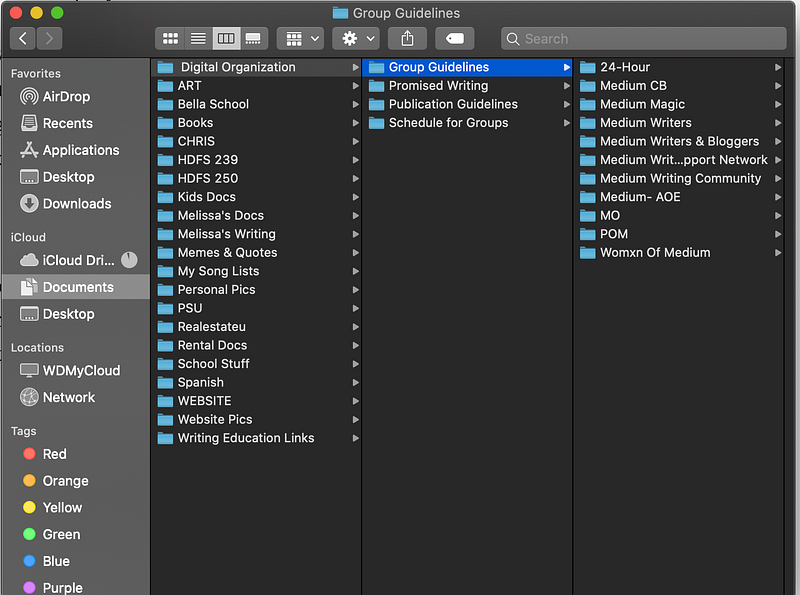
There is also an ease of use when organizing on a computer because it’s in the same place where you type your content— you can pull the data up with a click.
Remember to check for updates on every publication and group every week to ensure you don’t miss a beat. Read the announcements of the group posts — it is there to help you.
If you are like me and have a lousy memory, set a simple alarm on your phone to remind you to update your files or binder (at least every two weeks). Set the alarm to export and backup your content from Medium while you’re at it.
Other helpful resources to setup
- A notebook for to-do lists
- A notebook for all writing topics that come to mind
- A notebook for writing commitments outside of Medium
- A notebook for handwriting content
- A calendar or planner to pencil in your daily writing, posting, publishing, and networking plans
- Notes App, Calendar App, and Reminder App if you fancy technology
You can choose to organize by using a binder or easy-to-use Apps. Using a calendar will be incredibly useful for breaking down your weekly goals and help you focus on daily goals.
With a setup like this, there should be nothing that falls through the cracks. Of course, you can alter these tips to your liking, but the main takeaway is to have some groundwork laid out to help you accomplish your goals.
What is your S.M.A.R.T. goal for organizing? Will you take the old-school route with a binder, notebooks, and calendar, or will your information be digitally-based? Is your goal specific, measurable, attainable, realistic, and timely?
Conclusion
The plan is fluid — if the situation changes, the program must follow suit and change accordingly. If it does change, be sure to update yourself and those around you. The people you update can hold you accountable.
With clear S.M.A.R.T. goals, a superb organizational foundation, and laser- sharp focus, we can succeed.
My plan will be in full-effect starting October first.
Decide whether you want to be ahead of the game or behind it — that’s your first step.
Opting for a head-start:
- Set a goal to write your game plan.
- Set S.M.A.R.T. goals for content, publishing, social networking, and set limits for engagement while abiding by the 80/20 rule for the time you do have available.
- For each goal, ask — what is the purpose of this goal? What do I want to accomplish? What are my values and priorities? (Is the answer to this question aligning with my purpose?)
- Then it’s time to set the plan in motion and execute.
After giving your goals some time to play out, you can determine what is working and what isn’t working. Readjust the plan when needed. Continue the cycle until you get it right.
Now it’s time for the real work.
Here’s to maximizing productivity and decreasing stress! I wish you all the success you can imagine!

Thank you for reading! 💛 Buzz with Bee! Twitter/ Facebook/Instagram
Gratitude
Thanks to Age of Awareness for giving my words a platform.


