
Orbital Velocity and Re-Entry: A Complex and Risky Process
How do the spaceships or space shuttle enter back to Earth safely?
To answer the question, it is using a device that could slow down the orbital velocity and cause it to fall back toward Earth from space. But it would be very challenging and risky.
One way to do this is to use a retro-rocket, which is a rocket that fires in the opposite direction of the orbital motion, reducing the speed and lowering the orbit. This is how some spacecraft, such as the Apollo capsules and the Soyuz spacecraft, perform a de-orbit burn to initiate their re-entry into the atmosphere.
However, this method requires a lot of fuel, precise timing, and careful control of the re-entry angle and speed. If the retro-rocket is not powerful enough, or if the de-orbit burn is too short or too long, the spacecraft may end up in an elliptical orbit instead of a circular one, or even escape the Earth’s gravity altogether.
If the re-entry angle is too steep, the spacecraft may experience excessive heating and deceleration, which could damage or destroy it. If the re-entry angle is too shallow, the spacecraft may bounce off the atmosphere and back into space, like a skipping stone on a lake.
This is why re-entry vehicles have to follow a narrow range of angles, called the re-entry corridor, to ensure a safe and controlled descent.
Another way to slow down the orbital velocity is to use aerodynamic drag, which is the resistance of the air against the moving object. This is how some spacecraft, such as the Space Shuttle and the Orion capsule, use their lifting surfaces (wings or heat shield) to generate lift and steer their trajectory, gradually losing speed and altitude as they fly through the atmosphere.
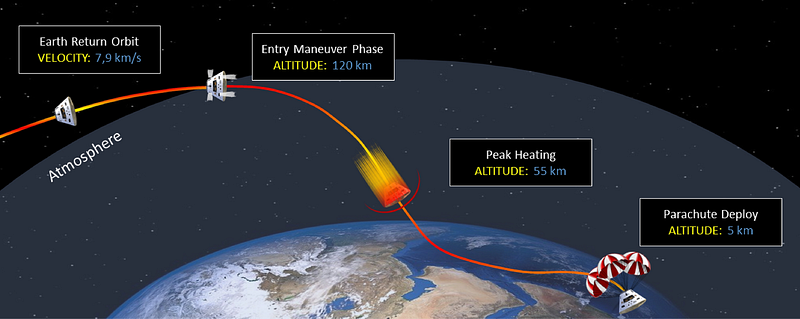
However, this method also has its limitations and dangers.
The spacecraft has to withstand very high temperatures and pressures, which could melt or deform its structure. This is why re-entry vehicles have to use special materials and designs, such as thermal-protection systems (heat shields or tiles), to protect them from the intense heat.
The spacecraft also has to maintain a stable attitude and orientation, which could be affected by atmospheric turbulence, crosswinds, or aerodynamic instabilities. If the spacecraft loses control or flips over, it could expose its vulnerable parts to the airflow, resulting in catastrophic failure.
Therefore, re-entry procedures involve many complex and critical factors that have to be carefully considered and balanced. It is not a simple or easy task. It requires a lot of engineering and scientific knowledge.
AdAstra,
RW
Reading source as of 22 Dec 2023