avatarAndrea Valenzuela

Free AI web copilot to create summaries, insights and extended knowledge, download it at here

2405

Abstract

1koLSLwnxDVg-kZEVkKg.png)"></div> </div> </div> </a> </div><h1 id="367a">Course Introduction</h1><p id="9e40"><b>Have you ever received lackluster responses from ChatGPT?</b></p><p id="2f3c">Before solely attributing it to the model’s performance, <b>have you considered the role your prompts play in determining the quality of the outputs?</b></p><p id="ddae">GPT models have showcased mind-blowing performance across a wide range of applications. However, the quality of the model’s completion doesn’t solely depend on the model itself; <b>it also depends on the quality of the given prompt</b>.</p><p id="7b03">The secret to obtaining the best possible completion from the model lies in understanding how GPT models interpret user input and generate responses, enabling you to craft your prompt accordingly.</p><p id="20a0">By leveraging the OpenAI API, you can systematically evaluate the effectiveness of your prompts. <b>In this training, you will learn how to enhance the quality of your prompts iteratively, avoiding random trial and error and putting the engineering into prompt engineering for improved AI text-generation results</b>.</p><p id="254b">This training will aid you in optimizing your personal usage of ChatGPT and when developing powered GPT applications.</p><h1 id="684f">Course Materials</h1><p id="4ea5">For those who wanted to follow the course offline, we prepared some <a href="https://github.com/for-code-sake/chatgpt/blob/main/optimizing-gpt-prompts/slides.pdf">slides</a> with the take home messages. <b>The slides also contain supporting material to better understand the most difficult concepts of the tutorial</b>.</p><p id="2883">In addition, we prepared two Jupyter Notebooks to follow the coding exercises of the tutorial:</p><ul><li>A Notebook containing all the<b> examples discussed during the trainin</b>g with solutions and model executions:</li></ul><div id="9df0" class="link-block"> <a href="https://github.com/for-code-sake/chatgpt/blob/main/optimizing-gpt-prompts/resolved-notebook.ipynb"> <div> <div> <h2>chatgpt/optimizing-gpt-prompts/resolved-notebook.ipynb at main · for-code-sake/chatgpt</h2> <div><h3>Contribute to for-code-sake/chatgpt development by creating an account on GitHub.</h3></div> <div><p>github.com</p></div>

Options

          </div>
          <div>
            <div style="background-image: url(https://miro.readmedium.com/v2/resize:fit:320/0*hp7BloIhCoYQsNDA)"></div>
          </div>
        </div>
      </a>
    </div><ul><li>A <b>code-along Notebook</b> with the structure to follow the tutorial, but with some empty text boxes with annotations. The main purpose of this notebook is to solve the exercises along with us during the tutorial:</li></ul><div id="94a8" class="link-block">
      <a href="https://github.com/for-code-sake/chatgpt/blob/main/optimizing-gpt-prompts/codealong-notebook.ipynb">
        <div>
          <div>
            <h2>chatgpt/optimizing-gpt-prompts/codealong-notebook.ipynb at main · for-code-sake/chatgpt</h2>
            <div><h3>Contribute to for-code-sake/chatgpt development by creating an account on GitHub.</h3></div>
            <div><p>github.com</p></div>
          </div>
          <div>
            <div style="background-image: url(https://miro.readmedium.com/v2/resize:fit:320/0*EnLT0picrdQfyti6)"></div>
          </div>
        </div>
      </a>
    </div><p id="cfb0">You can select the Notebook that suits you best and <b>watch the entire recording of the webinar in LinkedIn</b>:</p><div id="76fb" class="link-block">
      <a href="https://www.linkedin.com/events/optimizinggptpromptsfordatascie7089922802161438720/comments/">
        <div>
          <div>
            <h2>Optimizing GPT Prompts for Data Science | LinkedIn</h2>
            <div><h3>See who else is going to Optimizing GPT Prompts for Data Science, and keep up-to-date with conversations about the…</h3></div>
            <div><p>www.linkedin.co</p></div>
          </div>
          <div>
            <div style="background-image: url(https://miro.readmedium.com/v2/resize:fit:320/0*kytULzMhScVaaUra)"></div>
          </div>
        </div>
      </a>
    </div><p id="73eb">Do not hesitate to pass-by the tutorial recording and drop us a comment!</p><p id="3315"><b>Feel free to forward any question or inquiry about the tutorial at <i>[email protected]</i></b></p><p id="e397">And remember…</p><figure id="64af"><img src="https://cdn-images-1.readmedium.com/v2/resize:fit:800/1*1sss-BxGrJ2DDwUr1PzcEA.png"><figcaption></figcaption></figure></article></body>

Optimizing GPT Prompts for Data Science

DataCamp Tutorial on Prompt Engineering
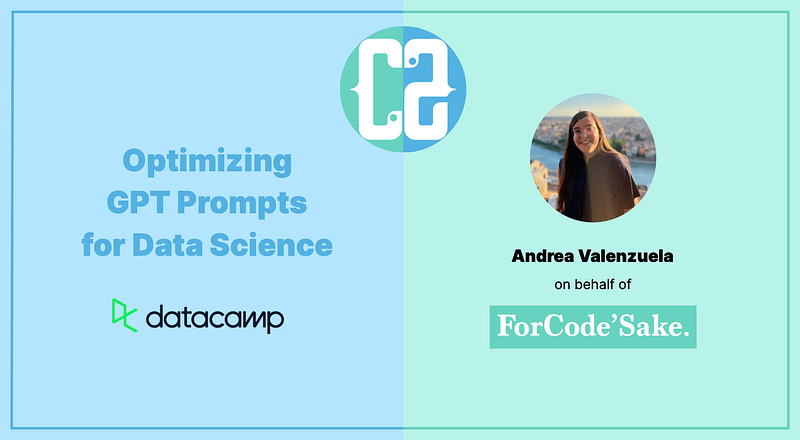
Self-made image. Tutorial cover.

It’s been a week and in ForCode’Sake we still have emotional hangover!

Last Friday 28th of July, we run our first ForCode’Sake online tutorial on Prompt Engineering. The tutorial was organized by DataCamp as part of their series of webinars about GPT models.

As the first online debut of ForCode’Sake, we decided to show different techniques to optimize the queries when using GPT models in Data Science or when building powered-LLM applications. Concretely, the tutorial had three main goals:

🎯 Learn the principles of Good Prompting.

🎯 Learn how to standardize and test the quality of your prompts at scale.

🎯 Learn how to moderate AI responses to ensure quality.

Feeling like you would like to follow the tutorial too? In this short article, we aim to provide the pointers to the course’s material for you to benefit from the full experience.

⚠️ To follow the webinar, you need to have an active OpenAI account with access to the API and generate an OpenAI API Key. No idea where to start? Then the following article is for your!

Course Introduction

Have you ever received lackluster responses from ChatGPT?

Before solely attributing it to the model’s performance, have you considered the role your prompts play in determining the quality of the outputs?

GPT models have showcased mind-blowing performance across a wide range of applications. However, the quality of the model’s completion doesn’t solely depend on the model itself; it also depends on the quality of the given prompt.

The secret to obtaining the best possible completion from the model lies in understanding how GPT models interpret user input and generate responses, enabling you to craft your prompt accordingly.

By leveraging the OpenAI API, you can systematically evaluate the effectiveness of your prompts. In this training, you will learn how to enhance the quality of your prompts iteratively, avoiding random trial and error and putting the engineering into prompt engineering for improved AI text-generation results.

This training will aid you in optimizing your personal usage of ChatGPT and when developing powered GPT applications.

Course Materials

For those who wanted to follow the course offline, we prepared some slides with the take home messages. The slides also contain supporting material to better understand the most difficult concepts of the tutorial.

In addition, we prepared two Jupyter Notebooks to follow the coding exercises of the tutorial:

  • A Notebook containing all the examples discussed during the training with solutions and model executions:
  • A code-along Notebook with the structure to follow the tutorial, but with some empty text boxes with annotations. The main purpose of this notebook is to solve the exercises along with us during the tutorial:

You can select the Notebook that suits you best and watch the entire recording of the webinar in LinkedIn:

Do not hesitate to pass-by the tutorial recording and drop us a comment!

Feel free to forward any question or inquiry about the tutorial at [email protected]

And remember…

Data Science
Artificial Intelligence
ChatGPT
Technology
Python
Recommended from ReadMedium