Introduction to Optical Circuits
Circuits with light
We are all familiar with electronic circuits, but let us get informed about a new concept in circuits, ie Optical circuits. As the name suggests, optical circuits involve the use of light or precisely photons instead of electrons. Compared to electronic circuits, we can see the photons as light, but it is impossible for us to see electricity.
What is light? What is optics? What is photonics?
Light is a common form of energy and is found naturally as well as it can be produced artificially. Science has a better definition of light ie. an Electromagnetic (EM) wave which is visible to Human eye or falls in the Visible Spectrum. Light falls in the 400nm to 700nm wavelength range in the EM spectrum. From Maxwell’s four equations on properties of light to Quantum Mechanics to Photoelectric Effect, Light has always given surprises to mankind.
The study of visible light and its characteristics in various mediums is called optics. There are two divisions of optics- Ray Optics and Wave Optics. Ray optics deal with light as a particle while Wave optics deal with light as a wave nature. Both have unique and distinguished learning paths.
Photonics is a modern branch and is entirely a new branch of physics which cannot be included in optics. The term “Photonics” was derived from the term “Phos” in Greek or the same word which was used to coin “Photon”. Photonics was born in the 1960s with the invention of LASER creating a new revolution in the field of light and its studies. Contrary to optics, Photonics deals with generation, processing and sensing of light including sensing of light.
Where do optical circuits lie?
Optical circuits don’t lie fully in either optics or electronics. It has a lot of relationship with Photonics, as Optical Circuits stand as an important subject in Photonics Degree. With the growing importance of photonics in the electronics field, a new branch named “Optoelectronics”.
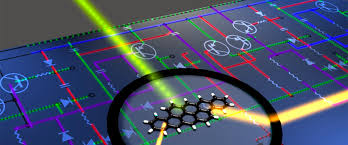
Optical Circuits are generally used as Photonic Integrated Circuits or PIC, just like the ICs which we commonly use. PIC is made up of Indium Phosphide (InP) and Lithium Niobate (LiNbO3), unlike Silicon and Germanium.
Photolithography
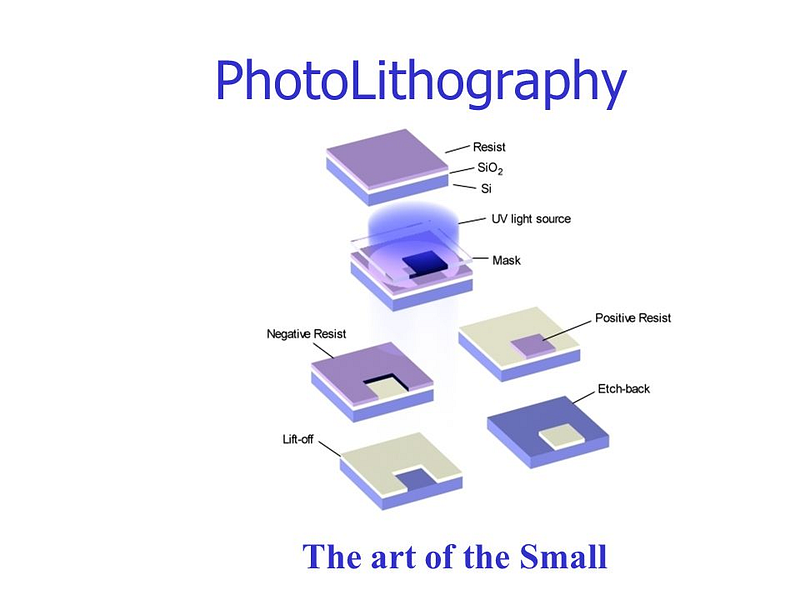
Photolithography is a process by which fabrication of PIC is done on a thin wafer. This process uses UV light and it is comparable to the manufacturing of Printed Circuit Boards. After cleaning the surface, they are given the necessary print using photomasks. A laser writer draws patterns on the surface, giving it an appropriate path for the light to pass.
Types of devices used
Like various electronic devices like diodes, transistors, FETs, MOSFETs, filters, capacitors etc. there are a lot of devices which are used in making Optical circuits.
Sources of light
These include devices which can emit a visible spectrum of Electromagnetic waves, ie Light of any colour. There are two types of light sources namely point sources and line sources. The point sources will always emit spherical wavefronts while line sources will emit cylindrical wavefronts.
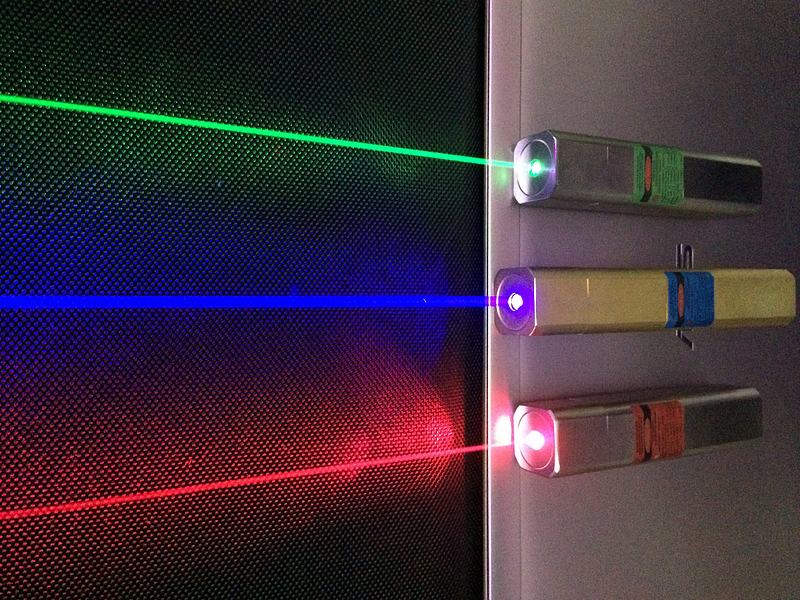
The different sources of light are Light Emitting Diode (LED) and Light Amplification by Stimulated Emission of Radiation (LASER). These sources are monochromatic in nature while there are other sources like lamps that do not emit monochromatic light. Always we prefer monochromatic sources of light for accurate results while doing experiments.
LED is a semiconductor device, which can emit light when electricity is supplied to it. LED is a modified PN Junction Diode which can emit light when it is forward biased. Thus it exhibits all characteristics of a diode. LED is a part of Solid-State-Lighting technique and it has now penetrated deeper than we can imagine.
LASERs are of three types- Ruby, Helium-Neon Laser and Semiconductor Laser. The principle of their function is the excitation of particles and these particles release energy in the form of waves which lie in the visible spectrum. This cycle typically continuous until external energy in the form of an electric power supply is provided. There are three main components of a Laser- Active Medium, Pumping Mechanism and Resonant cavity.
Power Splitters
This device is also known as a beam splitter. It divides a beam into two beams or more beams with lesser power. This is one of the most important passive devices used in optical circuits. There are basically two types of splitters- Fused Biconical Taper (FBT) and Planar Lightwave Circuit (PLT). The ratio in which the beam is split is known as splitting ratio.
WaveGuide
A waveguide is a device which allows the propagation of a light wave. It will generally have a high refractive index to allow waves to bend depending upon the requirement. We have planar waveguides which are polished surfaces used to allow waves to propagate, and on the other hand, we have channel waveguides which give a definite path for the light. They are made with semiconductors, glass, prism etc. Channel waveguides reduce propagation loss. The best example of a waveguide is optic fibre cable.
Photodetectors
Just like how sources use external energy to produce light, photodetectors use photons to create a voltage or current in the circuit. This way photodetectors can be used to detect the presence of photons in the circuit. Not only can we detect them, but also know the intensity of the light as well.
The popularly used photodetectors include a photodiode, phototransistor, avalanche photodiode, solar cell, LDR, MSM photodetectors etc. All of these are semiconductor devices. Photodetectors have a wide range of applications in photometry, radiometry, LIFI, Optical communication, LIDAR etc.
Optical filters
Optical filters are passive devices which allow only light of only a certain wavelength to enter the filter. There are two types of filters on the basis of operation- absorptive and dichroic filters. Absorptive filters absorb the light of a certain wavelength and thus allow the required light to pass. Dichroic filters are the filters which reflect unwanted light of a certain wavelength depending on the thickness. The angle of incidence is very important in this case.
There are three types of filters which work on ‘pass’ principle. They are longpass, shortpass and bandpass. Longpass, allows only a higher wavelength than threshold wavelength to pass through the filter. Shortpass allows only a shorter wavelength than the threshold wavelength to pass. At last, bandpass filters allow only a given bandwidth of given wavelength of light to pass.
Optical transistors
Like ordinary tripolar electronic transistors, an optical transistor is a light valve or optical signal amplification device. Transistors are also called an optical switch.
Optical Amplifier
Often during light wave propagation, the signal becomes weak or will lose its energy. For avoiding the same, we use amplifiers to strengthen the signals without even converting into electrical signals. Doped insulators are used for amplification, in laser crystals and glasses used in bulk form. An Erbium-doped amplifier is used for amplification in optical fibre communications.
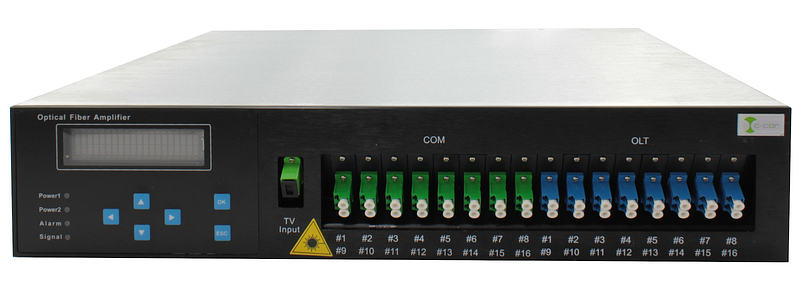
Some parameters related to Amplifiers
- Amplification factor or gain (db)
- Power efficiency
- Saturation energy
- Time of energy storage
- Bandwidth
- Noise
Comparison with Electronic circuits
Electronic circuits are indeed a revolution in the 20th century, but the 21st century will more be integrated between Photonics and Electronics. We can now technically understand that both are comparable and need to support each other. There are a lot of aspects in these circuits which are being replaced by Optics. Now we can also use photons for sending information which was not possible before. Even the Lighting industry is heavily dependent on electronic markets.
Advantages
Discussing the speed of circuits, optical circuits will have the upper hand as photons travel much faster than electrons. This is because photons have a speed of 3 x10⁸ m/s while the drift velocity of electrons is in the order of 10³. This is the major reason OFCs are getting more preference.
- Switching in the case of optical circuits is obviously faster.
- Light faces no electromagnetic interference while it happens in electrical circuits.
- Wastage of power due to heat loss and attenuation loss in optical circuits.
- Energy conversion from light-electronic-light in OFC isn’t required thus, power loss can be avoided.
Disadvantages
- Optical circuit component manufacturing is expensive and is dependent on electronic circuits.
- Highly expensive
- Fabrication and Integration of devices on-chip is very hard on a large scale.
- New technology in the market and requires more research, experimentation and practical applications.
- Electronics is moving and improving at a faster rate than photonics. CMOS technology has revived electronics making it far more superior.
- Highly sensitive to dirt and external particles
Applications
Optical Circuits are not just mere circuits for experiments, but they do have a wide range of applications across various areas in science and technology. Starting from basic room lighting to superfast fast broadband network powered by optic fibre cables, light is truly an amazing concept.
Optic Fiber Communication
OFC stands today as the most outstanding invention in the optoelectronics and communication field. They are superfast, allowing data to flow in Gbps rate. They are reliable than traditional transmission media. There won’t be any electromagnetic interference for the cables as they use light.
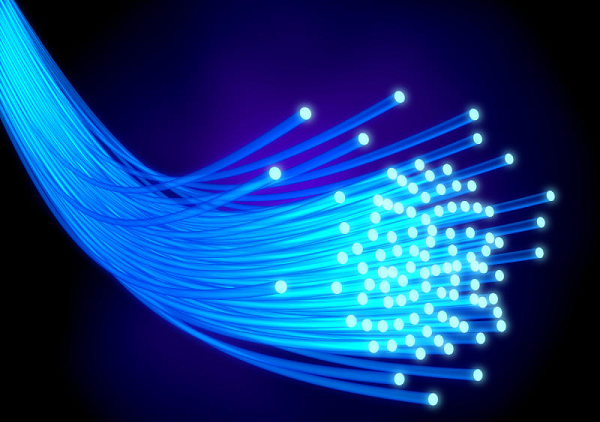
Principle of working
OFC works on the principle of Total Internal Reflection, where the light incident on the surface of the fibre bends if sine of the angle of incidence the refractive index of the medium.
In single-mode fibres, only one signal can be sent through the medium whereas we can send multiple signals in multimode index fibres.
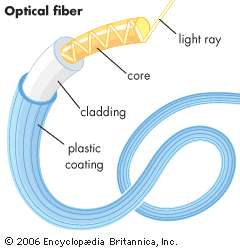
Components
- Transmitter
- Medium- Cable- Core, Cladding and Insulation
- Receiver
Traditional OFC vs New OFC
OFC used to convert an electronic signal from the transmitter to light and then to electronic signal at the receiver. This method has a lot of disadvantages like losses in energy during conversion. The loss was negated by the use of an optical amplifier, but now PIC comes in 100% optical use where no conversion is required and the only light is used, reducing the loss.
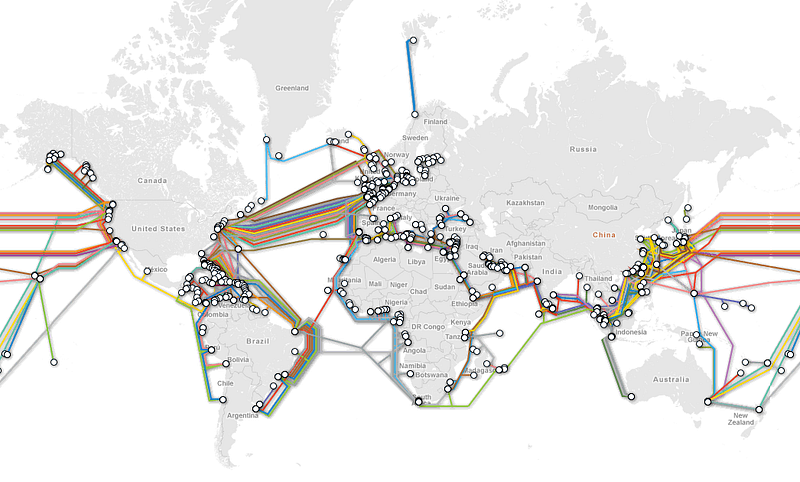
Optical Fibre communication is still not used on 100% potential today. Majority of the OFC used lies under oceans connecting all continents virtually. Contrary to popular belief, the majority of the information we get on the internet comes through undersea cables and not through satellites.
Light Fidelity (LIFI)
We are familiar with the term WiFi, but we are new to the term LiFi. Just like how a WiFi works, we can replace the same with LiFi as we can directly obtain internet from light. LiFi will be faster than ordinary broadband and may not require any physical connections.
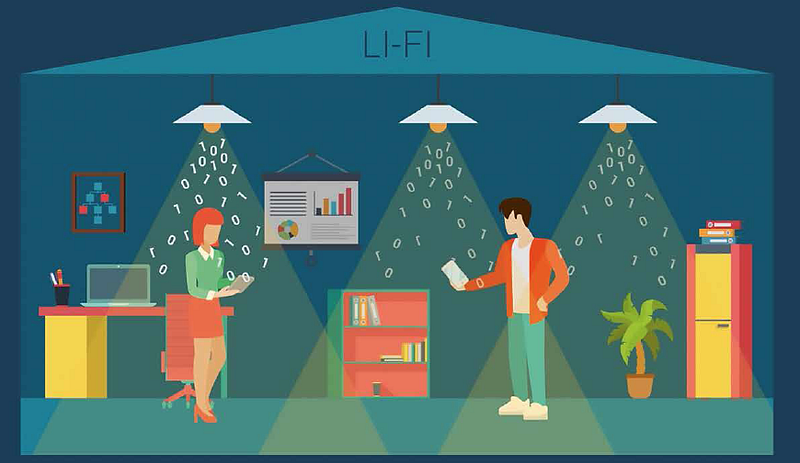
This technology is an emerging technology and the research on this topic is still proceeding, thus because of that LiFi isn’t commercially available to us. LiFi technology is highly expensive for an ordinary person. Also, at present LiFi also needs conversion- electronic to light and back to electronic format for computers which brings in a lot of energy and information. This brings us to another important application- Optical Computing.
OPTICAL COMPUTING
Computing refers to solving problems using various methods. In the modern period, we have devices performing computation called Computers. Digital computers use bits- 0 or 1, where electrons are used. Quantum Computers use Qubits. Optical computers replace these with photons. With the help of optical transistors and optical amplifiers, computing can be made faster. Optical computers promise large bandwidth and high speed. Just like LiFi, Optical computing also remains as an emerging field of study.
Parts
- Optical Processor- Researchers have developed a processor on the nanoscale to process optical signals.
- Optical data transfer medium- Like the Optic fibre cables.
- Optical storage- A memory space for storing data- CD, DVD, Blu-ray disc etc.
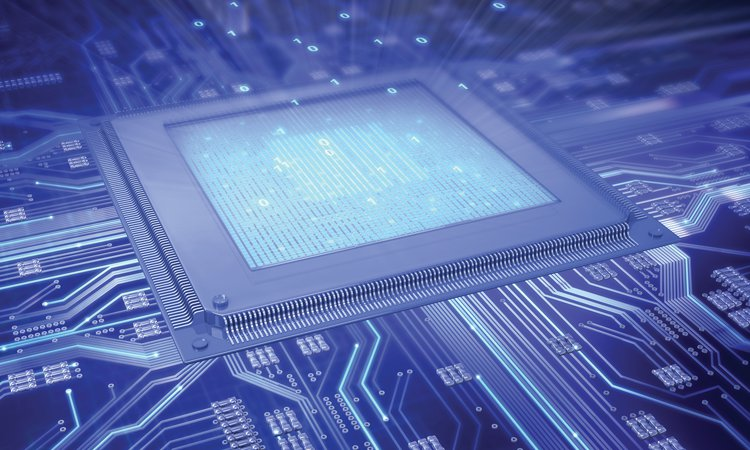
Optical computers in future will use optical chips and PIC, instead of ordinary electronic chips.
Wave Division Multiplexing
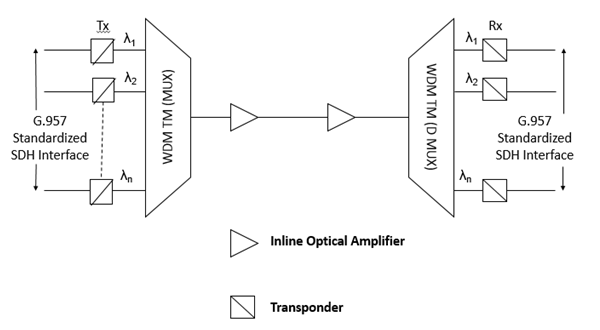
We encounter a big problem during communication, ie to send multiple lines at a single time. Due to cost constraints and material usage, we cannot do it in practice. For that in electronics, we use Multiplexing. In the optics field, we call it wave division multiplexing where the light of different wavelength is combined in the same channel during transmission and later split up. This method not only saves cost but also reduces the wastage of hardware used. This is indeed an amazing application of optical circuits. Usually, we use a combination of prisms for splitting and combining signals. Amplifiers are used throughout the channel to ensure that signal strength is maintained.
Biomedical field
The biggest application of Optical circuits in the Biomedical field is for the use of sensors. Fiber Optics are highly bendable and flexible compared to traditional fibres. The chemical sensors attached at the end of the fibres can detect chemicals, enzymes and other biomolecules. They can also detect pH levels, temperature, concentration, the refractive index of liquids etc.
We can also use fibres as Glucose sensor, Laminate cure analysis, Protein analysis, drug identification, pesticide detection, heart rate etc. Sensors as we discussed in the photo-detection section, it can be used to detect the presence of various substances and not just restricted with light.
Challenges to Optical circuits
With a lot of advantages, we encounter a lot of disadvantages and most of these can be solved easily with the help of technology.
The first and the most challenging will be the cost of extraction of rare materials for the manufacture of optical devices and their fabrication. The second challenge will be that “Light” is weaker than electricity. The signals will require amplification frequently. That is why optic fibres need more repeaters to strengthen signals and prevent attenuation. The source of silicon for circuit boards as well as for light sources can shoot up the price of circuits as well as create unwanted competition in the industry.
There is nothing like a device which can function fully in light today. Even optical computers today need the help of electronic circuits to complement their functions. Only a few Photonic integrated circuits can independently work on light, that too externally they require a power supply which is provided by electronic circuits, say for amplification or biasing. LASERs consume high power compared to other sources and it is challenging for designers to put Lasers on-chip.
Optical circuits need a lot of resonators, in order to maintain the energy level of the signals. The reason for the same is mentioned- losing its energy.
Looking into future
Photonics and Optoelectronics will conquer this century. Just like how LASER guns replaced traditional guns in many militaries, the market will look for good alternatives within a short span of time. The distinction between science and engineering has narrowed. Technology is shaping the world we live in.
Technologies like LiFi and optical computers will gain acceptance and manufacturing of these can help consumers. Optical fibres will soon replace the existing coaxial cables. Devices which partially work on electronics might fully shift to optical. Technology can make optoelectronic devices affordable to all. Along with making this world a technology hub, let us also consider the environment and make sure the majority of these are recyclable and eco-friendly in nature.
References
- Wikipedia
- Sciencedirect
- Tutorialspoint
- RP Photonics
- Research Gate
- Britannica encyclopedia
- OSA Publishing
- NIH USA
- Photonics Gr
- Edmund Optics
- Optiwave
- Scholarpedia
- IEEE
- Wiley Online Library
Image Courtesy
- Wikipedia
- General Electric
- Economic Times
- Tutorials Point
- Google Images
Follow us for more amazing and latest science and technology articles. We are also there on social media. Follow us on Instagram to stay updated!
NEW: We are also there on LinkedIn. Follow us there too!!!
HAVE A GOOD DAY!


