Opinion: This all reminds me of Cold War history jargon!
Sign up for The Weekend Brief newsletter by Areas & Producers
I am a loyal follower of Geopolitical Futures and its diverse team of writers, analysts and forecasters.
George Friedman is founder of Geopolitical Futures and author of many books on geopolitics. His latest podcast about the Hamas attack on Israel is insightful and a little controversial. Have a listen to it here.
Now, here are my thoughts about the podcast.
“The Middle East was solidifying into a single bloc. The various players — the Egyptians, the Saudis, and so on — were working with Israel. And the Hamas thought this was a terrible thing, it was breaking the bloc, and thought that an attack on Israel, that was as brutal as possible, would break up this bloc.”
So, George Friedman is calling these relationships between Israel, Egypt and Saudi Arabia a bloc, which, I think is mainly a reference to the fact that Saudi Arabia, and even other countries like Lebanon and Morocco, have decided to cooperate with Israel in recent years. I don’t think he would be calling this a bloc, otherwise, because Israel and Egypt already had formal relations. I don’t know if we should start using this “bloc” term to refer to today’s geopolitical shifts in the Middle East region. This all reminds me of Cold War history jargon.
“I’m still not convinced that Iran was involved; Iran is picking up the ball, because it may as well…but somebody already helped them. The missiles they were firing, the rockets, the amount of training that had to go into this, had to happen somewhere…This was a very professional, very capable attack.”
I still remember the first news story about the attack on Israel: everything was pointing to Iran, or at least some involvement from a regional actor. But I personally err on the side of caution. This attack could’ve been carried out by state interest groups or non-state actors, ranging from political parties, religious entities, or simply people with business interests in the Eastern Mediterranean. It’s important to pay attention to what’s happening in Israel’s offshore areas, as foreign investments are going into offshore gas production in a variety of Israel’s exclusive economic zones.
“The Israeli rhetoric better had be strong, because they’re speaking to the Israeli people. The Israeli people now, like people everywhere, are looking to their government to be decisive, to be courageous, and to be infallible. They have lost infallible, and are working on the other two.”
I think it’s wise to examine the meaning of infallible here. The Cambridge Dictionary defines infallible as “never wrong, failing, or making a mistake”. I don’t think people around the world are contemplating whether or not the Israeli government is infallible. To be infallible, according to the definition I presented, would mean that governments are supposed to be a functioning structure for effective decision-making — I argue that this is not the case. I think it’s more proper to say that the Israeli government needs to come up with a new strategy, and one that will be accepted, firstly, by the Israeli people, and then also the rest of the world. I seriously doubt that the latter is going to ever come true.
“Now the Arab governments have something to consider, because, if Hamas continues operating, continues to be running free, those countries are going to be hit…But here’s the thing, Israel has excellent intelligence about the Arab countries…So you look at it, and you’re really puzzled that the biggest puzzle there was, not just that it was an Israeli intelligence failure, we know that the Arabs had to know that this was going on. Why didn’t they stop it?”
These words from Friedman send chills up my spine. This is why I always go to Friedman and the Geopolitical Futures team for distinguished insights on geopolitics. It’s difficult for me to imagine what these countries are doing outside of the public sphere. We absolutely take for granted the fact that we can read from our favorite authors, news agencies, bloggers, etc, without really knowing what countries are doing behind closed doors. I also think of the significant divide between Arab countries throughout the world. We should discuss how Arabs living in other parts of the world feel about this latest attack by Hamas at the heart of Israel.
Listen to the full podcast: George Friedman on Where the Conflict Goes from Here.
After listening to the GPF podcast, please have a look at a very engaging thread about it below.
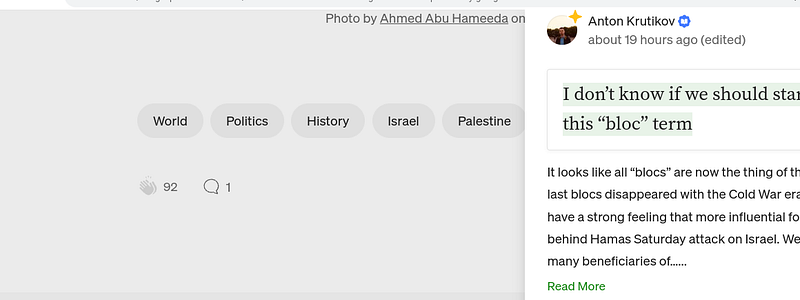
Since I originally posted this content in the publication Areas & Producers, you will see that the comments from me and another Medium writer Anton Krutikov were posted earlier this week.
I encourage everyone to join the discussion. We should be talking more about world affairs these days!


