Opinion: No expectations for a short war in Ukraine!
Sign up for The Weekend Brief newsletter by Areas & Producers
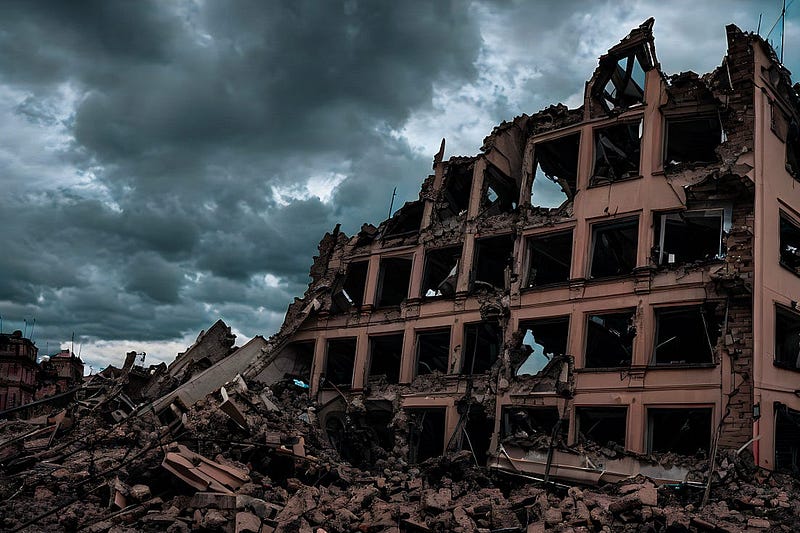
I am a loyal follower of Geopolitical Futures and its diverse team of writers, analysts and forecasters.
George Friedman is founder of Geopolitical Futures and author of many books on geopolitics. His latest writing about the Ukraine War is insightful and a little controversial. Have a look at it here.
Now, here are my thoughts about the article.
“The Russians had to expect a short war in which they crushed the Ukrainian army and its will to resist. If they fell short, they knew that the Americans after a short time would surge weapons into Ukraine, risking a protracted conflict.”
I don’t see how anyone could have had expectations for a short war in Ukraine. It’s a big area, encompassing maritime and land boundaries — flanked by NATO countries and American allies! At best, the Russians could’ve expected the Ukrainians to turn on their corrupt government and leaders, but instead, they just fled to countries where they would be taken in as refugees. I don’t know if this helped Russia or Ukraine more, but it certainly affected the countries who had to recieve Ukrainians as refugees.
“The Americans feared that the fall of Ukraine would bring Russian forces to the eastern line of NATO nations, restarting the Cold War. In this sense, the war has little to do with Ukraine, save that it has savaged the country, and is sliding toward a painful and dangerous cold war.”
There is no Cold War. This is 2023, let’s get over it, shall we? But anyways, I do agree that one of the United States’ worst fears in this war was that the threat of Russia pushing into Eastern Europe would be one of the likely outcomes. This would cause a major geopolitical shift, and I would argue that solidarity between the Black Sea countries — Romania, Bulgaria and Turkey — is one of the outcomes that no one saw coming. It remains to be seen, however, if the United States or Russia will have more influence in the Black Sea. Hopefully, the Black Sea countries can strengthen their cooperation, and come up with a strategy to increase their own leverage against the United States and Russia as a result of this war.
“Zelenskyy believed that if American intervention did not cause the Russians to abort, then it would at least allow Ukraine to counterattack on a vast scale. But the United States is engaged in a different conflict: keeping Russia away from NATO.”
I agree with the latter, but I disagree with the former. Ukraine depends on its agriculture exports and Ukrainian business leaders knew that their profits would decline significantly due to Russia’s invasion. They also know that they must cooperate with Russia to ensure that their business interests in agriculture exports continue to reach global markets through the Black Sea. Again, I am waiting to see how cooperation between Romania, Bulgaria and Turkey plays out before determining the future of Ukraine’s agriculture export economy.
“Russia has kept the U.S. away from its border but little else. Ukraine has retained sovereignty over a good deal of the country. And the U.S. has made a Russian penetration beyond Ukraine highly unlikely.”
I think the issue of Ukraine’s sovereignty has not been discussed enough in the context of Ukraine’s war. Before reading this statement by Friedman, I had previously formed most of my concepts about the Russia-Ukraine war as a war over business interests and NATO’s legacy. But, as I read this article, I realize how sovereignty has been a key issue in the broader geopolitical shifts. We might start talking about whether Ukraine has retained its full sovereignty, or only the parts where Russia’s military was pushed back, but what I don’t understand is how Ukraine is going to keep Russia out of its politics and markets in the long-term. In my view, this wil be the problem of Ukraine’s sovereignty, regardless of the war’s outcome.
Read George Friedman’s article: “The War Is Over, but No One Knows How to Stop Fighting”.
After reading Friedman’s article, please have a look at a very engaging thread about the article below.
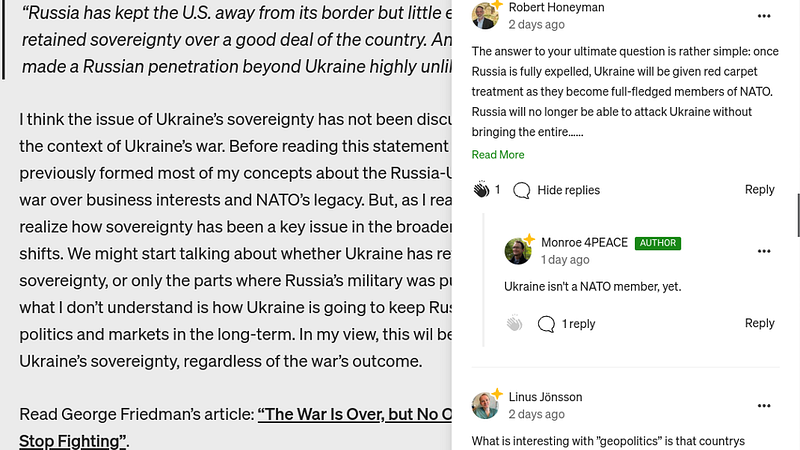
Since I originally posted this content in the publication Areas & Producers, you will see that the comments from two other Medium writers Robert Honeyman & Linus Jönsson were posted earlier this week.
I encourage everyone to join the discussion. We should be talking more about world affairs these days!


