
Special Forces
Operation Jaywick
Believe it or not, there was a time when special forces were considered to be a distraction to Australian ‘Big Army’ general staff, but one operation laid a solid foundation
Special forces have not been around forever, they are a relatively new concept in the annals of military doctrine. Certainly there have always been elite units in most armies for millennia, but the development of forces akin to the UK’s SAS and SBS or the USA’s Delta Force and Seal Teams has only come about since World War II.
The British SAS grew out of the Long Range Desert Group in North Africa during World War II and many of you may recall their very public success in ending the Iranian Embassy Siege in London in 1980, with extreme prejudice.
In Australia the special forces evolved along a more complex route.
Author Robert Macklin has traced the evolution of the Australian special services in his book ‘Warrior Elite’. There were many political battles fought from the initial WWII establishment of an irregular group of very tough mainly Aussie soldiers (akin to the LRDG, but more specialised in jungle warfare than desert operations) through to today’s pinnacle of military professionalism.
Basically, it took the Australian General Staff many years to recognise the essential part that special forces could play in the nation’s security, even during peacetime.
Macklin’s book is a detailed and occasionally heavy-going history with his definition of special forces embracing not only the SAS but the Secret Intelligence Service (ASIS) and several other branches including those operating in the world of ELINT (today the Australian Signals Directorate).
One of the earliest operations of what were then called ‘the commandos’ is known as Operation Jayrick and its tale could have been lifted from Boys’ Own magazine.
Operation Jaywick
Operation Jaywick was a daring special operation undertaken by the Allied Z Special Reconnaissance Unit during World War II. It was planned that in September 1943, a team of 14 commandos and sailors would infiltrate Singapore Harbour, a heavily fortified Japanese stronghold, with the objective of sinking enemy shipping.
The team of eleven Australians and three British men would travel to Singapore in a vessel disguised as an Asian fishing boat. They would then use folboats (collapsible canoes) to attach limpet mines to Japanese ships.
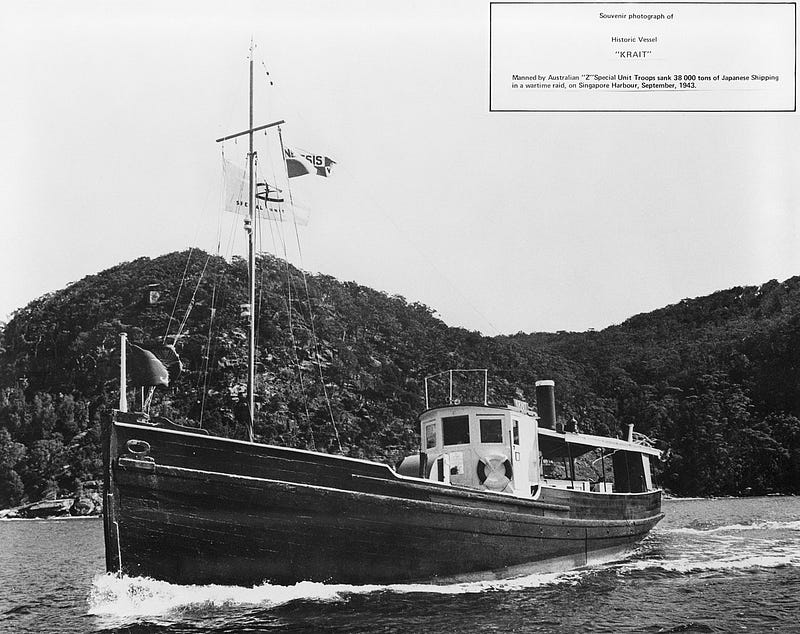
The MV Krait, length 70', was a diesel engined fishing boat, with a speed 6.5 knots and a range of 8000 miles. It had formerly been the property of a Japanese firm in Singapore. Commandeered by an Australian civilian, it was used to evacuate civilians from Singapore. Then when the Dutch East Indies surrendered to Japan the Krait was sailed to India and eventually reached Australia under its civilian skipper, Bill Reynolds.
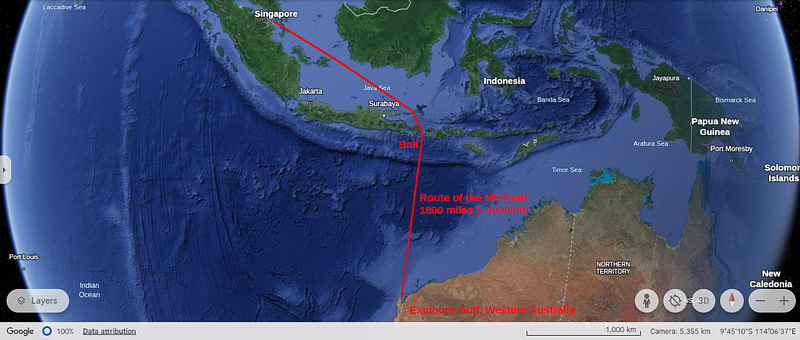
On 2 September 1943, the MV Krait departed Exmouth Gulf in Western Australia on the 1800 mile passage to to Singapore. The unit had been trained and was led by Captain Ivan Lyon, who was killed in a later operation. Operational security was very tight — the commandos dyed their skin to appear Asian, dressed appropriately for fishermen and were very careful about the source of any garbage they dropped overboard.
It was a daunting passage to undertake — almost 1000 miles across open ocean and then a passage through the rough Lombok Strait near Bali where currents can run at up to eight knots; onward through intricate chains of islands to avoid Japanese eyes.
The Krait’s propeller shaft snapped en route and was re-welded at sea with the assistance of a US submarine which was tracking them. That repair job at sea was no easy feat and then was soon followed by a force 9 severe gale.
When they arrived and anchored at an island near Singapore, the folding canoes were assembled and loaded with the limpet mines and provisions. The canoes had not been constructed exactly to plan and some modifications were necessary. The commandos — two to each canoe — then paddled 50 km at night into the heart of the anchored Japanese cargo ships.
The limpet mines exploded on September 26th, 1943, sinking six Japanese ships with a total tonnage of over 39,000. This dealt a significant blow to Japanese shipping in the region and boosted Allied morale. The commandos laid low on a nearby island for a few days and then rendezvoused with the Krait further along the coast after a long paddle in their canoes.
On the return journey to Australia they narrowly avoided detection by Japanese patrol vessels (even waving to a Japanese minesweeper near Bali) and arrived safely at their Exmouth base on October 19th, 1943 at the end of their 48 day covert operation. Remarkably the team had survived intact, with only minor injuries from hiking.
Operation Jaywick is considered one of the most successful and daring special operations of World War II. It demonstrated the courage, skill, and resourcefulness of the special forces and had a significant impact on the course of the war in the Pacific.
The Japanese did not consider that the events were due a mission run from Australia and thought that local saboteurs were responsible. They were convinced that prisoners interned in Changi Prison were responsible and Japanese military police raided the cells and interrogated 57 prisoners in October 1943. Fifteen of the prisoners were tortured to death in what became known as the Double Tenth Incident.
The Allies did not claim responsibility and the operation was kept a tightly guarded secret. More of the same were planned.
A similar operation to Singapore was run again in 1944, led by Lyon, now a Lt. Colonel. All 23 sailors and commandos were either killed or captured and executed by the Japanese.
The Z special forces carried out several important operations in the East Indies during the rest of WWII and honed their jungle fighting techniques in Borneo and Timor.
The Krait has been preserved at the Australian National Maritime Museum in Sydney. The story of Operation Jaywick has found a place in the annals of Australian military history and become the subject of several books and films.
Strangely, it’s Australia Day as I finish this article here in New South Wales.