Open Closed principle and Rule engine design pattern
Respect the privacy.

The SOLID principle is a subset of the many tenets promoted by American software engineer and instructor Robert C Martin, known as “Uncle Rob.” In this article, I would be talking about one of the S{O}LID principles, i.e., Open-Closed Principle(OCP).
I would use C# for demonstrating code, but OCP is language-agnostic.
The official definition of OCP is:
software entities (classes, modules, functions, etc.) should be open for extension, but closed for modification
Benefits of OCP
OCP recommends practices that make it easy to upgrade software applications. Imagine a use case where WhatsApp wants to extend the chat service to send messages to Facebook messenger.
The developers would like to re-use relevant components of the chat service. There are two ways of doing it.
- Modify existing chat service to support the new requirement. It will expose the chat service code to bugs. The complexity of chat service will increase, and automated test cases might fail.
- Extend the chat service code by using relevant components. The code written to support new features will be in the form of new classes but will benefit from the core functionality of the chat service. The benefit of this approach is that new features can be deployed and tested independently.
Rule Engine design pattern is one of the many ways to obey OCP. Many other design patterns allow us to follow OCP, but I am limiting this session to the Rule Engine design pattern, which is one of the easiest ways to demonstrate the power of OCP.
Rule Engine
One of the popular design patterns to help developers follow OCP is the Rule Engine design pattern. It is an efficient design pattern to develop software applications with multiple and complex business rules processing the same entity.
Business rules could be correlated and complex. There could be a lot of complicated branching and conditional logic involved. Following OCP will enable the developers to add, remove or disable business results independently.
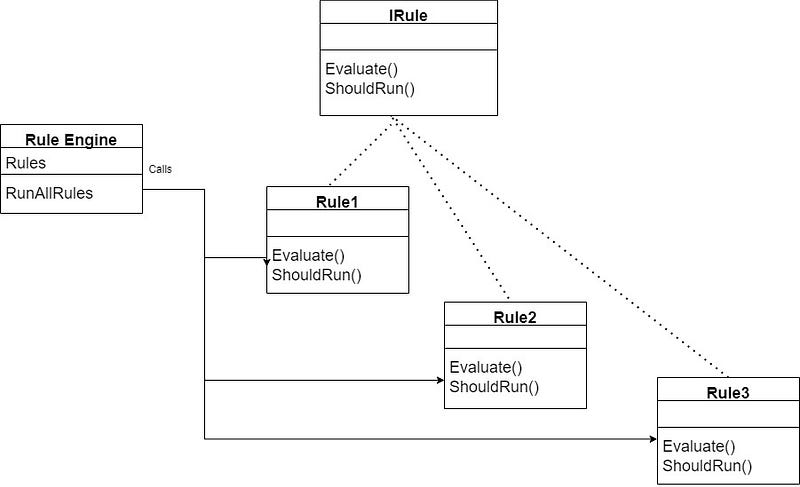
There are two components of a Rule Engine:
- Rule Engine — An Engine that executes all rules on an entity to produce a result.
- Business Rule — A Rule defines a processing logic or a condition.
A Tax Calculator
Let’s try and implement Rule Engine design pattern for a Tax Calculator application. Tax Calculation is a complex process and depends on many factors like Age, Gross Income, Residency status, etc. A lot of business rules evaluate these factors to determine Tax amount. Government policies drive these business rules and can change them frequently. I will use the Rule Engine design pattern to keep these business rules independent in this use case.
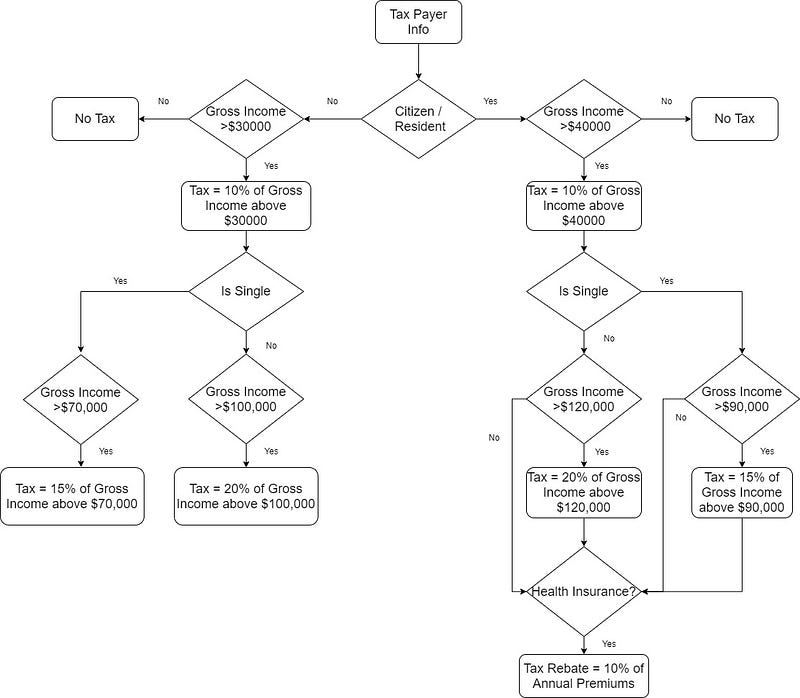
Steps to implement Rule Engine Design pattern
Complete code can be found at https://github.com/tarunbhatt9784/TaxCalculator.git
Step 1 — Write all the rules in one place
Write all rules in one method using if-then-else conditional statements.
Step 2: Create classes for each rule.
Create separate classes for each rule. Add a ShouldRun() method in each class file to determine whether the business rule has to be executed or not.
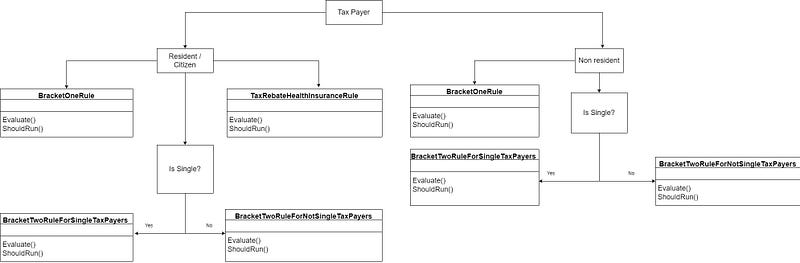
Each class has two methods — Evaluate() and ShouldRun().
Hence we can create an Interface and let all these Rule specific classes implement this interface. Let’s class this interface ITaxCalculatorRule.
Step 3: Create Rule Engine
Once we have the contract of each rule in the form of an interface and the concrete rule classes, it’s time to process them with the help of a Rule Engine. The Rule Engine will be responsible for evaluating these rules. It’s a two-step process:
- Find all implementations of the Rule Interface — ITaxCalculatorRule
- Check ShouldRun() for each rule, and if it returns true, run the Evaluate() method
Complete code can be found at https://github.com/tarunbhatt9784/TaxCalculator.git
Conclusion
Let’s summarize and re-iterate the advantages of using the Rule Engine design pattern
- Independent testability of Business Rules
- Rule Engine does not need to change with the addition or removal of each business rule.
- Business Rules can be enabled or disabled separately without changing other rules or Rule Engine
Thanks
P.S — Medium is an excellent platform to read, write and learn from fellow authors. If you want to join me in this journey, Join medium today.
Glossary
Open–closed principle — Wikipedia
Open–closed principle — Wikipedia


