
Survival of the Friendliest
New science from dogs and foxes says our survival is not because we’re smarter. It’s because we’re friendlier.
In the late 1950s, Russian geneticist Dmitry Belyaev had a problem. He had to lie. The Soviet Union had banned the study of genetics. In fact, Belyaev’s older brother, also a geneticist, had been executed by Joseph Stalin. The lie Belyaev told was that his Siberian farm of wild foxes was a study on furs. In reality, he was trying to find out if he could turn wild foxes into something like dogs. His hunch was that what made dogs playful, tail-wagging, loyal companions was one thing, being friendly.
In Siberia, he selected the least aggressive and most friendly foxes for breeding. In the first generation of cubs, they did the same thing again, selecting less than 10% of them. By only the fifth generation, they already started to see astonishing changes. Cubs began wagging their tales, whining, and licking researchers. After Belyaev’s death in 1985, Lyudmila Trut continued the experiment. And after nearly 50 generations, the foxes were totally acting like playful friendly dogs.
But their findings remained in relative obscurity until 2004 when Brian Hare, a young scientist and dog enthusiast from the United States, learned about the fox experiment.
Brain Hare had his own hunch about dogs. Dogs were smart because they had been bred that way by our ancestors. Why else would they be so good at the object choice test? Tasty treats were hidden while researchers pointed to the hidden place to see if the animals understood. Dogs aced it. Three-year-old children aced it. Chimps and wolves and other animals failed the test miserably. No amount of pointing or gesturing or hinting worked. So with his hunch about dogs being bred to be smart, Brian Hare took off to frozen Siberia.
Because the Siberian foxes had been bred for friendliness, Brian assumed they would not be able to pass the object choice test. But he was spectacularly wrong. To his amazement, the friendly foxes aced the test. They had the same smarts as dogs. That meant only one thing. Being friendlier and tamer also made the foxes smarter. What was also remarkable was that tame foxes had more sex. They were more reproductive. They also retained juvenile features into adulthood. And they had thinner bones and narrower faces to go along with their tail-wagging playfulness.
Now Brian Hare had another hunch. And this one had to do with with humans. Scientists have known for a long time what happens with domesticating animals. It not only makes them friendlier, but also changes then physically. They become darn cute. Pink, curly-tailed pigs. Short-nosed, floppy-eared dogs. And the physical difference in males and females is less exaggerated.
Here’s Brian Hare’s hunch. Did something similar happen to humans? After all, we can be very friendly. We are much different in appearance from other hominids. And the physical difference between our sexes is not that great. So did humans domesticate themselves by selecting for friendliness? The idea goes all the way back to Charles Darwin. But it has not been seriously pursued until recently. The theory goes, says Hare, that the reason homo sapiens are extremely social and have thinner bones and faces is because, like the Siberian foxes and dogs, we selected friendlier mates as time went on.
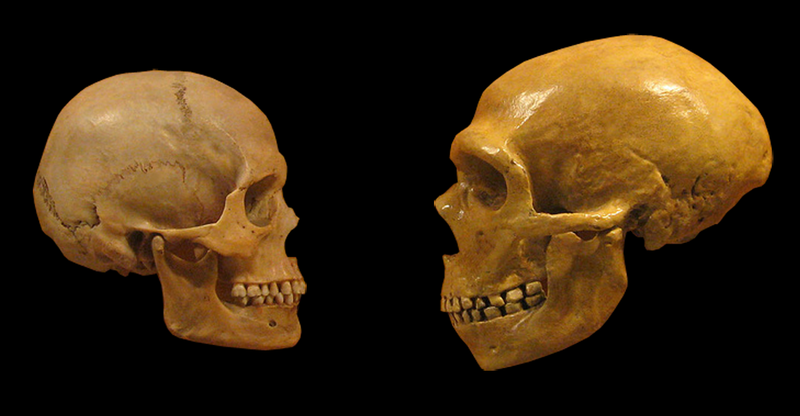
According to Brian Hare and his wife Vanessa Woods, in a recent Scientific America article, homo sapien skulls found after 80,000 years ago had a 40% reduction in how far their brow ridge stuck out. The brow ridge in modern humans is nearly gone. “They were also 10% shorter and 5% narrower” than skulls before 80,000 years ago. They had friendlier looking faces. Signs of domestication, they say.
Another sign is the increased presence of the chemical serotonin. Many studies have shown that serotonin promotes cooperation and friendliness. In fact, domesticated animals have higher levels of serotonin than their wild counterparts. And experiments have shown that serotonin will alter the shape of an animal’s skull. “Neanderthals had heads shaped like footballs,” say Hare and Woods. While ours are more like balloons. Increased serotonin may have played a pivotal role.
Not long after that change in our skulls, there is an explosion of evidence about “our expanding social networks and cultural prowess.” Shells for jewelry that that were obtained from hundreds of mile away. Meaning people were on the move and possibly trading. Cave painting galore. Such as the lions and mammoths of Chauvet Cave in southeastern France. What accounts for all these sudden changes? We chose friendlier mates, says Hare and Woods.
And now there is some genetic evidence too. A press release from the University of Barcelona said, “Researchers identified a genetic network involved in […] the modern human face and prosociality, which is absent in the Neanderthal genome.”
The gene is BAZ1B. It helps tell the cells in an embryo where everything goes to develop properly, such as the spinal cord and facial bones. If this gene is reduced then things move to slow. This causes Williams Syndrome, where people have smaller skulls, elf-like features, and are incredibly friendly. It’s an extreme version of what scientists see in domestication. This gene also shows a pretty reliable link between physical changes and friendly behavior. What’s more, the study also points to how our genes may have split from Neanderthals and developed differently. It may explain why we survived and Neanderthals died out. We were just plain nicer.
Human self-domestication is a very intriguing idea. And it makes some intuitive sense. Although some questions remain, what these scientists are showing is that what makes us unique is our friendliness. From our different skulls, our different brains, our different bodies, and our different behaviors. Being friendly has enabled us to form into large groups and harness our collective knowledge. It’s made us smarter. It’s allowed us to collaborate and cooperate at high levels. It’s allowed us to laugh and to play. It’s allowed us to enjoy nothing more than being with the people we love most.


