
Only 12 Months to Protect Your Critical Inventions

The last thing you want to hear is, “I’m sorry, but it’s too late to patent that invention.”
I’ve had to share this bad news with far too many tech startups during the past 20 years. This is terrible news for your company, especially when a critical invention is involved.
Even worse, most of the time the problem could have easily been avoided.
The 12-Month Deadline
The United States patent laws have specific timing requirements for filing a patent application.
If a company 1) publicly discloses an invention, 2) sells a product containing the invention, or 3) offers to sell a product containing the invention, those activities may trigger a 12-month patent application filing deadline in the United States.
In most situations, if a patent application is not filed by the 12-month deadline, the company forfeits the ability to protect the invention with a patent.
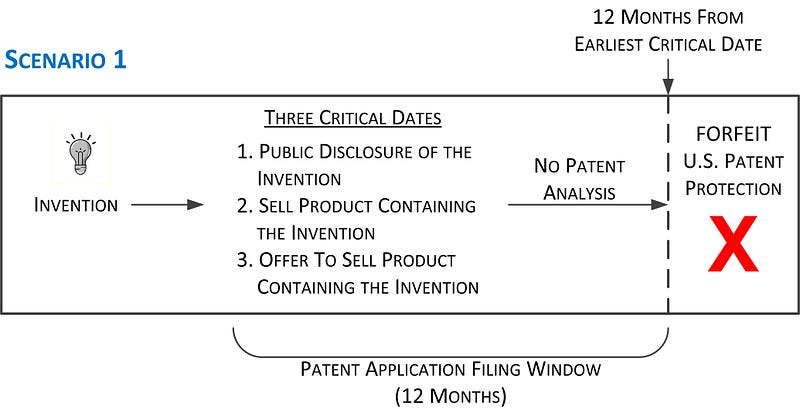
Unfortunately, many tech company leaders don’t understand these patent filing requirements.
They recognize the importance of patenting inventions, but often let the filing deadlines slip through the cracks because they aren’t aware of the 12-month deadline.
That’s when I become the bearer of bad news.
Sometimes, though, companies get “lucky.”
In one case, a company’s product was first sold almost a year before our initial meeting, but we still had a little time to get a patent application filed before the 12-month deadline.
This was a great outcome. But if our initial meeting had been scheduled just one week later, there would be no patent for that valuable invention. The invention is critical to the company because it’s part of their core technology that is disrupting the data communication industry.
Invention Triage(TM) Process
Fortunately, there’s a solution to forfeiting your patent protection — and it doesn’t even require being lucky!
The solution is the Invention Triage(TM) process.
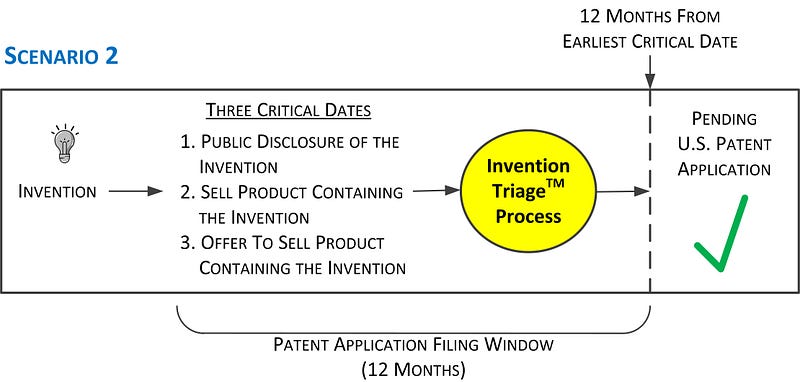
How does it work? By identifying inventions and determining which ones are the most urgent and need to be handled first.
For example, inventions that are approaching a 12-month deadline are the highest priority.
The Invention Triage process is particularly important when you are just starting to build a patent portfolio or it has been several months since your team identified or evaluated recent inventions.
I recently started working with a computer hardware company that already had four issued patents covering inventions developed several years ago. However, after filing the initial patent applications, the company entirely stopped focusing on protecting new inventions.
Even though several new products were developed and released during the previous two years, no thought was given to identifying and protecting inventions in those products.
Our first activity was to apply the Invention Triage process to identify and prioritize all inventions developed since filing the initial patent applications. This process yielded five important inventions that distinguish the company’s products in the marketplace. We analyzed all of the inventions and had to eliminate three from consideration because they were past the 12-month patent filing deadline.
The remaining two inventions were carefully evaluated using criteria specific to the company’s goals and priorities.
The evaluation determined that both inventions represented significant value for the company, so they decided to file patent applications for both inventions to strengthen their portfolio of patents.
Although three of the inventions were already past the 12-month deadline, the company was able to “rescue” two of the inventions. If they had waited two more months to implement the Invention Triage process, all five of the inventions would have been forfeited due to the 12-month patent filing deadline.
Act Today
You only have 12 months to protect your invention after 1) publicly disclosing an invention, 2) selling a product containing the invention, or 3) offering to sell a product containing the invention.
After that time has passed, your patent rights are gone.
The Invention Triage process helps you quickly identify looming 12-month deadlines and take action to protect critical inventions.
Even if you have filed some patent applications, don’t assume that you have fully protected all of your most valuable inventions. Conducting a periodic analysis uncovers critical inventions that have not been protected.
Without this process, those inventions may slip through the cracks and end up being donated to your competitors to use freely.
Action Step: Get your entire team involved in this process and encourage them to disclose any activities that may trigger the 12-month patent filing deadline. I recommend designating a person or group within your organization to receive and monitor these important activities.
Need more help protecting your inventions? Get a Free copy of my latest book, Cracking the Patent Code, and discover my proven system for identifying, evaluating, and protecting your most valuable inventions. https://stevesponseller.com/book/


