
One Thousand Books About Columbo
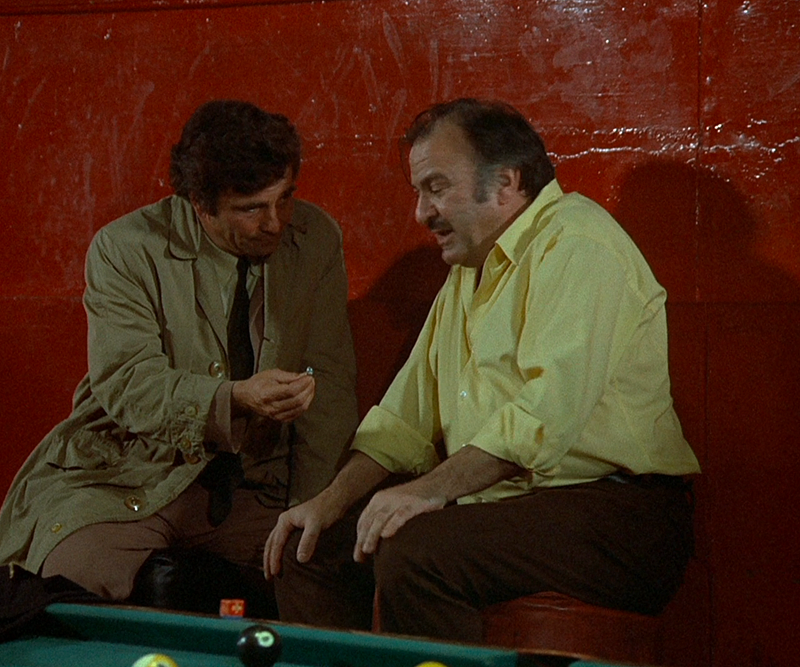
I tell my friends that I have become obsessed with Columbo. It is how I lately murder hours.
I tell my friends that I have become obsessed with Columbo and they confess to me or claim innocence. If they know what I’m talking about I’m free to let it go, make a few appreciative noises, tick off names of favorite episodes. “I went through the whole box set” someone says. The least that needs saying. I only suffer a throb of avarice that he has the physical object, a block-like trophy I can easily picture. Me, I have to peel episodes off YouTube TV, The Sundance Channel, I have to watch commercials to watch Columbo. I might have to kill them for that box set. I might have to kill them with it, then swab off my fingerprints.
Those who claim innocence? They’re the ones forced to listen.
Wikipedia: Columbo (/kəˈlʌmboʊ/) is an American crime drama television series starring Peter Falk as Columbo, a homicide detective with the Los Angeles Police Department.[2][3] After 2 pilot episodes in 1968 and 1971, the show originally aired on NBC from 1971 to 1978 as one of the rotating programs of The NBC Mystery Movie. Columbo then aired less frequently on ABC from 1989 to 2003…Columbo is a shrewd but inelegant blue-collar homicide detective whose trademarks include his rumpled beige raincoat, unassuming demeanor, cigar, old Peugeot 403 car, and unseen wife (whom he mentions frequently). He often leaves a room only to return with the catchphrase “Just one more thing” to ask a critical question.
I tell my friends that I have become obsessed with Columbo and they patronize me.
I tell my friends that I have become obsessed with Columbo and my posture degenerates.
This is in late November, through the holidays and January, these bleak weeks of the latest subvariant burp. Driven indoors, scratching gatherings off the calendar, we watch television. The first binge, two years earlier, had been dire and profound, abyssal: three seasons of David Lynch’s Twin Peaks, with Fire Walk with Me and The Missing Pieces in sequence between seasons two and three. Now it’s straight-up nostalgia, comfort food, microwave mac and cheese television. The 1970’s: watching the detectives. Not the bald one, not the one in the wheelchair, not the athletic one who lives in a trailer. The rumpled shambolic one, the priest of eternal return, the lurker in doorways.
Omicrolumbo. It has just one more thing it wants from us.
I tell my friends that I watched Columbo as a child and found it deep and mysterious and they ask whether I’ve lately had a look at McCloud, Hart to Hart, or Kolchak, The Night Stalker.
I could decorate my Columbo obsession with references to all the “multiple auteurs” of the television show; with mentions of the John Cassavetes movies Husbands and A Woman Under the Influence; of Dostoyevsky’s Inspector Porfiry; of the Hungarian writer Miksa Falk, mistaken for Peter Falk’s grandfather, an error not corrected before a statue of Columbo smoking a cigar was erected on “Miksa Falk Street” in Budapest. I’m doing that now: decorating.
But you want to remind me that for anyone younger, Columbo is the loveable grandfather reading a bedtime story in A Princess Bride.
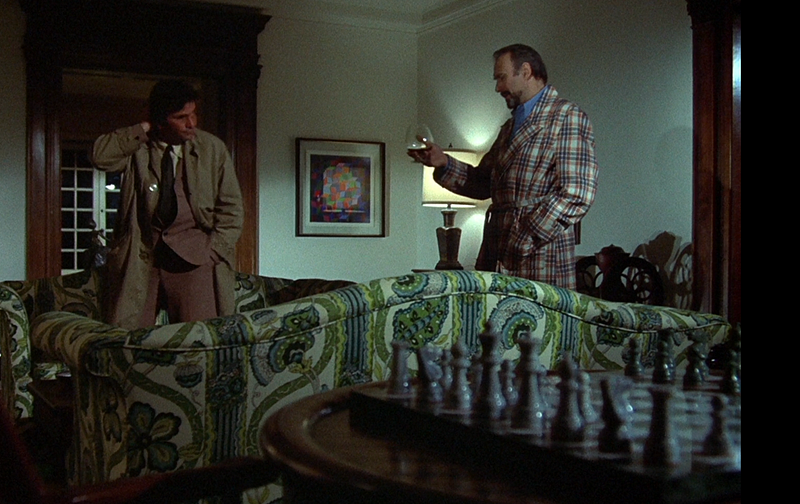
In my obsession I determine that Columbo is not the protagonist of Columbo. The murderer, who appears first and dominates the tale for sometimes up to half an hour before Columbo ever appears — they, the murderers, are the protagonists. They, unlike Columbo, have desires that embed them in the human world. They connive, they preen and sulk, they dream of changing their lives. They’re human, and might even be forgivable, if not so totally annoying. They possess visible family members, a visible home. Columbo has a car and a cigar. Sometimes a dog and sometimes a hard-boiled egg in his pocket.
Some will tell you that Columbo is a working-class underdog. That his quarry, the murderers, the “guest stars”, are always contemptibly privileged. That it is the satisfaction of seeing this bumbling man, who is sometimes mistaken for homeless, triumph over the arrogance and privilege of the famous and wealthy murderer, which drives the show. In this view Columbo is a machine for producing a ritual wish of compensation, of class revenge.
I suspect it may be more paradoxical. What if it’s the tension between this wish and its opposite which drives the show? The narrative architecture thrusts me into the position of the murderer, however contemptible they may be, however posturing, however cold. Watching, I’m driven slightly mad by the killer’s tiny errors, the clues they leave behind. When Columbo shambles so pleasingly into the frame, he has come to destroy a part of me. It is a part I wish destroyed, yet it is still a destruction.
This recipe is one that never completely settles down, despite the ritual familiarities. The dispersal of clues, rifts in the field. The furrowed brow, the homely banter, the crossing and windmilling of the arms, the doofus pantomimes with pencil and notebook. The savor of delay, then the closing in. When it comes, that instant of capture, the killer’s defeat and confession, it provides just a momentary thrill. Mostly, it’s a collapse, and totally enervating. The finish is always sad, and comes surprisingly fast, after so much stalling. No one is more disappointed than Columbo, unless it’s the murderer, or me.
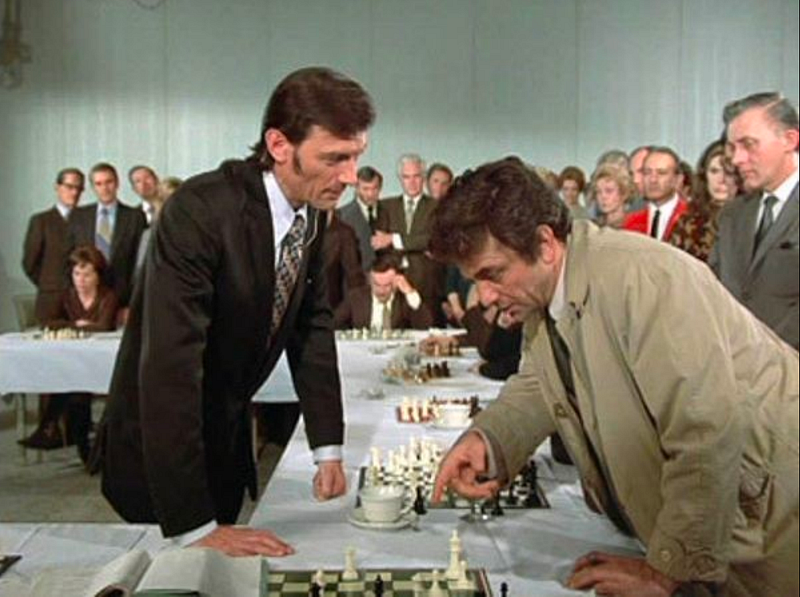
Here’s my half-assed generalization: the recipe of so much bad-faith television, Dallas, Mad Men, Succession, is to unveil a glamour and corruption to which we can feel superior. A splendor to properly loathe, one we yearn to see toppled and demolished. Yet succulently, please — let the camera linger. Columbo teases this nerve with a different formula. The pretentious overbearing murderers are round characters; Columbo’s flat. He’s a wish made from cigar smoke; a human Deputy Dawg, an effective Inspector Clouseau. Yet they never return, and he always does. We wallow here in a world supplied with innumerable shitty, charismatic, tasteless sociopaths. It could remind us of the “real” world, apart from the presence of this one unreal savior, a bore, who, while loveable, if we’re honest, we neither expect nor desire ever to meet.
But no, no, this isn’t right at all. I take it back. Columbo’s irascible, adorable. He’s everyone’s avuncular man-dog. Just like a dog you’d open the door and let him pass in and out forever, rolling your eyes with affectionate exasperation. He grumbles through the world animating all he touches, decanting the soul of each human who meets him on his level. He wakes them from their automated routines with his innocence and confusion. Asking: How does this machine work? On what, exactly, do you spend your hours? Really? People do that? Amazing. You people are amazing. The waiters and seamstresses and gas station attendants, the working stiffs, they recognize in him a kindred, and find themselves recognized in turn. Columbo’s an acting teacher who casts all passers-by in his Method improv workshop. By contrast, the privileged heirs and managerial bores and uptight poseurs whose world Columbo invades, those who resist him, and rush to provide an ashtray for his crumbling cigar, those who employ pre-Method elocution and stage postures, these are none other than the walking dead, the zombies. In their lifeless realm, one among them has attempted to self-animate, but by the worst possible maneuver: by taking a life. Columbo recognizes and pities this desire. He knows a kinder way to feel alive: just be.
I tell my friends that I have become obsessed with Columbo and they ask, “Where should I start?” and I’m struck mute with shame. At that instant I feel there are no good episodes, only flawed and embarrassing ones, bad ones; bad episodes which are all equally essential, because they form a pattern like the meaning of the night sky, which has no point of entry. You need, like me, always to have been watching Columbo, watching semi-consciously, a wondering child, then fifty years later to watch again, at first in a spirit of irony and nostalgic sentiment, but one which deepens into awed respect, then unfathomable obsession. A starting point? I can’t help you with that.
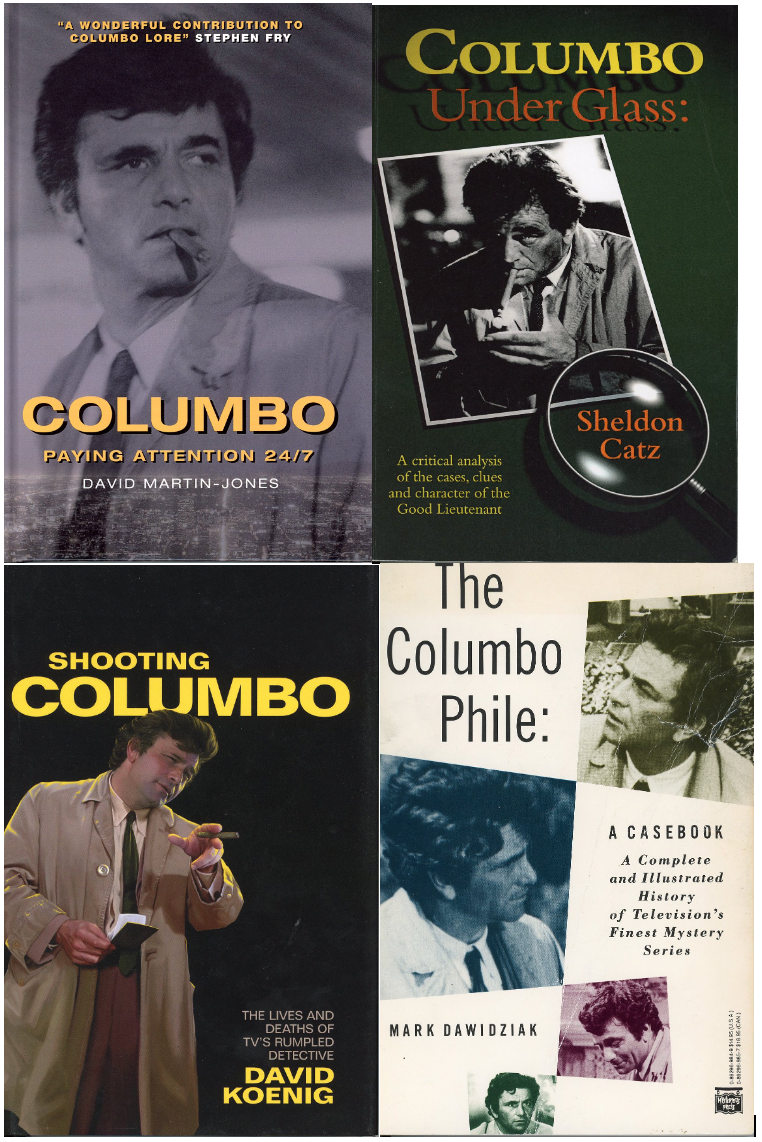
I tell my friends that I have become obsessed with Columbo and they say “So, are you going to write a book about Columbo?” This only deepens my shame. Driven to the search engine, I find that, yes, there are books about Columbo, many such — nine-hundred and ninety-nine, to be exact. I begin to purchase them, for dollar amounts often in the single digits. They arrive my house and I unwrap and read them. They are covered with fingerprints, these copies, frequently also with library stamps and pencil notations in the margins. Clues. Every one is worth reading, they overflow fantastically with data, names, origins, production histories, intricate tracings of patterns and inconsistencies, yet they are all unsatisfying; the books about Columbo are all flawed, because they are all written by persons, mostly men, like oneself. They all make reference to one another, these persons-mostly-men, these books — they form a constellation of argument about nothing, finally, more urgent than which, pray tell, which are the best episodes? Before reading their lists I had already become certain that there are no good episodes. Although, it can be admitted, there are lesser ones. These may be worth tabulating, in order that you can avoid them, if you have failed to avoid seeing Columbo altogether. In this one small sense, then, the efforts of the authors of the books about Columbo are not wasted.
But there are no good episodes because Columbo is unworthy of Columbo. The detective wanders through episode after episode in stoical certainty that he is to be disappointed — really, to be disappointed twice. First, he is to be disappointed in finding that the protagonist has murdered imperfectly, and second, that they have murdered at all. It is this fact of murder that has beckoned Columbo out of the mists, the wreaths of his own cigar smoke, and into existence in the first place. For Columbo is a ghost, one wandering in search of that perfect murder, or for the protagonist who chooses not to murder. He is searching for the room he never needs even inhabit with his fumes, because the protagonist, for once, thought better of it. They have decided against murdering, because Columbo’s influence has been felt in advance. For this once Columbo needs not be disappointed. For this once Columbo needs not pretend to exist.
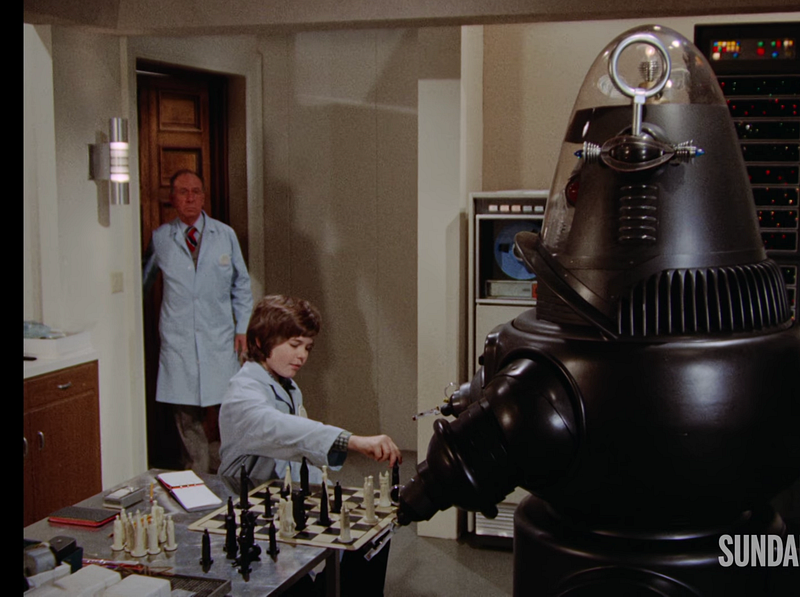
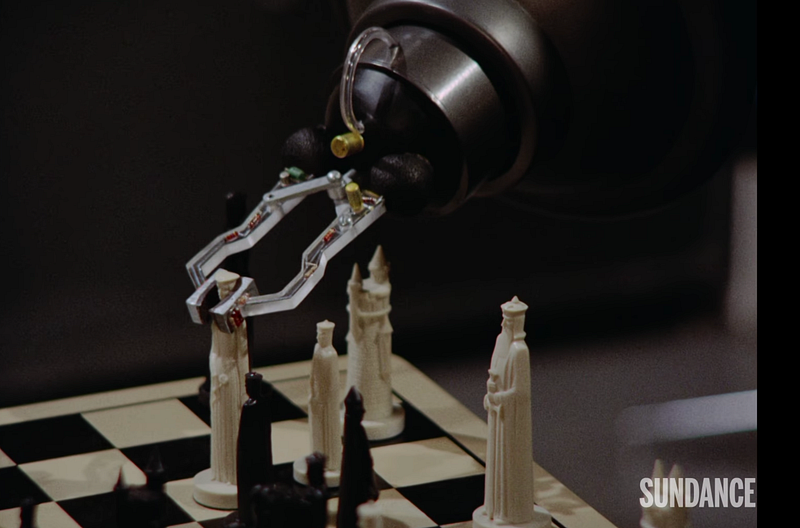
The best scenes in Columbo are the worst scenes in Columbo, and they are most specifically those designed to expand the show to fill a two-hour slot, the scenes that only exist to murder time. Columbo waiting, Columbo looking at art in a gallery, Columbo watching video monitors produce abstract patterns, Columbo showing his dog the sea, Columbo riffing, Columbo clowning, Columbo blundering into a mermaid’s lair. In my obsession I plan a slim, commanding monograph called Chess in Columbo, though I only get as far as four screenshots before I understand that I am killing what I adore.
In my obsession I am dreaming of the thousandth book about Columbo: Columbo as what happens if you let Kafka’s cockroach out of its bedchamber. Columbo as Bartelby the Scrivener: “I would prefer not to ask you just one more thing.” Columbo as J. Alfred Prufrock: “I shall grow old, I shall wear my trench coat sleeves rolled… do I dare to crack a hard-boiled egg on an important piece of evidence in a homicide investigation?” Columbo as Hank Quinlan, the corrupt Mexican police detective in Orson Welles’ Touch of Evil, with Marlene Dietrich playing piano in her bordello where he wanders in asking for chili, Dietrich saying “I didn’t recognize you, you should lay off those candy bars” and “Your future’s all used up”, then eulogizing him when he lays dead in the creek: “He was some kind of a man… what does it matter what you say about people?” Columbo as Ringo in the Beatles, always just a hint behind the beat. Billy Wilder’s Double Indemnity as the greatest Columbo episode (or the only one that’s any good at all): We begin inside the florid tale of the murderers, Fred MacMurray and Barbara Stanwyck; then the investigator appears in in the form of Edward G. Robinson, a distracted, garrulous, prosaic man with cigars but no matches to light them with; he grinds the suspects down with the doggedness of his investigation, until MacMurray confesses. Columbo as Donald Trump being taken for his first walk around the white house by Obama, needing to have all the systems, and the roles of all the office inhabitants, explained to him: “These people here, what do they do, exactly?” Columbo as Wire’s fly in the ointment from “I Am The Fly”: “Crawling, over your window/you think I’m confused/I’m waiting for the divergent wasp/to complete my current ruse.” Columbo as Beckett’s Krapp, in Krapp’s Last Case, obsessed with a tape recorder, one that has been used to fake the alibi in a murder. Columbo as my father, in his studio painting, stepping back from the canvas, then near again, scrubbing out a too-decisive line, scribbling a note in his notebook, pacing out his eternal just-one-more-thing.
No, no, I refuse to become the man who writes the thousandth book about Columbo. I will write only One Thousand Books About Columbo.