
One Thing That Can Complicate Elder Care
More is not always better
Often you’ll hear people explain that they wanted to have multiple kids (or even one kid) so there would be somebody to “look after me when I’m old.”
People who think this way might also think that having more kids or friends, and having them nearby, will always lead to an easier time of caregiving for both the caregivers and the person receiving care.
That may not always be true.
My nuclear family of two parents and multiple siblings has always been very close. Not only did we feel that we had (mostly) good relationships with one another, throughout the years we have chosen to stay geographically close to one another.
As a consequence, even after my father died, my mother could still depend upon her five children and multiple grandchildren to help her maintain her house, stave off loneliness, and take her to doctor appointments and keep an eye on her medications.
As Mom aged, she developed both macular degeneration (a mostly genetic condition that can leave people mostly blind and will affect larger shares of our population as everyone ages) and cognitive decline.
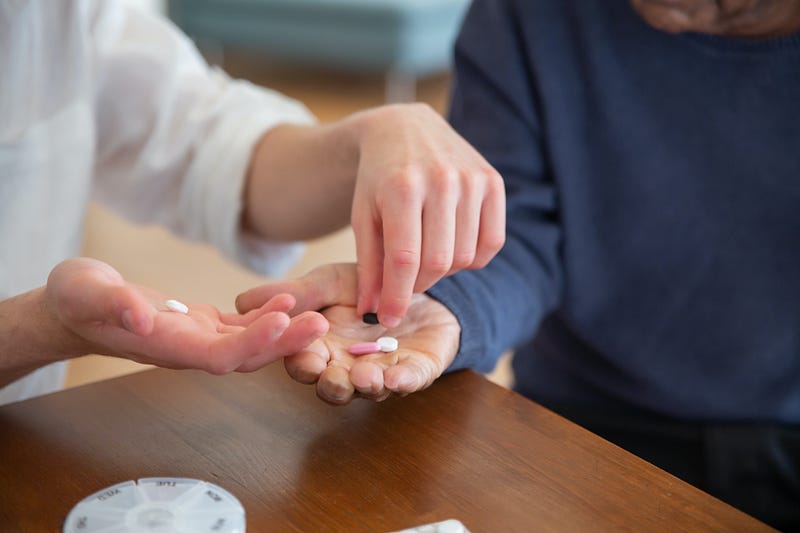
Fiercely independent, she nonetheless eventually became unable to see what pills she was taking, and started forgetting when to take them altogether. She also became increasingly confused about the time of day (meaning she didn’t know when to eat or what meal to even think about trying to prepare) and started to struggle with incontinence. The years her children spent increasing the time they spent with her, in her own home, until we were staying with her around the clock, were scary for her and logistically difficult for us.
Eventually my Mom had to move to a Memory Care facility, where she is now.
We all love our mom and we siblings (mostly) still love each other. But the experience of providing care, as a group, for our mother, very nearly wrecked several of our relationships (both with each other and with our spouses). For one sibling, the stress of caregiving as part of a team left them with such bad residual feelings that they have chosen not to visit Mom in her care facility as regularly as they might have if she’d gone to one sooner.
And nobody blames that sibling at all. Caregiving, alone OR in a group, is exhausting.
When medical personnel interacted with my mother and heard that she had five children all living within half an hour of her, they all said, “Aren’t you lucky to have all your kids close by?”
When we told other people about helping take care of our mom, our statements almost invariably ended with, “We’re so lucky to have so many of us to share the load.”
And often, that is true.
But this is true too: Caregiving in conjunction with several people, all who have their own ways of doing things and interacting with the world, as well as who have long-standing relationships and patterns with one another — not all of them healthy — can also be very, very challenging. Here’s are two of the major conflicts we developed when providing elder care as part of a team:
- Each of us had our own outside responsibilities
Although my siblings and I differ in age, we’re all firmly middle-aged. However, one of us still has kids in grade school; one of us doesn’t have kids at all. One works a demanding full-time plus job; the others work a variety of freelance and part-time jobs. Several of our spouses have very serious health conditions.
We all wanted to help our mom as much as possible, and we also wanted to keep the number of hours spent helping as fair and equitable as possible. We eventually developed a system of picking “shifts” when we would be at Mom’s home. Although we kept the number of shifts and hours equal, I think it would be inaccurate to say that all siblings were equally happy with the amount of time we were spending providing care at Mom’s house.
It was sometimes hard to be honest with one another about our preferences, because we didn’t want to let each other down.
2. One person had healthcare Power of Attorney, but everyone had their own opinion on Mom’s treatment
Mom is not really able to understand her healthcare options anymore, so one sibling was designated as her healthcare Power of Attorney (POA). However, periodically questions like what pills Mom is on and why, and what sorts of measures she wants taken to prolong her life, crop up.
These are all difficult questions, as are the questions that arise when considering palliative care. Is Mom experiencing anxiety? Would she want to be on medication that decreases her anxiety, but might increase her fall risk and lead to pain and suffering?
Everyone has a different opinion about these questions. Everyone has a different opinion about how these questions should be resolved. Should the person with POA decide them unilaterally? Does the family need to take a vote? Resolving these issues can take a large amount of time in addition to the time actually spent providing physical care to the person in need.
Although Mom is now in a care facility, my siblings and I have all made it a priority that one of us visit her there every day. Because Mom frequently sundowns (sundowning is broadly defined as “late-day confusion” and agitation) and can be rather trying to manage, we also field phone calls when she demands that staff call a family member for her to speak with.
Overall, however, we have been so thankful for the careful and compassionate care she is receiving. The one thing I have unequivocally learned throughout this experience is that Certified Nursing Assistants (CNAs) and other caregivers do not make enough money for what they do.
I’m still sad every day, though, that going to a Memory Care facility was necessary for my Mom.
But I’d also be lying if I said I didn’t think it was important for all of us siblings to get more time back in our schedules. We all let things slide in our work, in our homes, and even with our own families while we were busy trying to provide care for Mom in her home.
I’d also be lying if I said there weren’t times that I didn’t think (with a bit of jealousy) about a friend of mine, who had the sole responsibility for helping his mother. Because there was only one of him, toward the end he often had the daily responsibility of stopping at his Mom’s home to eat with her, and eventually stopping at her Memory Care facility to eat dinner with her. But he did not have to spend hours discussing the best possible options with multiple siblings. There were also times when he couldn’t make it, and that was that — he didn’t have to feel guilt about letting other people down also.
As the Baby Boomers age and more people face these questions and responsibilities, it will be important for everyone to think about how — and with whom — they will help to take care of older family members.


