avatarNancy R. Gough, PhD

Free AI web copilot to create summaries, insights and extended knowledge, download it at here

4451

Abstract

i,</i> and <i>B. bavariensis. </i>Thus, the ideal vaccine would protect against all of these forms and be appropriate for use all regions where ticks can transmit the bacteria.</p><p id="a054">The first attempt to create a vaccine used a protein called OspA from <i>B. burgdorferi. </i>The entire protein was used in the vaccine. The vaccine (<a href="https://www.drugbank.ca/drugs/DB00045">LYMErix</a>) was effective, passed through clinical trials, and reached the market. However, the <a href="https://doi.org/10.1017/s0950268806007096">manufacturer </a>withdrew it from the market because of concerns about adverse effects in some people.</p><p id="eec1">A different company has taken a different strategy. The new vaccine, VLA15, is still based on OspA. However, only a part of the protein is used. Additionally, the new vaccine includes fragments of OspA from 6 “serotypes,” which are forms of the bacteria that can trigger different immune responses. The vaccine contains fragments from <i>B. burgdorferi</i> (serotype 1), <i>B. afzelii</i> (serotype 2), <i>B. garinii</i> (serotypes 3, 5, and 6) and <i>B. bavariensis</i> (serotype 4).</p><figure id="f32c"><img src="https://cdn-images-1.readmedium.com/v2/resize:fit:800/1*Rn10VtAvjAopV7_IRShXCQ.jpeg"><figcaption>Diagram of the VLA vaccine strategy. The vaccine has 3 engineered proteins each contain 2 forms of OspA from different <i>Borrelia </i>bacterial serotypes and a lipid modification to enhance immunogenicity. The OspA proteins are shown as octagons and the antibodies induced by the vaccine as the Y-shapes. [Credit: Nancy R. Gough, Ph.D.<a href="http://www.bioserendipity.com"> BioSerendipity</a>, LLC]</figcaption></figure><p id="6370">To make the proteins for the vaccine. A fragment of a serotype-specific OspA protein was connected with an amino acid linker to second serotype-specific OspA. Lipids were then attached to boost the immune reaction.</p><p id="ebe5">Early results from the Phase II <a href="https://clinicaltrials.gov/ct2/show/NCT03769194">clinical trial </a>were reported by <a href="https://valneva.com/press-release/valneva-announces-positive-initial-results-for-phase-2-study-of-lyme-disease-vaccine-candidate/">Valneva. </a>In the group receiving the higher dose of the vaccine, which was given 3 times, ~95% developed antibodies to one of the serotypes and ~80% developed antibodies to another serotype. No serious adverse reactions were reported. Participants who had previously been exposed to Lyme-causing bacteria still developed antibodies to the OspA serotypes in the vaccine.</p><p id="7a05">With these encouraging results, <a href="https://investors.pfizer.com/investor-news/press-release-details/2020/Valneva-and-Pfizer-Announce-Collaboration-to-Co-Develop-and-Commercialize-Lyme-Disease-Vaccine-VLA15/default.aspx">Pfizer and Valneva</a> have entered into a collaboration to continue the next phases of clinical testing and development. In addition to continuing to monitor safety, next steps include testing if the antibodies induced by the vaccine trigger immune-mediated toxicity to the Lyme disease-causing bacteria. As the CEO of Valneva, Thomas Lingelbach, notes Pfizer has “outstanding development and commercial capabilities,” which will help VLA15 achieve the goal of protecting children and adults from Lyme disease.</p><p id="347e"><b>Sources</b></p><div id="56a1" class="link-block"> <a href="https://investors.pfizer.com/investor-news/press-release-details/2020/Valneva-and-Pfizer-Announce-Collaboration-to-Co-Develop-and-Commercialize-Lyme-Disease-Vaccine-VLA15/default.aspx"> <div> <div> <h2>Valneva and Pfizer Announce Collaboration to Co-Develop and Commercialize Lyme Disease Vaccine…</h2> <div><h3>Phase 2 vaccine candidate, VLA15, is being evaluated for adult and pediatric indications in North America and Europe…</h3></div> <div><p>investors.pfizer.com</p></div> </div> <div> <div style="background-image: url(https://miro.readmedium.com/v2/resize:fit:320/)"></div> </div> </div> </a> </div><div id="fd38" class="link-block"> <a href="https://valneva.com/press-release/valneva-announces-positive-initial-results-for-phase-2-study-of-lyme-disease-vaccine-candidate/"> <div> <div> <h2>Valneva Announces

Options

Positive Initial Results for Phase 2 Study of Lyme Disease Vaccine Candidate</h2> <div><h3>Phase 2 study VLA15-201 met its endpoints Compared to Phase 1, the higher doses used in this trial elicited higher…</h3></div> <div><p>valneva.com</p></div> </div> <div> <div style="background-image: url(https://miro.readmedium.com/v2/resize:fit:320/0*kTrnvYALU84BX-j_)"></div> </div> </div> </a> </div><div id="09ff" class="link-block"> <a href="https://journals.plos.org/plosone/article?id=10.1371/journal.pone.0113294"> <div> <div> <h2>Design and Development of a Novel Vaccine for Protection against Lyme Borreliosis</h2> <div><h3>There is currently no Lyme borreliosis vaccine available for humans, although it has been shown that the disease can be…</h3></div> <div><p>journals.plos.org</p></div> </div> <div> <div style="background-image: url(https://miro.readmedium.com/v2/resize:fit:320/0*XOHhf5UYeI8TbDBE)"></div> </div> </div> </a> </div><div id="3bac" class="link-block"> <a href="https://pubmed.ncbi.nlm.nih.gov/16893489/"> <div> <div> <h2>The Lyme vaccine: a cautionary tale - PubMed</h2> <div><h3>People living in endemic areas acquire Lyme disease from the bite of an infected tick. This infection, when diagnosed…</h3></div> <div><p>pubmed.ncbi.nlm.nih.gov</p></div> </div> <div> <div style="background-image: url(https://miro.readmedium.com/v2/resize:fit:320/0*Be9dZl512OH4t7xw)"></div> </div> </div> </a> </div><div id="953c" class="link-block"> <a href="https://www.ecdc.europa.eu/en/borreliosis/facts/factsheet"> <div> <div> <h2>Factsheet about Borreliosis</h2> <div><h3>Borreliosis, also known as Lyme disease, is caused by the bacterium Borrelia burgdorferi and is transmitted to humans…</h3></div> <div><p>www.ecdc.europa.eu</p></div> </div> <div> <div style="background-image: url(https://miro.readmedium.com/v2/resize:fit:320/0*n7SlLDOReI0JXRCZ)"></div> </div> </div> </a> </div><div id="c7fc" class="link-block"> <a href="https://www.cdc.gov/lyme/index.html"> <div> <div> <h2>Lyme disease home | CDC</h2> <div><h3>Lyme disease is the most common vector-borne disease in the United States. Lyme disease is caused by the bacterium…</h3></div> <div><p>www.cdc.gov</p></div> </div> <div> <div style="background-image: url(https://miro.readmedium.com/v2/resize:fit:320/0*pJAtzOjMa57cwjW5)"></div> </div> </div> </a> </div><p id="df0c"><b>Also of Interest</b></p><div id="d50e" class="link-block"> <a href="https://readmedium.com/making-the-blood-toxic-to-borrelia-64c5631459a9"> <div> <div> <h2>Making the Blood Toxic to Borrelia</h2> <div><h3>Antibody Prevents Lyme Disease by Killing Bacteria in Ticks and Blocking Infection by Tick Bite</h3></div> <div><p>medium.com</p></div> </div> <div> <div style="background-image: url(https://miro.readmedium.com/v2/resize:fit:320/1*fyDu5pcFOqL5YUfE-HfIrQ.jpeg)"></div> </div> </div> </a> </div><div id="1a47" class="link-block"> <a href="https://www.columbia-lyme.org/treatment"> <div> <div> <h2>Treatment</h2> <div><h3>Treatment options are many for Lyme disease. For New cases of Lyme disease: Individuals not yet treated with…</h3></div> <div><p>www.columbia-lyme.org</p></div> </div> <div> <div style="background-image: url(https://miro.readmedium.com/v2/resize:fit:320/0*OfcWmZBpubxMSqxT)"></div> </div> </div> </a> </div></article></body>

A dog, a man, and a woman walking in the woods [Credit: https://www.devostock.com/stock-photo/woman-and-man-walking-in-the-woods-with-dog-18949.html]

One Step Closer to a Lyme Disease Vaccine

Phase II trial results show VLA15, the Valneva Lyme disease vaccine, induces antibodies.

Like many people, I enjoy taking walks in the woods and playing with my dogs at the park. Where I live, every nature walk or even being in my own backyard carries the risk of getting Lyme disease. Consequently, I have been eagerly waiting for a Lyme vaccine. Valneva has a vaccine that is showing promise in Phase II clinical trials. The results are encouraging enough that Pfizer and Valneva have joined forces to bring this to Phase III testing and hopefully to the market.

Lyme Disease

Lyme disease is caused by several related species of bacteria (Borrelia burgdorferi, Borrelia afzelii, and Borrelia garinii). A person gets the bacterial infection from a bite from an infected tick. Sometimes, but not always, the tick bite will produce a telltale bull’s eye rash, which indicates the tick bite delivered the bacteria.

The ticks that transmit this disease are not very large and can transmit the bacteria at the adult and nymph stages of their life cycle. The adults are the size of a sesame seed and the immature nymphs are the size of a poppy seed. Nymphs, in particular, can be difficult to detect. The longer the tick stays attached, the greater the chance of transmitting the bacteria.
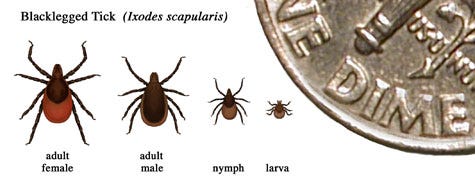
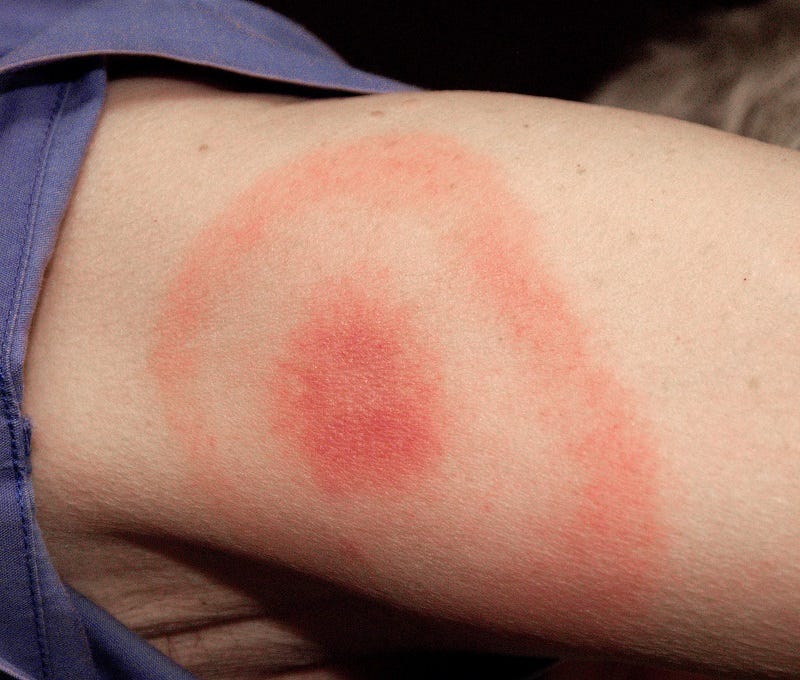
Left: Lyme disease-causing ticks and their sizes at different stages of life are shown next to a dime for comparison. Right: Bull’s eye rash from a Lyme disease-carrying tick. [Source: CDC, https://www.cdc.gov/lyme/transmission/index.htm; https://phil.cdc.gov/details.aspx?pid=9875]

Lyme disease can be effectively treated with antibiotics, which makes it seem as if a vaccine is unnecessary. Unfortunately, people often do not realize they have been infected. Antibiotics are most effective if taken early in the course of the infection.

Untreated Lyme disease can cause a range of symptoms from rash and severe headaches to arthritis, irregular heart beat, and neuropathy. Delayed treatment leads to a greater chance of a poor outcome with severe symptoms. Additionally, some people develop a neurological condition called “Post-Treatment Lyme Disease Syndrome,” which can last months even after the bacterial infection has been cleared with antibiotic therapy.

Because the disease-carrying ticks are common throughout North America and Europe and because of the potential for serious long-term symptoms, a vaccine would be beneficial. Indeed, an effective vaccine would be tremendously helpful for children and adults in regions where the disease-carrying ticks are common.

Indeed, the Centers for Disease Control in the US estimates ~300,000 people are infected annually and more than 350,000 cases of Lyme disease occur annually in Europe according to the World Health Organization and European Centre for Disease Prevention and Control.

Vaccine Progress

A challenge to creating an effective vaccine is that there are different species of the Borrelia bacteria that cause the disease in different regions. In North America, there is a single pathogenic species: B. burgdorferi. In Europe, 4 pathogenic species are common: B. burgdorferi, B. afzelii, B. garinii, and B. bavariensis. Thus, the ideal vaccine would protect against all of these forms and be appropriate for use all regions where ticks can transmit the bacteria.

The first attempt to create a vaccine used a protein called OspA from B. burgdorferi. The entire protein was used in the vaccine. The vaccine (LYMErix) was effective, passed through clinical trials, and reached the market. However, the manufacturer withdrew it from the market because of concerns about adverse effects in some people.

A different company has taken a different strategy. The new vaccine, VLA15, is still based on OspA. However, only a part of the protein is used. Additionally, the new vaccine includes fragments of OspA from 6 “serotypes,” which are forms of the bacteria that can trigger different immune responses. The vaccine contains fragments from B. burgdorferi (serotype 1), B. afzelii (serotype 2), B. garinii (serotypes 3, 5, and 6) and B. bavariensis (serotype 4).
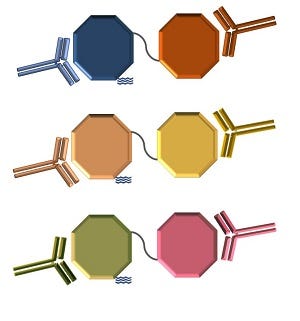
Diagram of the VLA vaccine strategy. The vaccine has 3 engineered proteins each contain 2 forms of OspA from different Borrelia bacterial serotypes and a lipid modification to enhance immunogenicity. The OspA proteins are shown as octagons and the antibodies induced by the vaccine as the Y-shapes. [Credit: Nancy R. Gough, Ph.D. BioSerendipity, LLC]

To make the proteins for the vaccine. A fragment of a serotype-specific OspA protein was connected with an amino acid linker to second serotype-specific OspA. Lipids were then attached to boost the immune reaction.

Early results from the Phase II clinical trial were reported by Valneva. In the group receiving the higher dose of the vaccine, which was given 3 times, ~95% developed antibodies to one of the serotypes and ~80% developed antibodies to another serotype. No serious adverse reactions were reported. Participants who had previously been exposed to Lyme-causing bacteria still developed antibodies to the OspA serotypes in the vaccine.

With these encouraging results, Pfizer and Valneva have entered into a collaboration to continue the next phases of clinical testing and development. In addition to continuing to monitor safety, next steps include testing if the antibodies induced by the vaccine trigger immune-mediated toxicity to the Lyme disease-causing bacteria. As the CEO of Valneva, Thomas Lingelbach, notes Pfizer has “outstanding development and commercial capabilities,” which will help VLA15 achieve the goal of protecting children and adults from Lyme disease.

Sources

Also of Interest

Health
Lyme Disease
Investing
Biotechnology
Science
Recommended from ReadMedium