
WOMEN WHO CHANGE THE WORLD
One Small Woman Makes One Huge Difference in Police Officer Training
A heroine and advocate for the mentally ill.

One woman.
In her home.
Changed our future and the future quality of law enforcement care.
She doesn’t take up a lot of space. Quite petite and very soft-spoken, her bright eyes shine with knowledge, love, and compassion. There truly is an unspoken language between people who have walked the journey with a loved one who suffers from a mental illness.
She has always fascinated me.
She was in her 60s when she single-handedly changed the trajectory of our NJ State Police training program.
One small woman who dreamed big.
She wanted to do better for her son and the population that also suffers from brain disorders. She would advocate for those with mental illnesses. Law enforcement was lacking skills, knowledge, and understanding. Her son fell victim to their treatment.
She stepped up to the plate and hit a home run.
We’ll call her Elaine. This works out well because that, indeed, is her name.
In May of 1990 a 20-year-old male was arrested and detained due to a false report, maybe a misinterpretation of events, which was reported and then recanted within minutes, to the local Police Department.
The young man had just recently been released from the hospital after experiencing his first onset of mental illness.
The police officers had little to no knowledge of mental illnesses nor the training to handle such situations.
The 20-year-old was not only detained, but continually accused of an action he had no awareness of, and subsequently suffered physical abuse in addition to emotional badgering. As he sunk into a psychotic state, he was isolated in the local hospital and strapped to a bed.
He was in a state of confusion and despair at that the thought that he had somehow committed a horrific crime.
His parents were excluded from the arrest process until the next day when they were able to witness the effects of the beatings and the abusive police treatment, including his blackened eye.
The charges were found to be bogus but the officers had supplied the young man’s name, address, and the charges, to the local newspaper. The family’s suffering escalated as their son required re-hospitalization due to his continued downward spiral in mental health. To add additional stress and grief, the family became the victims of anonymous threatening phone calls.
All of this occurred because the officers were not familiar with mental illness and were not trained to recognize the signs and symptoms nor how to treat the mentally ill.
Close to a decade after this incident, the painfully shy artist and mother, who ran a home-based graphic design business, answered a call from NAMI, the National Alliance on Mental Illness for speakers on mental health. Elaine was not comfortable with the thought of public speaking.
However, she was not willing to miss this opportunity to educate and advocate, either.
The memory of her son and his gut-wrenching experience was still painfully fresh after all those years.
She was given a packet but was dissatisfied with the content. Her research began.
“I decided there were three groups that could have the most impact if they understood the nature of mental illness and how to deal with a crisis. My target audiences would be law enforcement, clergy, and educators, in that order. In early June 1999, I sent out hundreds of letters to my county prosecutor, police departments, clergy, and school counselors.
There was not one response.
Eventually, a group of school counselors expressed interest but never followed through. That was it.” ~ Elaine
She spent the summer of 1999 reading police training manuals. She became the President of the County chapter of NAMI in hopes that the position and title would garner a better response to her pleas to speak to other organizations.
She could not find a willing audience.
She had a story to tell and no group willing to listen.
Her first opportunity finally arose which involved speaking to the staff of a local sheltered workshop. They were familiar with developmental disabilities but were interested in learning how to handle people with mental illnesses.
The door had cracked open and in she went, eager to share her personal experience, research, and knowledge. Using her home graphic design studio equipment, she crafted handouts defining different brain disorders and associated major mental illnesses.
She was invited back.
Interest had ignited.
One participant in the workshop expressed that her husband, a police officer, would be very interested in this presentation.
And so, Elaine made more phone calls to arrange presentations and continued to be ignored or dismissed.
Her position, title, and door-banging to spread the word regarding the proper treatment of people with mental illnesses finally landed her an invitation to a local radio program. The County Prosecutor hosted his own show on this same college broadcast and heard her speak during October’s Mental Illness Awareness Week.
His secretary called Elaine directly and said the Prosecutor would be interested in meeting with her.
Her. The shy woman and mother who had pushed aside her self-doubt in the interest of serving, ultimately an entire population of those who were mistreated, to discuss biological brain disorders.
She told me,
“From that moment on, it was as if a red carpet rolled out before me. I prepared for the meeting and I asked him the question: How much training in mental illness do police officers in our county get?”
His answer: “None. They need it. How can we get it?”
The long meeting concluded with an agreement to host a half-day “Train the Trainers” which included lunch. When in doubt, attract people with food.
The prosecutor asked Elaine to design a handout of “Do’s and Don’ts” to give to the officers. Her first handout was on 5.5 x 8.5 paper, was filled to the brim, and promptly rejected.
A wallet-sized version was requested.
She would have to pare it down with the ‘at a glance’ key points for those on duty to refer to in a crisis immediately.
And, so she did.
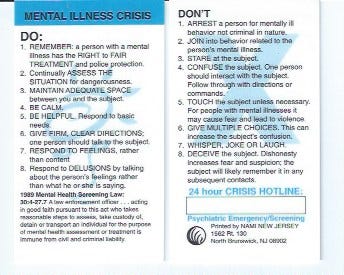
The wallet card was born, right out of her home studio, and training sessions commenced.
When the Executive Director of NAMI NJ saw the card, she ordered 150,000 prints and distributed them to police departments throughout the state.
What started as a grassroots local issue, spread to the County level and right into full saturation of the entire State of New Jersey.
One woman.
In her home.
Changed our future and the future quality of law enforcement care.
All officers were required to carry this card on them.
On one side, was the significant part of the NJ Psychiatric Emergency Screening Law:
“A law enforcement officer . . . acting in good faith pursuant to the act who takes reasonable steps to assess, take custody of, detain or transport an individual for the purpose of mental health assessment or treatment is immune from civil and criminal liability.”
By training the officers to recognize a person in mental crisis they were encouraged to take people to their local screening center rather than jail.
In early 2000, the wallet cards were distributed to the cadets in the NJ State Trooper Police Academy as the new policy in training. The cards became the model for various versions distributed nationwide.
One woman.
In her home.
Changed our future and the future quality of law enforcement care.
“I ran into the retired Director of the Academy just a couple of years ago and he showed me that he was still carrying the card.” ~ Elaine
Her dream took on its own life force and Elaine was appointed, throughout several years, to various related County and State level Boards.
In 2005 she was invited to the Council on State Governments Justice Center in Washington, D.C. to participate in the creation of a booklet called, Improving Responses to People with Mental Illnesses: The Essential Elements of a specialized Law Enforcement-Based Program.
The booklet was published in 2008 and provided nationwide guidelines for law enforcement dealing with mental illness crises.
Elaine was the keynote speaker at a County gathering of about 500 criminal justice, mental health, and social services professionals and held a workshop at a NAMI Convention in Washington, D.C.
By 2006 Elaine had taught more than 5000 criminal justice personnel, including dispatchers, law enforcement officers, prosecutors, judges, corrections personnel, probation officers, and domestic violence personnel about mental illness and how to deal with crises.
In 2006 her hearing was failing. It was then, at 66 years of age, that she retired from the circuit.
One woman.
In her home.
Changed our future and the future quality of law enforcement care.
Her love and devotion changed our future and the quality of law enforcement care for all our loved ones and the community of mental illness sufferers.
I am proud to know her and call her my friend.
Be an Elaine.
Make a difference.
No matter that she was one small woman; she made big changes.
Thank you, Elaine.
Ready to join Medium and read endlessly?

Stop by: Substack | Kindle Vella Nonfiction | Kindle Vella Fiction