
One Small Stroke of Paint Can Make a Painting Complete!
Composition and Design concern all artists, but strokes of paint are what we love.
I have written a lot about how an artist works and what works to help us create.
I don’t know who on this Medium platform is interested in my writing about the process of doing a painting. But, I am going to try one for an experiment!
Here is a little bit about painting.
I work in oil, acrylic, or pastel as my medium. If you don’t know it, we call the type of paint we use the “medium!” That word has several other meanings in our work. So don’t get confused, okay?
For instance, if you work in oil, there is a “medium” that can facilitate the use of the oil paint in different ways. One of those speeds up the drying time, and another extends it. There are other different types of bottles of medium to use for various help in painting. You will need to read the different bottles or online help for those.
Paintings can be representational, impressionistic, expressionistic, or abstract … and called traditional or contemporary. There are other “titles,” but the above are the most known. There may be a different name for the type of art you like or that you create. I try not to get too caught up in “being” one or the other of any of these.
I paint what I like and never worry too much about what to call it. I would probably be called traditional with a leaning toward impressionistic. I call myself a “colorist!” Think about it!
If you need more on those “titles,” I would suggest putting in a search for any you need more information about. But let’s go a little further into the actual process of painting.
How to start a painting
If you are an artist, you may have your own method of beginning a painting. It is good to have a sketchbook and do a quick sketch or even write the feelings or objects you want to paint. It helps flesh out the “intent” of what you want to try.
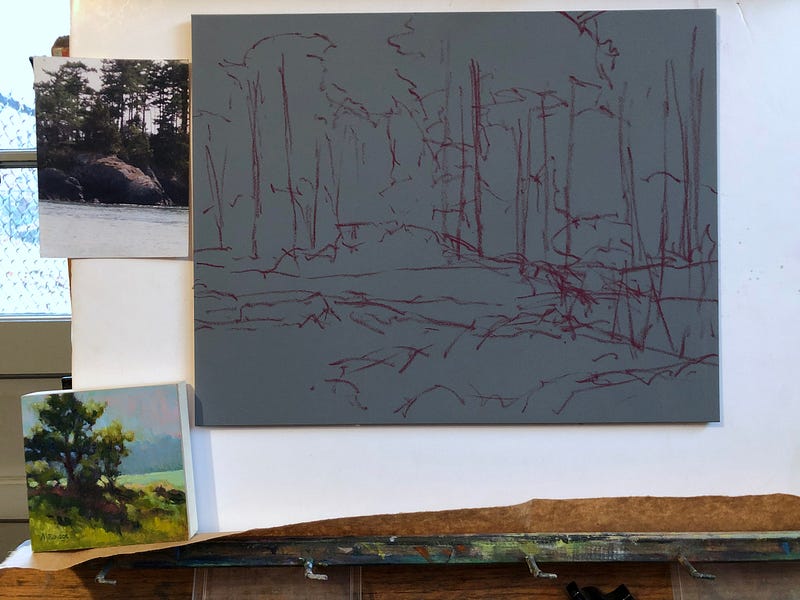
I typically start with a surface and a pencil to create a map of what I want to paint. It may be intricate, or it could be only “tick marks” to show me where specific points of interest are located … as in the top of a tree, or where the river may flow … or some particular item that could be the focus of the piece.
I try to go with my instinct on this. I don’t want an intricate drawing as I like for the painting to have a way to speak to me about what it wants and what will work at any given time in the process. I know … talk to me? Yes, they do that quite often.
The photo above shows just one of the methods I use. I have created a little more on this one for the drawing than I usually do. I felt I needed to do so to have a starting point. At least at first, the idea was about the negative spaces between the trees.
One big thing I hope not to do is copy a photograph. If I am painting on location, I also do not paint it exactly as seen. I am the artist! To make it better, I get to move a tree or bush or add an element of my own from outside the scene.
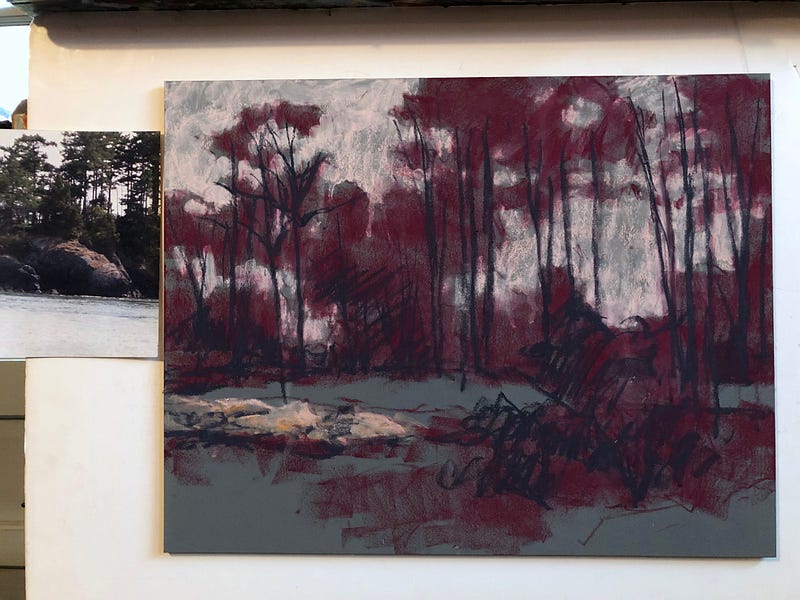
Creating a feeling instead of a copy.
The photo to the left gives me a feeling about the scene. It is related to the spacing of the sky between the trees. I talk quite a bit about “negative spaces” being almost more important than the “positive” objects in the painting. I am also changing the foreground, which is a boring water mass along the land’s edge.
I decided to add some rocks and foreground masses that could eventually be small, low-growing brush and grasses. That is what being an artist is about. How this scene evolves as I put paint on the surface.
I call using pastels painting!
You just read that I am working on this one using “pastels.” I have people ask me, “Are you painting today or working with pastels?” Oh My! Don’t get me started … but I consider working in pastel “painting.” It just happens to be a dry medium!
Now back to what I am doing on the painting.
At the point you see above, I can go many different ways on this painting. I can use representational colors or opt to be “expressionistic” in my color choices. That is more about “feeling” instead of copying!
Below is the addition of grasses and water that are not in the photograph. They come from my memory of painting outdoors from life.
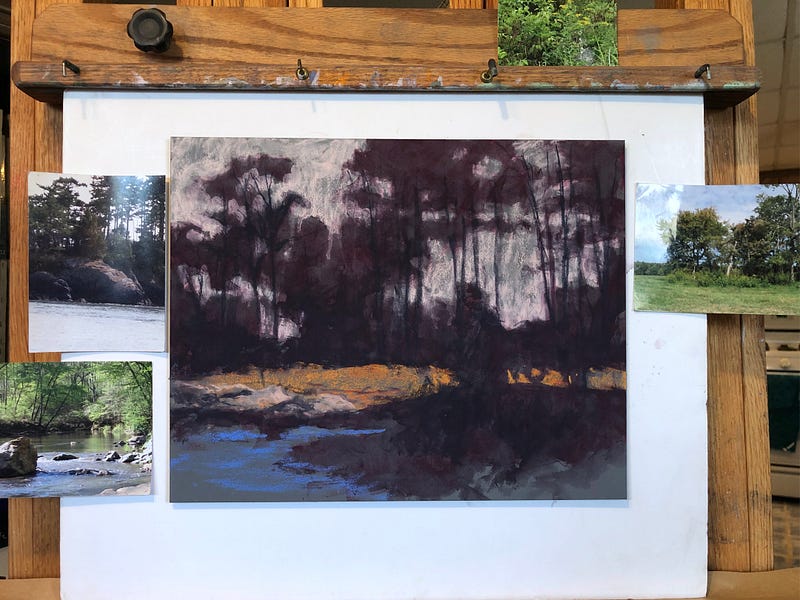
Working on the right side of the brain!
Many people talk about the two sides of the brain… left and right! The right side of the brain is considered to be the creative side. The left side is the logical side and the one we usually use to deal with most things in our lives.
We like for artists to have a book in their library: “Drawing on the Right Side of the Brain” by Betty Edwards. If you are not familiar with this book, I highly recommend it.
The Official Website of Betty Edwards
So at this point, I am allowing myself to work from the creative side of my brain. I might put something into the painting and then brush it out when I do this. It gets to be a little experimental. It is also loads of fun to do this. Hey … I am an artist, and I can do it any way I want to!
I’m not going to give a complete painting lesson here. I will let some of the words and thoughts give you ideas. I will let the photos speak to you also.
Here is where I have stopped the above in-progress painting. I did change the landscape some. Can you tell what those changes are?
It may get more done to it, but I like a space of time when it is nearing the “stop and don’t do anything else” yet idea!
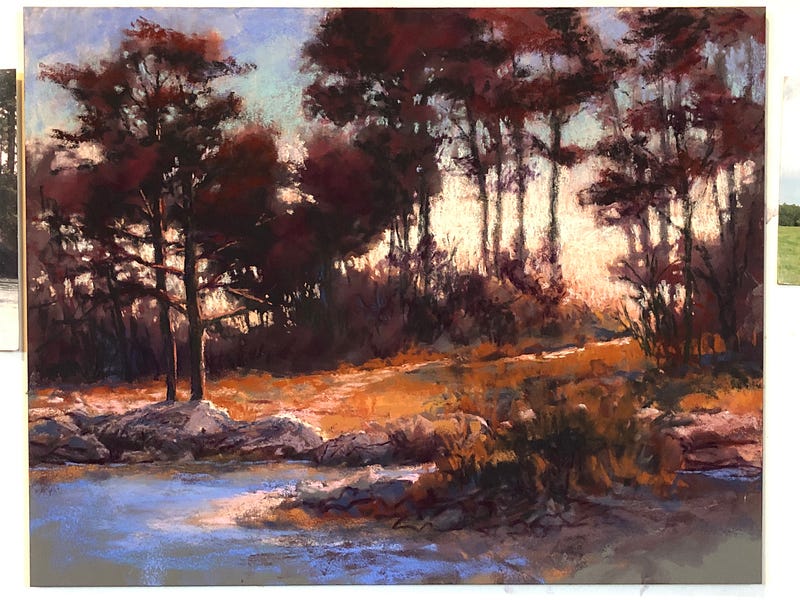
What can you learn from the above?
Play is a big part of doing a painting. Feelings have more to do with what makes it to the finish line.
There should be a willingness to try something and if it does not work, try something different!
My favorite thought is about it “being a journey, not a destination.”
And, I don’t call it a painting until it becomes one. It is just a study!