
One pomegranate to bring them all…
… and in diversity bind them
Once upon a time, the essence of every plant in the world thrummed in a pomegranate twig.
Ancient traditions have it that long ago, in the lands that later became Persia, there lived a prophet who sang to mortals how to tell apart order from confusion, good from evil.
He sang to the sacred fires — and as time went by, fire became the most important symbol identifying his followers.
He sang to the waters, honouring their life-giving powers in many rituals aimed to vivify and purify them.
This legendary prophet was Zarathustra, and the only reason I’ve brought him up (along with the religion he is credited to have founded, Zoroastrianism) is the pomegranate.
You see, I’ve had pomegranates on my mind for a while.
Pomegranates, also known as Punica granatum: virtually the only species in her genus and, until recent taxonomic rearrangements, the only one in her family as well.
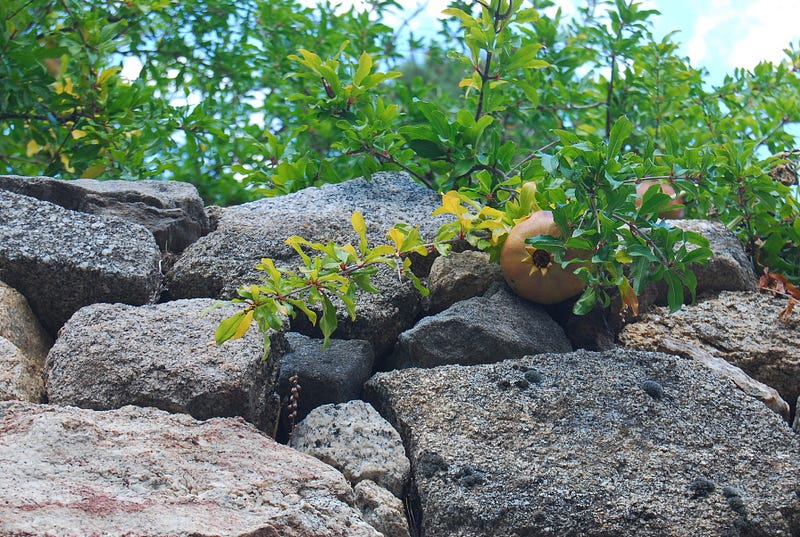
Punica granatum, whose fruit has seen a surge of popularity in recent years, lauded as superfruit, superantioxidant, superhealthy, supereverything.
My affair with pomegranates goes way back, although for the longest time it was rather, ehm, tepid.
I grew up with a stumpy pomegranate tree in the backyard, next to the chicken coop. However, (and as I didn’t particularly like eating pomegranates) I never took much notice of her. She was simply there, like a comfortable piece of furniture so humble and unassuming that you constantly overlook her…
… until I began paying attention to her stories.
And the more I peeled back the layers, the more I found them fascinating, full of contradictory meanings in history and myth — and yet, like the girdle of a taijitu symbol, her rind was capable of embracing opposites and merging them into a whole.
1. Haoma, milk and pomegranate
In 1941, the British anthropologist E. S. Drower visited a Parsi (ie Zoroastrian) fire temple in Mumbai, India, where several priests enacted some of the most important ceremonies for her.
One of them, called yasna, harks all the way back to Zarathustra’s songs, which were written down and compiled after centuries of oral tradition. Structured into several ritual sequences, the ceremony’s ultimate objective is keeping Creation together and in working order. The central pillar of the ritual is a plant with mythical reminiscences: haoma, closely linked to the controversial soma of Vedic scriptures.
In 1941, Mumbai’s parsis imported their haoma from Iran; the plant has long been identified with several Ephedra species, most of all E. major subsp. procera.
What I found most intriguing about it though was that, during the ceremonial preparation of haoma called āb-zōhr or “offering to the Waters”, the third main ingredient after haoma and milk is pomegranate. Together, haoma and pomegranate are offered to the waters in representation of the whole plant kingdom (whereas milk would stand in for the animal kingdom).
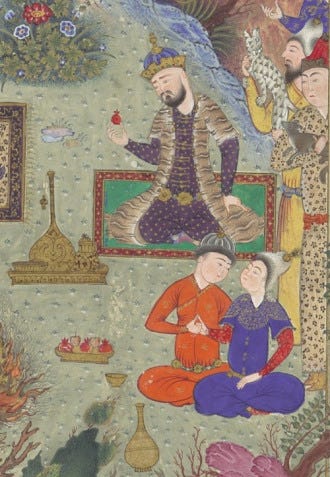
In the ritual witnessed by Drower, a pomegranate twig (urvaram) — previously cut from a tree that grew in the temple garden next to a palm tree — was crushed alongside the other ingredients in a mortar. Other sources mention pomegranate leaves, but be as it may, Punica granatum is so important in the ceremony that, according to Drower, it “must be found in every fire temple” (together with a date palm, also used in ritual).
Other Zoroastrian ceremonies foresee the use of pomegranate seeds, or even whole pomegranates (Panj Tai; āfrīnagān); the fruit is also connected to marriage rituals, a pairing frequently found in other countries as well. In Zoroastrian tradition pomegranate is associated with eternity and cherished as the most valuable of all the “blessed fruits”.
Indeed, valuable enough to hold within her the very essence of what it means to be a plant; valuable enough to become a ritual offering capable of purifying the waters that sustain all life on Earth.
2. Pomegranate blood, or How to encompass opposites
Like Zoroastrian magoi, the pomegranate dispersed out of her Iranian cradle of origin in all directions and was welcomed with great interest everywhere she went. For now though we’ll skip her wanderings around China or Mesopotamia, focusing instead on her adventures further west: in ancient Greece.
Unlike what happens with other fruit trees, multiplying pomegranate trees isn’t hard: a twig simply stuck in the ground usually fares pretty well. Besides, Punica granatum happened to be perfectly suited to the Mediterranean climate, so she soon found herself joining the agricultural systems of Mediterranean peoples — and their symbolic ones, too.
Now, imagine autumn has arrived. Days are shorter, grapes and pomegranates quicken and ripen, the time of sowing draws close. The Greek world is getting ready to celebrate the great festival of women in honour of Demeter and Persephone (often called Kore): the Thesmophoria.
For three days, the married women of city-estates such as Athens left their homes and camped on their own, celebrating rites about which we actually know very little, but that would reflect the myth of the Abduction of Persephone.
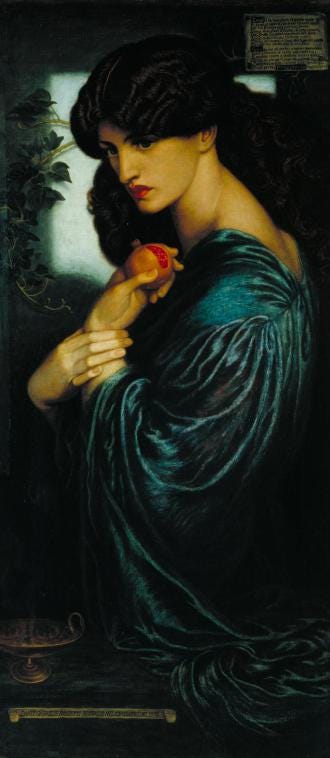
In case this doesn’t ring a bell, here’s a quick summary: Demeter — goddess of grains and the harvest, among other things — had a daughter, Persephone, who was kidnapped by the underworld god Hades while she was flower-picking in a field (and some authors mention it was the narcissus…). Demeter went into deep depression and set off in search of her daughter, causing a humongous agricultural crisis. Fearing for humankind, the gods finally managed to convince Hades to let Persephone rejoin her mother, but before she left, he gave her something to eat… something that didn’t quite prevent her from returning to her mother, but that would bind her to the underworld, where she’d have to descend every year to spend a few months with Hades. That something, as myth would have it, was a pomegranate.
Besides making men very nervous (they had no idea of what was going on in women’s tents and, as it often happens, they imagined the worst), the Thesmophoria involved a series of rituals related to fertility and the harvest. We know there were pigs involved (spoiler alert: they ended badly), and some sort of special bread. It was also mentioned that women were forbidden to eat pomegranate seeds that had fallen to the ground, something that could be interpreted as those seeds being marked off as food for the dead.
(Not a bad diet, if current studies are right about pomegranate’s antioxidant properties. If pomegranate wrinkle creams work, those dead Greeks must’ve had baby-soft skin and great health.)
In the Greek pantheon pomegranates nearly always appear in the hands of goddesses, and they are connected with spheres that one might, at first glance, describe as antithetical: fertility, life, blood, death.
Pomegranate is, for example, one of Hera’s main attributes in several Hellenistic temples; one of the most famous, the Heraion at Samos, has yielded finds of pinecones and pomegranates (both real ones and clay or even ivory models), connected with fertility.
The wooden statue of Athena Niké venerated in the Acropolis of Athens also depicted the goddess of victory holding a pomegranate (as well as a helmet, a much more predictable attribute for a warrior goddess. I for one was rather surprised at finding our pomegranate here, as in the 6thcent BCE pomegranates didn’t yet explode, nor were they part of the weapon arsenal). Aphrodite, as could be expected, is also linked with the pomegranate.
The fruit has retained her connection with fertility until current times, and thus pomegranates are considered an appropriate gift for newly wedded couples; just as elsewhere a dish with rice and wheat is smashed before the bride and the groom as a wish for abundance and happiness, in Greece a pomegranate is smashed in front of the household door. ’Tis also said that in Epidaurus, farmers would break open a pomegranate and mix the seeds with wheat grains about to be sown, to ensure a bountiful harvest.
Fertility. Fecundity. Both in the plant world and in the human one.
On the other hand though, myths speak of pomegranates as being born of spilt blood. Sometimes it’s Dionysus’, torn apart by titans; other times it’s blood of the hermaphroditic monster Agdistis castrated by the gods, and yet other times that of Side, a girl whose life (as could be expected in a Greek myth) ends very badly.
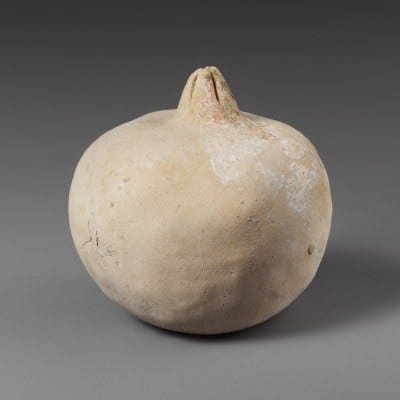
Pomegranates are also found in funerary contexts, eg. in statues of girls holding a fruit in their hands.
Death, violence, underworld.
Pomegranate holds both sides of the coin, the entire cycle of life: she descends into the underworld with Persephone and the wheat grains sown during October/November; and she climbs back into the light in spring along with the wheat spikes, first unfurling the fiery red of her flowers then swelling and ripening — only to fall once again, come autumn, into the lap of the goddesses.
She closes the circle that encompasses everything, and then begins anew.
3. The bittersweet republic of the imperial pomegranate
They weren’t thinking about mass tourism when they christened her, yet the Spanish city of Granada (“pomegranate”) bears a name that perfectly encapsulates how a visitor might feel on a weekend: like a ripe pomegranate grain, with no breathing room whatsoever while trying to walk along the city streets, squashed against thousands of other human grains.
The Arabic word for pomegranate doesn’t resemble the Spanish one: rummān (root r-m-n, that crops up in Hebrew rimmōn, as well as in other Semitic languages such as Akkadian or Assyrian). The Arabic city wasn’t called Rummān or anything like it, but غرﻧﺎﻃﺔ Garnāṭa instead — and although the pomegranate became the city’s emblem, their respective names apparently do not directly derive from one another (if etymology is your cup of tea, I explain a bit more about this in the Bibliography).
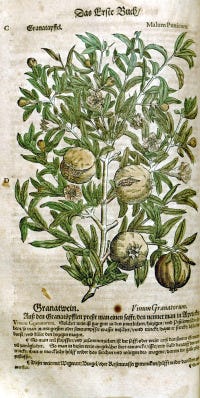
By the time Granada fell into the hands of the Catholic Kings in 1492 and the fruit formally became the city’s symbol, pomegranates had been happily living in the peninsula for many, many centuries: ’tis believed she arrived to the western Mediterranean with the Phoenicians during the 1stmillenium BCE.
Incidentally, the Phoenicians also have something to do with the pomegranate’s scientific name: Punica is a reference to the Latin name of the fruit, malum punicum or “Punic apple”, highlighting the fruit’s link to Carthage and the Phoenician civilisation.
Be as it may, in Iberia pomegranates acquired symbolic meanings that were slightly different from those attached to the fruit elsewhere. Yes, there is a shadow of the common themes ‘fertility, blood, resurrection’ that crop up in most pomegranate-savvy cultures, and Christian symbolism is present as well, of course. Yet these associations aren’t the most relevant ones.
According to a 17th century Spanish dictionary, pomegranates are “a well-known fruit” full of grains. A few lines later we are introduced to her first symbolic meaning: a republic and its happy inhabitants — and yet, right after that the author mentions that “She is adorned with a crown, which means dominion and empire”.
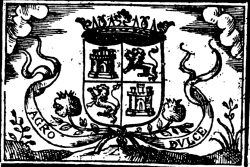
One would think that republic and empire are hard to reconcile — and yet they peacefully coexist within a pomegranate, the fruit that can embrace opposites.
But there’s another symbolic occurrence that’s relevant in Iberia: the pomegranate was part of the royal badge of Henry IV, along with the motto “Agro dulce”, meaning bittersweet.
Because a king should exercise both bitter justice and sweet mercy, which should “temper one another”.
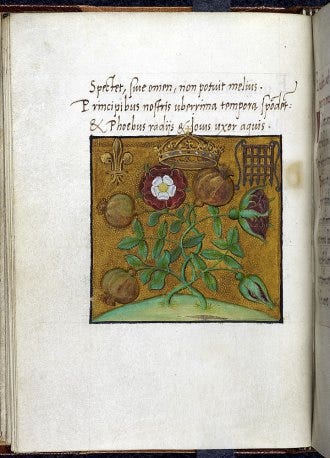
After Henry IV, pomegranates were adopted by his sister Isabella of Castile and her spouse Ferdinand of Aragon until they became something of a family symbol, associated with the House of Trastámara.
When Isabella’s daughter Catherine married king Henry VIII, she brought pomegranates to England in her badge, where they joined the Tudor rose; these fruits also graced the badge of Catherine’s daughter, Mary Tudor. And although current heraldic interpretations see them as a “symbol of fertility and prosperity”, I find their original meaning much more accurate, a sad reflection of what befell the women bearing pomegranates on their badge in England…
Bitter & Sweet indeed.
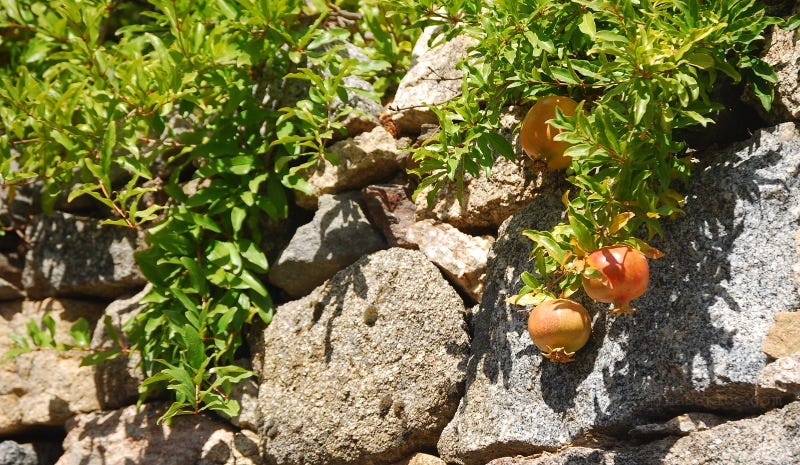
Legend has it that, in a garden outside of space and time, there grows (or grew, or shall grow…) a pomegranate tree.
That garden is known as Paradise, and rumours place it both at the beginning and at the end of myths. Some biblical interpretations, for example, have pomegranate as the forbidden fruit in the Book of Genesis that got us kicked out of Eden. The Qur’an, on the other hand, places pomegranates among the plants growing in the garden that welcomes the faithful after death.
Beginnings, & endings — and everything in between.
To me, pomegranates have become the perfect metaphor for diversity, and pomegranate trees an emblem of everything that makes diversity even possible.
Every culture, every religion that’s ever known this plant has embraced and invested her with symbolic meanings: she belongs to everyone, thus she belongs to no one.
Nobody can claim exclusive ownership of pomegranates, and the paradise within its leathery rind welcomes everyone.
There are only two conditions: accepting the paradoxes it contains, and learning to share a space with all those other pomegranate grains, different from you — yet just like you. Well managed diversity is the key.
So here’s my wish for us this coming year: that we try to imagine unity and wholeness… like a pomegranate would.


Need the story’s References & Resources? Being rather long and detailed, I’ve tucked them away but can be accessed here.
Illustrations
The image of folio 22v of the Shāhnāmeh of Shah Tahmasp (Tabriz, 1525) comes from the MET Museum. Go check it out because the full illustration is way bigger…
Painting of Persephone/Proserpina by Dante Gabriel Rossetti, 1874, comes from the Tate Gallery. Another version may be seen here.
Image of the Greek terracotta pomegranate comes, once again, from the MET collections.
Matthioli’s print of a pomegranate in his New Kreüterbuch (edition of 1563) is digitised and freely available via the Biodiversity Library.
Henry IV’s badge appears represented as pictured in the article in Juan de Horozco y Covarrubias’s book Emblemas morales (digitised and freely available on Google Books).
Thomas More’s illustrated poem featuring a pomegranate and a rose comes from the British Library’s Collections.
All other photos are by Yours Truly; please send me a line if you wanna use them!
Originally published at naturemeetsculturestories.wordpress.com on December 27, 2017.
Have any thoughts/questions about it? Awesome. Do let me know in the comments : )