
One Of The Oldest City Wants To Talk To You !!
Historically Relevance
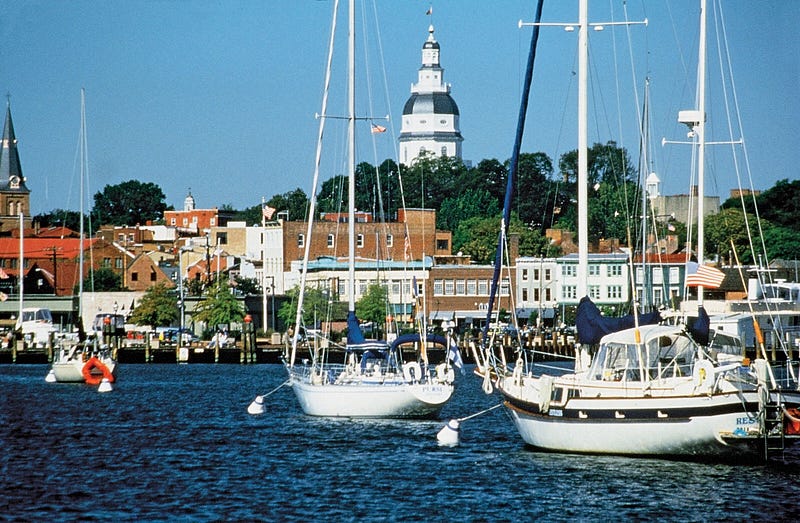
It was my pleasure trip to Fairfax Virginia a few days before. Fairfax is the border county of Maryland which is an hour's drive.
Yes I am talking about Annapolis which is the capital of Maryland.
Today, Annapolis has more of these original 18th-century structures standing than any other city in the United States.
Sir Francis designed a city worthy of a Queen. Instead of using a customary grid, he constructed a baroque plan similar to the magnificent capitals of Europe. He drew circles with radiating streets to create focal points and give importance to certain structures.
Annapolis is one of the oldest cities in the United States and served as the nation’s capital before it was moved to the District of Columbia, and as a result, it is brimming with historically significant buildings and landmarks. Annapolis was one of the first cities to be designated a National Historic Landmark District, an area that includes top historic attractions like the William Paca House, St. Anne’s Church, and the Maryland State House
Located on Chesapeake Bay, Annapolis is a picturesque community with lovely historic buildings and scenic views out over the ocean. As the state capital, Annapolis is also home to some of the best museums and historic sites in Maryland.
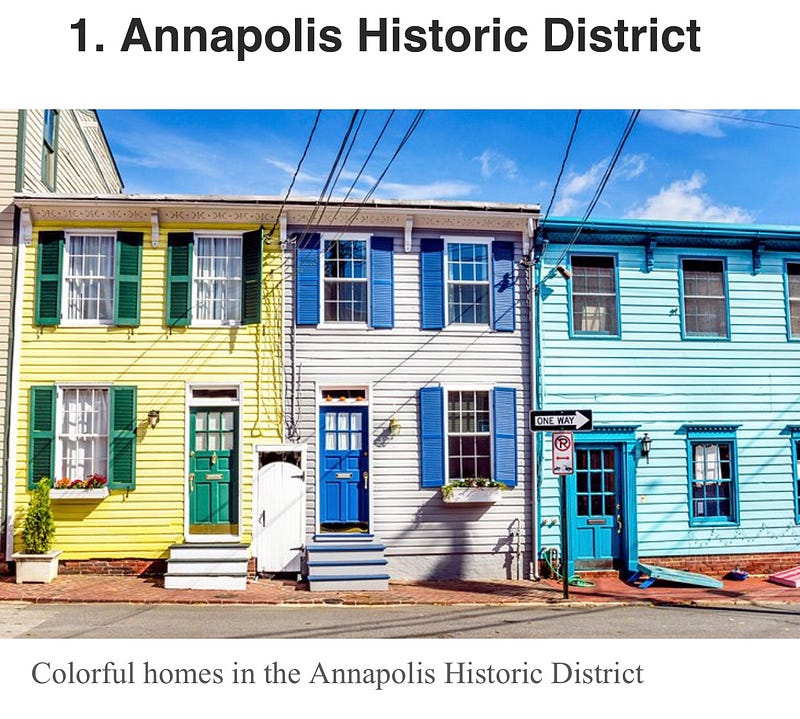
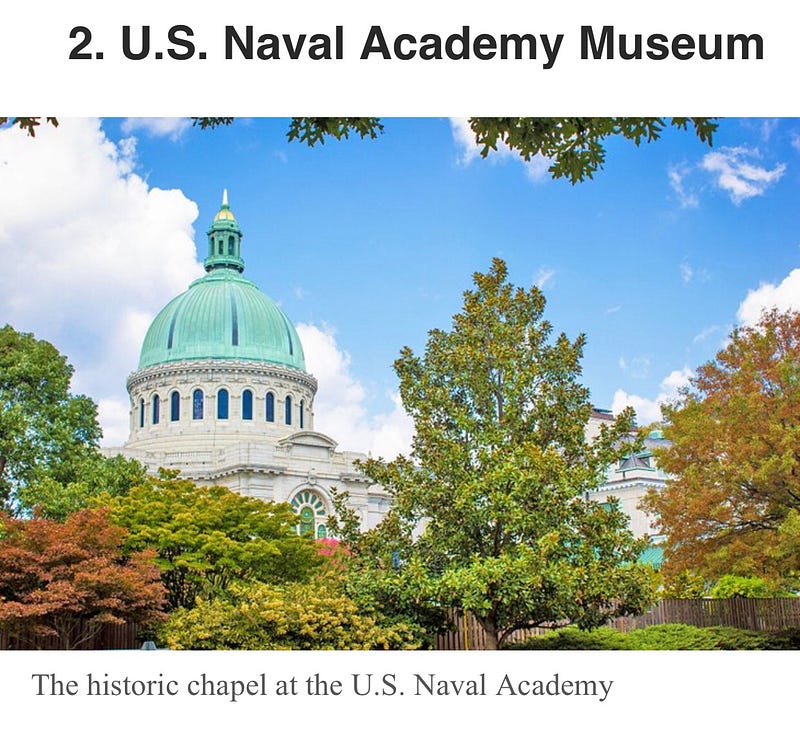
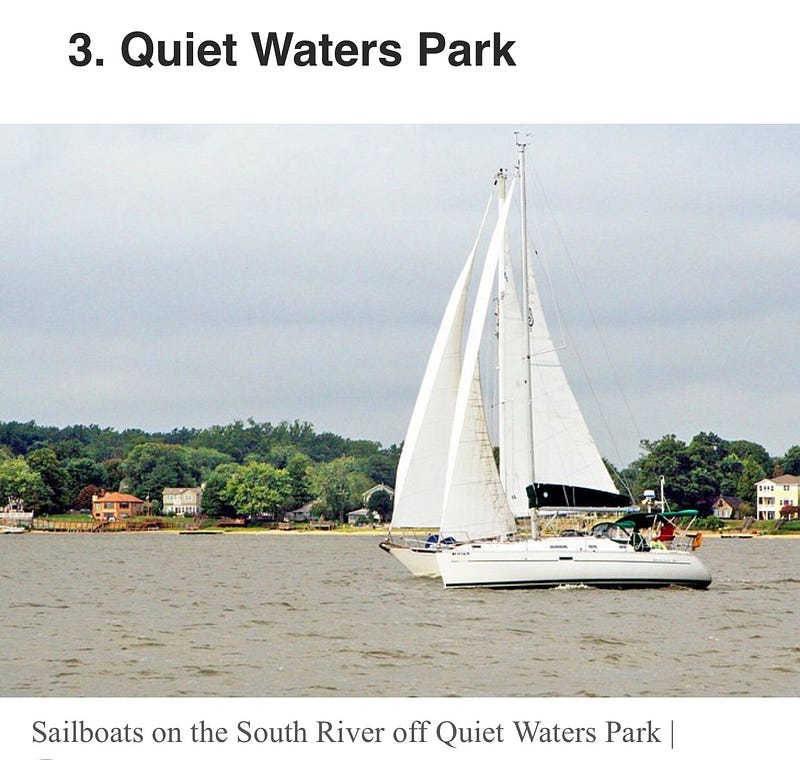
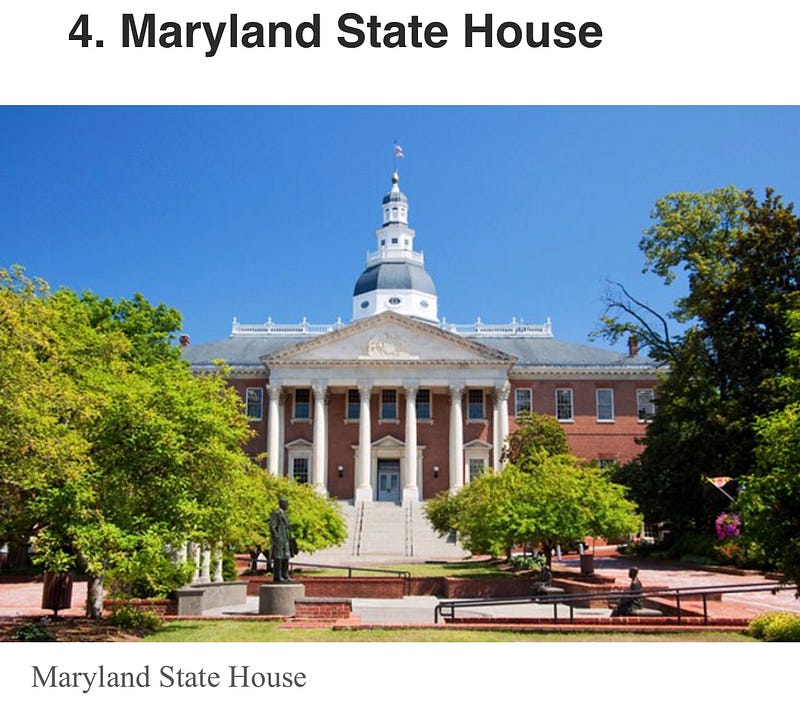
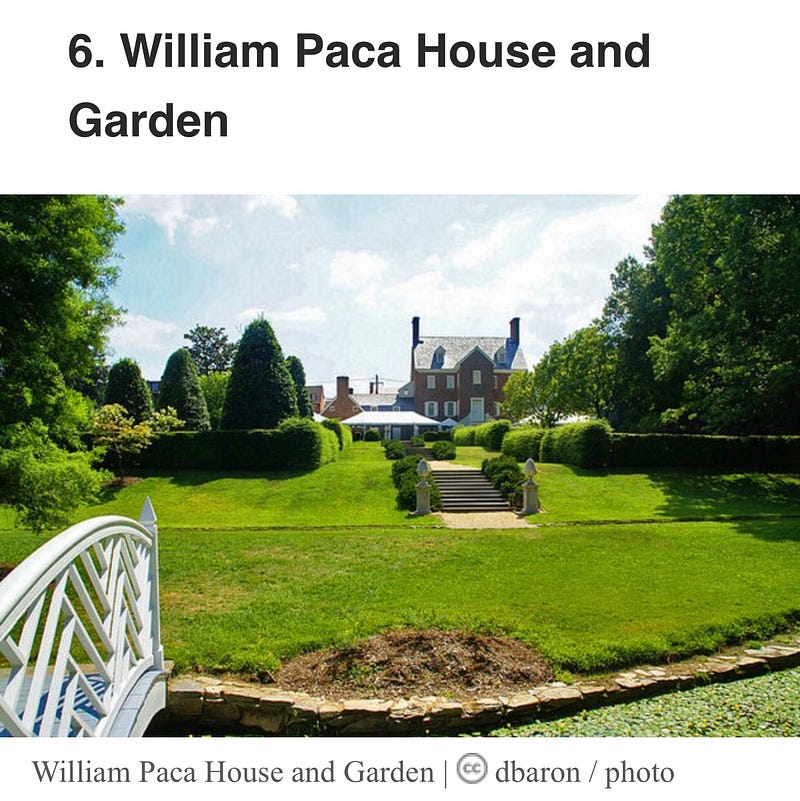
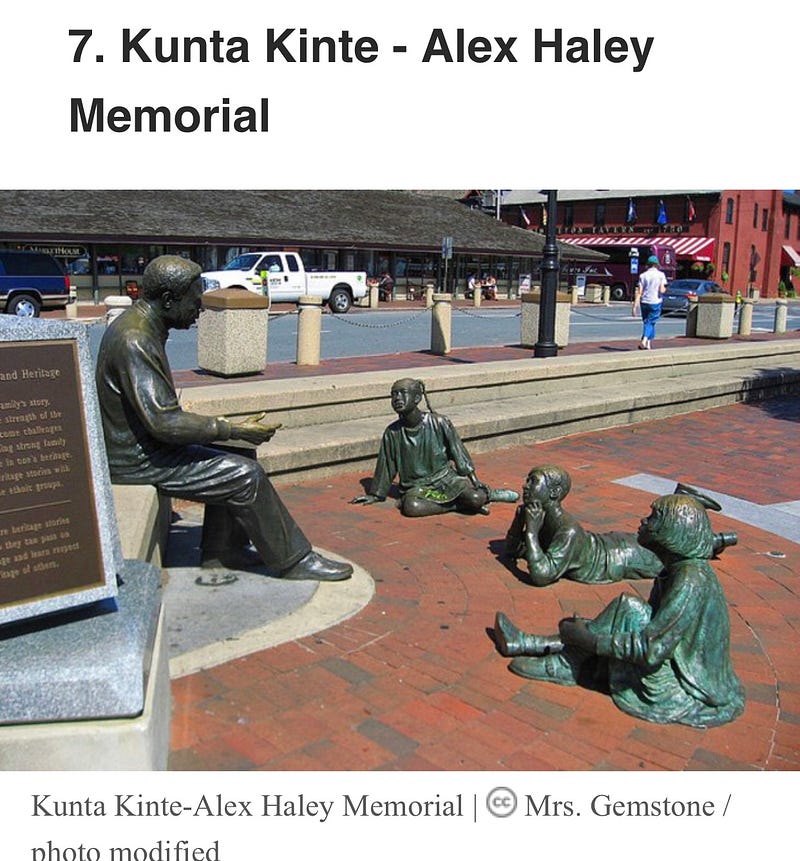
Among Maryland’s highlights are the U.S. Naval Academy and the associated Academy Naval Museum, the Old Senate Chamber in the State House, the Annapolis Maritime Museum, and the William Paca House and Gardens.
The city also has a vibrant theater scene, some lovely parks, and a lively arts district that hosts regular festivals and events during the summer months, including the romantic Dinner Under the Stars.
Annapolis is also known to many as “America’s Sailing Capital,” and for good reason.
Annapolis hosts a variety of boat shows each year, and the bay is always alive with sailboats and yachts.
Colonial and early United States (1649 — 1808)
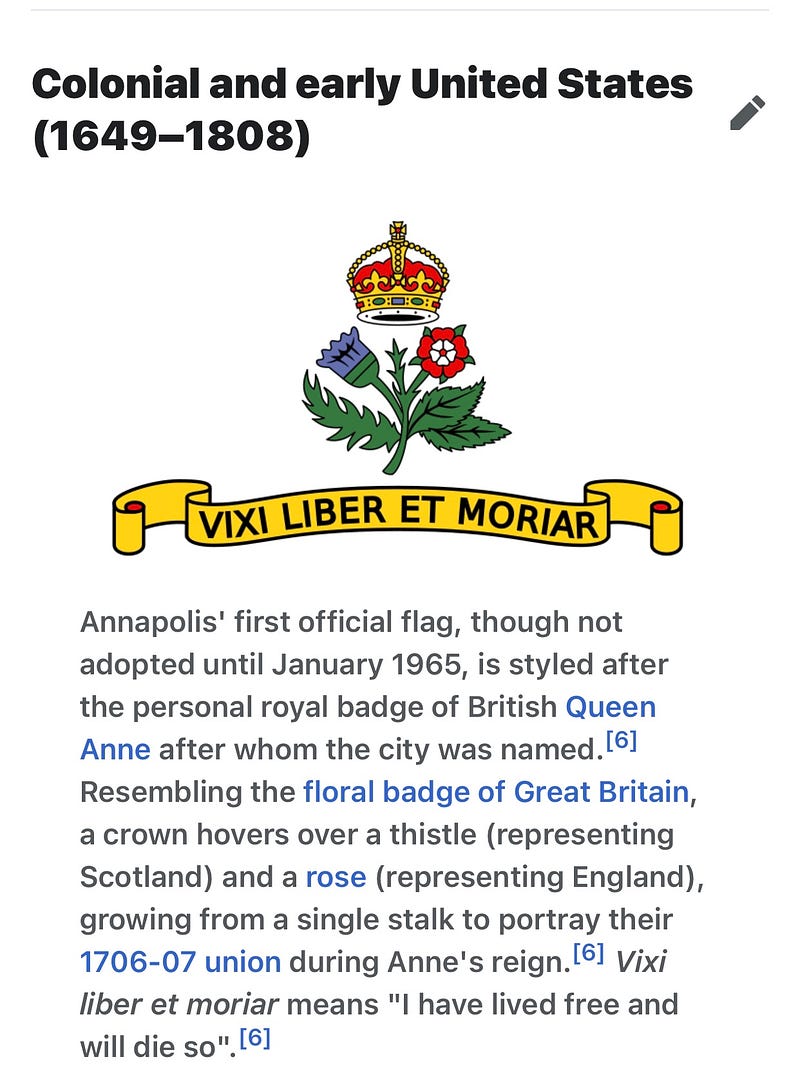
Annapolis’ first official flag, though not adopted until January 1965, is styled after the personal royal badge of British Queen Anne after whom the city was named. Resembling the floral badge of Great Britain, a crown hovers over a thistle (representing Scotland) and a rose (representing England), growing from a single stalk to portray their 1706–07 union during Anne’s reign. Vixi liber et moriar means “I have lived free and will die so”.
A settlement in the Province of Maryland named “Providence” was founded on the north shore of the Severn River on the middle Western Shore of the Chesapeake Bay in 1649 by Puritan exiles from the Province/Dominion of Virginia led by third Proprietary Governor William Stone (1603 — 1660). The settlers later moved to a better-protected harbor on the south shore. The settlement on the south shore was initially named “Town at Proctor’s,” then “Town at the Severn,” and later “Anne Arundel’s Towne” (after Lady Ann Arundell (1616 — 1649), the wife of Cecilus Calvert, second Lord Baltimore, who died soon afterward).
In 1654, after the Third English Civil War, Parliamentary forces assumed control of the Maryland colony and Stone went into exile further south across the Potomac River in Virginia. Per orders from Charles Calvert, fifth Lord Baltimore, Stone returned the following spring at the head of a Cavalier royalist force, loyal to the King of England. On March 25, 1655, in what is known as the Battle of the Severn (first colonial naval battle in North America), Stone was defeated, taken prisoner, and replaced by Lt. Gen. Josias Fendall (1628 — 1687) as fifth Proprietary Governor. Fendall governed Maryland during the latter half of the Commonwealth period in England. In 1660, he was replaced by Phillip Calvert (1626 — 1682) as fifth/sixth Governor of Maryland, after the restoration of Charles II (1630 — 1685) as King in England.
In 1694, soon after the overthrow of the Catholic government of second Royal Governor Thomas Lawrence (1645 — 1714), then third Royal Governor Francis Nicholson (1655–1727/28, served 1694 — 1698), moved the capital of the royal colony, the Province of Maryland, to Anne Arundel’s Towne and renamed the town Annapolis after Princess Anne of Denmark and Norway, soon to be the Queen Anne of Great Britain (1665 — 1714, reigned 1702 — 1714). Annapolis was incorporated as a city in 1708.[8] Colonel John Seymour, the Governor of Maryland wrote Queen Anne on March 16, 1709, with qualifications for municipal officials and provisions for fairs and market days for the town.[9]
In 17th-century Annapolis was little more than a village, but it grew rapidly for most of the 18th century until the American Revolutionary War as a political and administrative capital, a port of entry, and a major center of the Atlantic slave trade. The Maryland Gazette, which became an important weekly journal, was founded there by Jonas Green in 1745; in 1769 a theater was opened; during this period also the commerce was considerable, but declined rapidly after Baltimore, with its deeper harbor, was made a port of entry in 1780. Water trades such as oyster-packing, boat building, and sail-making became the city’s chief industries. Annapolis is home to a large number of recreational boats that have largely replaced the seafood industry in the city.
Whether you come for the history, the education, the water, or the hospitality, there is always something going on in Annapolis for you to enjoy.
Thanks for reading and appreciate your precious time.
( Below is the Extract for this story )
https://en.m.wikipedia.org/wiki/Maryland