avatarChristopher P Jones

Free AI web copilot to create summaries, insights and extended knowledge, download it at here

4045

Abstract

ate iconographical symbolism into the details of the painting in such an unobtrusive way was one of his great skills as an artist. He painted what can be thought of as a modified version of reality, one in which spiritual symbols pervade a highly naturalistic setting.</p><figure id="7d0b"><img src="https://cdn-images-1.readmedium.com/v2/resize:fit:800/1*mZg39P_lHrqHjGoIhYEiYA.jpeg"><figcaption><i>Detail of ‘Madonna with Canon van der Paele’ (</i>1434–1436) by Jan van Eyck. Oil on panel. 124.5 × 160 cm. Groeningemuseum, Bruges, Belgium. Image source <a href="https://commons.wikimedia.org/wiki/File:Jan_van_Eyck_-_The_Madonna_with_Canon_van_der_Paele_%28details%29_-_WGA7711.jpg">Wikimedia Commons</a></figcaption></figure><p id="bc11">Such an approach alerts us to other details in the painting too, such as how the baby Jesus is holding a parrot in his right hand. In his left, he clutches a posy of flowers — a nosegay — which his mother also pinches between her thumb and forefinger.</p><p id="488e">It’s possible that the flowers make symbolic reference to the Passion and the Crucifixion of Christ, since the red flowers are thought to be carnations, commonly known as <i>nagelbloem</i> (nail flower) because of their resemblance to the serrated edges of a medieval nail, whilst the white flowers are perhaps members of the mustard family whose Latin name is <i>Cruciferae.</i></p><figure id="57ed"><img src="https://cdn-images-1.readmedium.com/v2/resize:fit:800/1*Cz-Imxn665eDZyQn-pasmA.jpeg"><figcaption><i>Detail of ‘Madonna with Canon van der Paele’ (</i>1434–1436) by Jan van Eyck. Oil on panel. 124.5 × 160 cm. Groeningemuseum, Bruges, Belgium. Image source <a href="https://commons.wikimedia.org/wiki/File:Jan_van_Eyck_-_The_Madonna_with_Canon_van_der_Paele_%28details%29_-_WGA7711.jpg">Wikimedia Commons</a></figcaption></figure><p id="a83f">And whilst a parrot was sometimes used in art as a reference to Mary’s purity through her Immaculate Conception, in this instance, it seems likely that these two objects together — the parrot and the posy — have a different purpose: to make further reference to the Garden of Eden.</p><p id="4e80">Working in tandem with the floral background that adorns Mary’s throne, the parrot and flowers add weight to the idea that with Christ’s birth, humankind can return to a more innocent, atoned state.</p><p id="f7db">All of these signals are designed to play into the central subject of the painting: the exalted arrival of God’s son, Christ the Redeemer, into the world.</p><h1 id="8f7e">The Wider Painting</h1><p id="aedf">To the Virgin Mary’s right stands St Donatian, the once Bishop of Reims and the patron saint of the church for which the painting was made.</p><p id="8fde">According to legend, as a child, St Donatian was thrown into a river. He was rescued by a holy man using five candles affixed to a water wheel, which revealed the child’s location. It’s for this reason that St Donatian, in his Bishop’s garb, is depicted holding a wheel with candles on it.</p><figure id="ac53"><img src="https://cdn-images-1.readmedium.com/v2/resize:fit:800/1*-H-dlXulA18zPQFf7hC6PA.jpeg"><figcaption><i>Madonna with Canon van der Paele (</i>1434–1436) by Jan van Eyck. Oil on panel. 124.5 × 160 cm. Groeningemuseum, Bruges, Belgium. Image source <a href="https://commons.wikimedia.org/wiki/File:Jan_van_Eyck_069.jpg">Wikimedia Commons</a></figcaption></figure><p id="5489">On the other side of Mary stands St George — recognisable from his knight’s armour. St George’s popularity reached a peak during the Middle Ages as the legend of his dragon slaying was transmuted into a Christian symbol of chivalry and selflessness.</p><figure id="d186"><img src="https://cdn-images-1.readmedium.com/v2/resize:fit:800/1*dZ4TUw8wLRsHrjP19Ey1gg.jpeg"><figcaption><i>Detail of ‘Madonna with Canon van der Paele’ (</i>1434–1436) by Jan van Eyck. Oil on panel. 124.5 × 160 cm. Groeningemuseum, Bruges, Belgium. Image source <a href="https://commons.wikimedia.org/wiki/File:Jan_van_Eyck_-_The_Madonna_with

Options

Canon_van_der_Paele%28details%29_-_WGA7711.jpg">Wikimedia Commons</a></figcaption></figure><p id="81fb">Kneeling beside St George is an elderly man in a white robe, notable for being depicted with naturalistic facial features — as opposed to St George, for instance, whose appearance is more of a general archetype. This naturalism should indicate that the kneeling man is a contemporary of the artist and that this is an accurate portrait of him.</p><p id="6d1c">The man is Joris van der Paele, the commissioning patron of the painting. He falls to his knees before the Virgin and Child as St George extends his hand to present him.</p><h1 id="684e">Personal Legacy</h1><p id="bae6">Van der Paele was in his mid-60s when he commissioned Jan van Eyck to make this painting. A prominent figure in the Flemish city of Bruge, Van der Paele’s health had fallen in decline and death beckoned, at which he sought to secure his public legacy.</p><p id="e57f">This monumental painting was the result.</p><figure id="f591"><img src="https://cdn-images-1.readmedium.com/v2/resize:fit:800/1*-H-dlXulA18zPQFf7hC6PA.jpeg"><figcaption><i>Madonna with Canon van der Paele (</i>1434–1436) by Jan van Eyck. Oil on panel. 124.5 × 160 cm. Groeningemuseum, Bruges, Belgium. Image source <a href="https://commons.wikimedia.org/wiki/File:Jan_van_Eyck_069.jpg">Wikimedia Commons</a></figcaption></figure><p id="c380">In his white robes or “surplice”, Van der Paele is shown in the role from which he had since retired, as a canon of the church of St Donatian in Bruges. In his hands, he holds a book of hours, a Christian devotional prayer book, and a pair of spectacles, the frame of which casts a shadow onto the page of the book.</p><p id="3cf8">The presence of the spectacles may indicate that Van der Paele is witnessing a visionary embodiment of his prayer, an explanation that fits with the artist’s deep interest in optical concepts and effects.</p><figure id="bdb2"><img src="https://cdn-images-1.readmedium.com/v2/resize:fit:800/1*9qzSTGGF1vIH1rfqTteyqA.jpeg"><figcaption><i>Detail of ‘Madonna with Canon van der Paele’ (</i>1434–1436) by Jan van Eyck. Oil on panel. 124.5 × 160 cm. Groeningemuseum, Bruges, Belgium. Image source <a href="https://commons.wikimedia.org/wiki/File:Jan_van_Eyck_-_The_Madonna_with_Canon_van_der_Paele_%28details%29_-_WGA7711.jpg">Wikimedia Commons</a></figcaption></figure><p id="715f">Mary and the Christ Child have turned to look at Van der Paele as he raises his eyes from the prayer book, perhaps confirming that paradise is at hand.</p><p id="790d">As illness left Van der Paele unable to fulfil the functions of his office as canon, he endowed a chaplaincy to the church and commissioned this work from Van Eyck. Upon his death in 1443, Van der Paele donated the panel to the church and remained there until the building was demolished in 1779.</p><p id="b7d4">Fortunately, the painting survived. Now widely regarded as a masterpiece of the Northern Renaissance, the work transforms the vision of Mary and Christ to a profound visitation through its meticulous detail.</p><p id="74fb">It is rightly regarded as one of Jan van Eyck’s most accomplished and complex paintings.</p><figure id="1fba"><img src="https://cdn-images-1.readmedium.com/v2/resize:fit:800/1*igQbKCOI4qGLg6JzYP7H9w.png"><figcaption></figcaption></figure><p id="637b">If you liked this, you may also be interested in my book <a href="https://www.chrisjoneswrites.co.uk/masterpieces-of-art-explained/"><i>Masterpieces of Art Explained</i></a><i>, </i>an examination of some of art’s most enthralling images.</p><h1 id="bfd2">Would you like to get…</h1><p id="496e">A free guide to the <i>Essential Styles in Western Art History</i>, plus updates and exclusive news about me and my writing? <a href="https://www.chrisjoneswrites.co.uk/sign-up-art/">Download for free here</a>.</p><h1 id="ca24">Join me…</h1><p id="e6e8">On <a href="https://www.instagram.com/greatpaintingsexplained/">Instagram</a> for more great paintings on the go!</p></article></body>

One of the Most Intricate Paintings Ever Made

Jan Van Eyck’s outstanding Virgin and Child
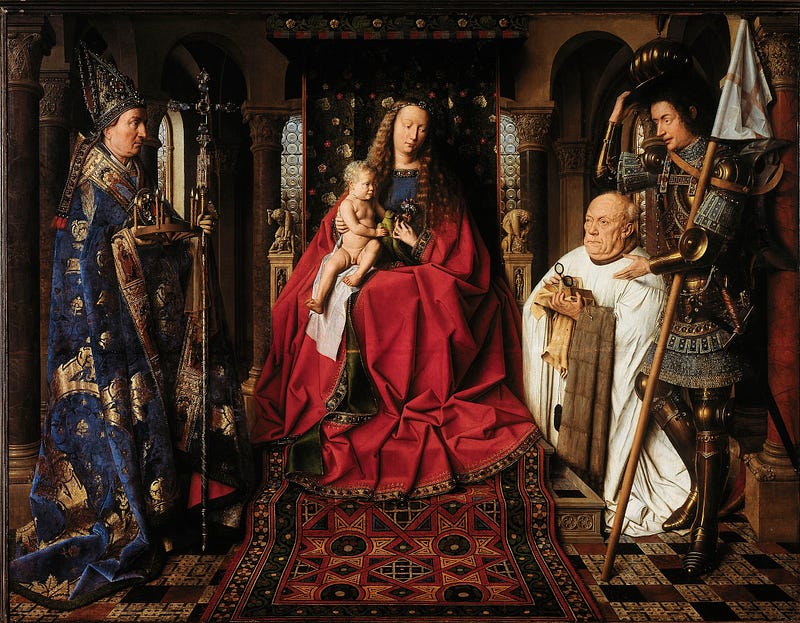
Madonna with Canon van der Paele (1434–1436) by Jan van Eyck. Oil on panel. 124.5 × 160 cm. Groeningemuseum, Bruges, Belgium. Image source Wikimedia Commons

Let me draw your attention to two details in this almost unbelievable painting by the Flemish artist Jan van Eyck, made around 1436.

The painting shows the Virgin Mary and the Christ Child sitting on a large throne, flanked by two pillars where on top are shown a pair of carvings.
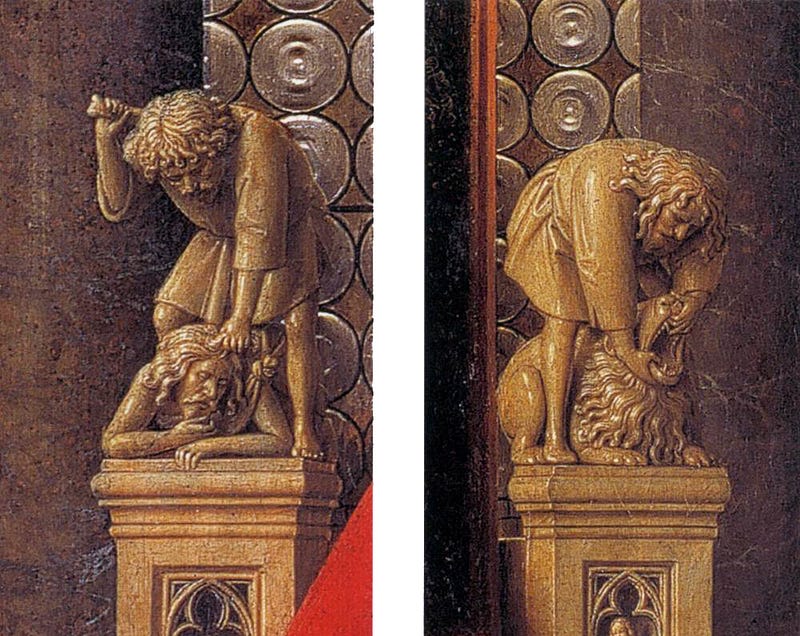
Details of ‘Madonna with Canon van der Paele’ (1434–1436) by Jan van Eyck. Oil on panel. 124.5 × 160 cm. Groeningemuseum, Bruges, Belgium. Image source Wikimedia Commons

Both carvings adopt a similar form: a robed man hunched over a prostrate creature, a man in one case, a lion in the other.

Before looking at their meaning, just take a moment to consider the virtuosity of these small painted figures, how for instance the sheen of the material catches the light with such convincing detail, and how the carvings blend so seamlessly with the wider setting of the picture, thereby giving them such a realistic form.

Here’s the full painting again, as a reminder of how the carved figures are but a small detail in a tremendously complex work.

Madonna with Canon van der Paele (1434–1436) by Jan van Eyck. Oil on panel. 124.5 × 160 cm. Groeningemuseum, Bruges, Belgium. Image source Wikimedia Commons

It goes without saying that these figures are not there out of chance; their symbolic meaning is an important constituent of the broader painting.
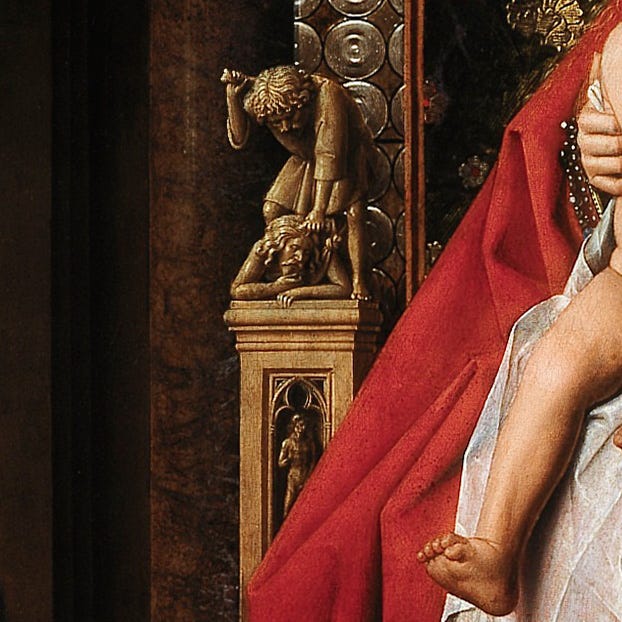
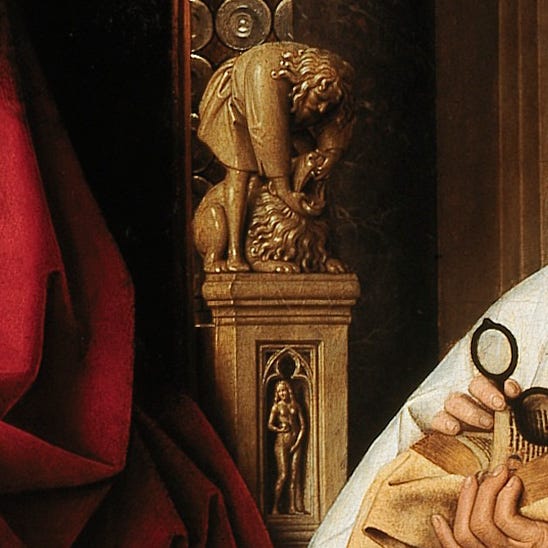
Details of ‘Madonna with Canon van der Paele’ (1434–1436) by Jan van Eyck. Oil on panel. 124.5 × 160 cm. Groeningemuseum, Bruges, Belgium. Image source Wikimedia Commons

The carving on the left depicts the moment when Cain killed his brother Abel, as told in the Book of Genesis. Cain is shown about to strike his brother with a club.

The carving on the right shows Samson fighting the lion with his bare hands, as recounted in the Book of Judges.

The purpose of pairing these biblical stories is to impart the idea that redemption from sin (Cain’s slaying his brother) can only be achieved through the power of faith (Samson’s faith in God helped him overpower the lion).

Now notice that below the two carvings are an additional pair of figures, identifiable as Adam and Eve. As is common in Christian art, they are shown naked and hence after their expulsion from the Garden of Eden. Naturally, these figures refer to “The Fall”, when humankind’s relationship with God went from a state of innocence to one of guilty disobedience.

Van Eyck’s ability to weave intricate iconographical symbolism into the details of the painting in such an unobtrusive way was one of his great skills as an artist. He painted what can be thought of as a modified version of reality, one in which spiritual symbols pervade a highly naturalistic setting.
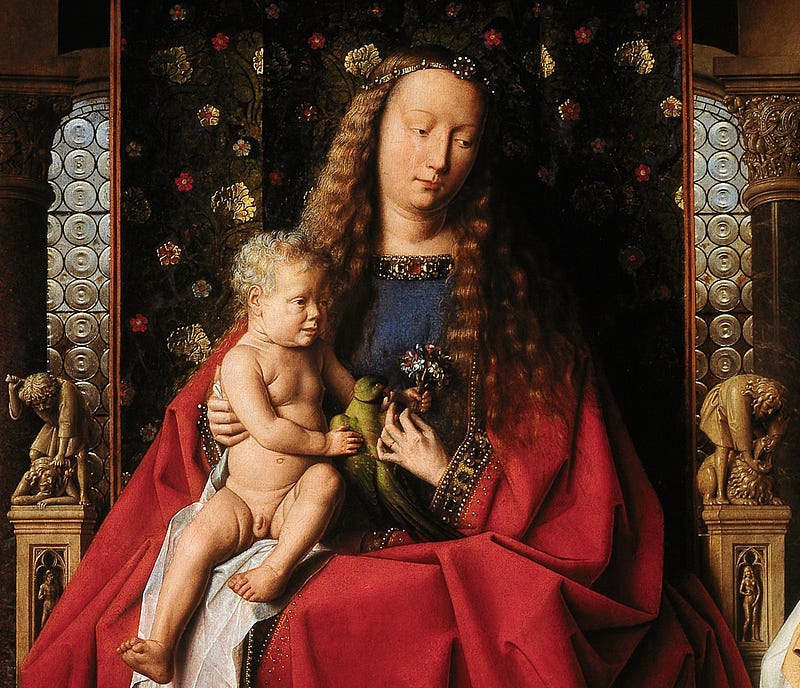
Detail of ‘Madonna with Canon van der Paele’ (1434–1436) by Jan van Eyck. Oil on panel. 124.5 × 160 cm. Groeningemuseum, Bruges, Belgium. Image source Wikimedia Commons

Such an approach alerts us to other details in the painting too, such as how the baby Jesus is holding a parrot in his right hand. In his left, he clutches a posy of flowers — a nosegay — which his mother also pinches between her thumb and forefinger.

It’s possible that the flowers make symbolic reference to the Passion and the Crucifixion of Christ, since the red flowers are thought to be carnations, commonly known as nagelbloem (nail flower) because of their resemblance to the serrated edges of a medieval nail, whilst the white flowers are perhaps members of the mustard family whose Latin name is Cruciferae.
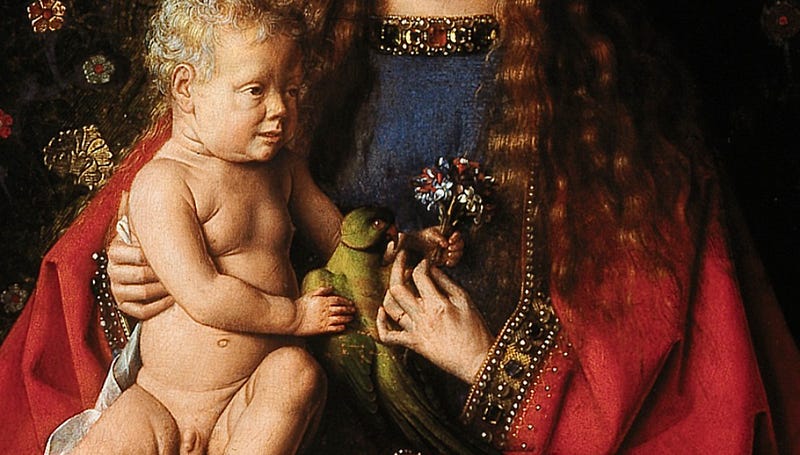
Detail of ‘Madonna with Canon van der Paele’ (1434–1436) by Jan van Eyck. Oil on panel. 124.5 × 160 cm. Groeningemuseum, Bruges, Belgium. Image source Wikimedia Commons

And whilst a parrot was sometimes used in art as a reference to Mary’s purity through her Immaculate Conception, in this instance, it seems likely that these two objects together — the parrot and the posy — have a different purpose: to make further reference to the Garden of Eden.

Working in tandem with the floral background that adorns Mary’s throne, the parrot and flowers add weight to the idea that with Christ’s birth, humankind can return to a more innocent, atoned state.

All of these signals are designed to play into the central subject of the painting: the exalted arrival of God’s son, Christ the Redeemer, into the world.

The Wider Painting

To the Virgin Mary’s right stands St Donatian, the once Bishop of Reims and the patron saint of the church for which the painting was made.

According to legend, as a child, St Donatian was thrown into a river. He was rescued by a holy man using five candles affixed to a water wheel, which revealed the child’s location. It’s for this reason that St Donatian, in his Bishop’s garb, is depicted holding a wheel with candles on it.

Madonna with Canon van der Paele (1434–1436) by Jan van Eyck. Oil on panel. 124.5 × 160 cm. Groeningemuseum, Bruges, Belgium. Image source Wikimedia Commons

On the other side of Mary stands St George — recognisable from his knight’s armour. St George’s popularity reached a peak during the Middle Ages as the legend of his dragon slaying was transmuted into a Christian symbol of chivalry and selflessness.
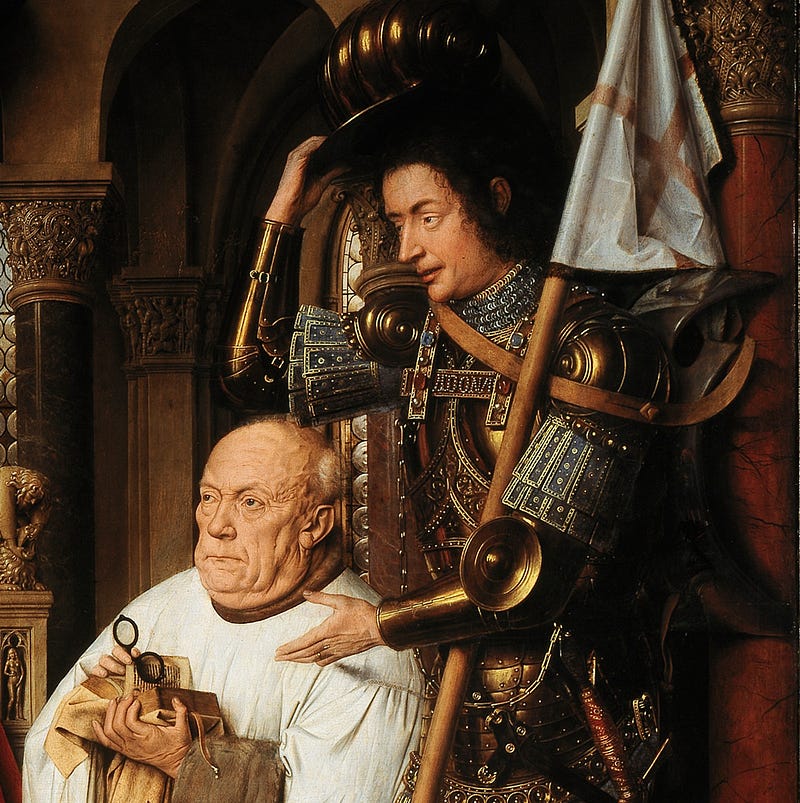
Detail of ‘Madonna with Canon van der Paele’ (1434–1436) by Jan van Eyck. Oil on panel. 124.5 × 160 cm. Groeningemuseum, Bruges, Belgium. Image source Wikimedia Commons

Kneeling beside St George is an elderly man in a white robe, notable for being depicted with naturalistic facial features — as opposed to St George, for instance, whose appearance is more of a general archetype. This naturalism should indicate that the kneeling man is a contemporary of the artist and that this is an accurate portrait of him.

The man is Joris van der Paele, the commissioning patron of the painting. He falls to his knees before the Virgin and Child as St George extends his hand to present him.

Personal Legacy

Van der Paele was in his mid-60s when he commissioned Jan van Eyck to make this painting. A prominent figure in the Flemish city of Bruge, Van der Paele’s health had fallen in decline and death beckoned, at which he sought to secure his public legacy.

This monumental painting was the result.

Madonna with Canon van der Paele (1434–1436) by Jan van Eyck. Oil on panel. 124.5 × 160 cm. Groeningemuseum, Bruges, Belgium. Image source Wikimedia Commons

In his white robes or “surplice”, Van der Paele is shown in the role from which he had since retired, as a canon of the church of St Donatian in Bruges. In his hands, he holds a book of hours, a Christian devotional prayer book, and a pair of spectacles, the frame of which casts a shadow onto the page of the book.

The presence of the spectacles may indicate that Van der Paele is witnessing a visionary embodiment of his prayer, an explanation that fits with the artist’s deep interest in optical concepts and effects.
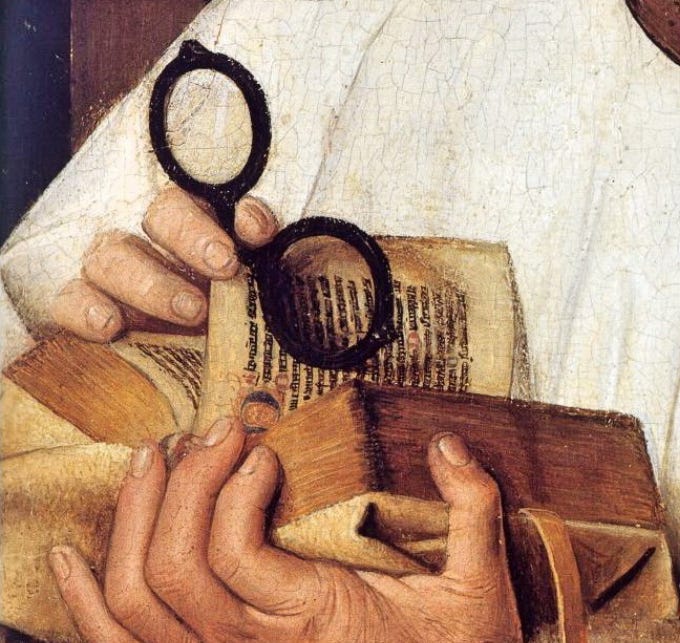
Detail of ‘Madonna with Canon van der Paele’ (1434–1436) by Jan van Eyck. Oil on panel. 124.5 × 160 cm. Groeningemuseum, Bruges, Belgium. Image source Wikimedia Commons

Mary and the Christ Child have turned to look at Van der Paele as he raises his eyes from the prayer book, perhaps confirming that paradise is at hand.

As illness left Van der Paele unable to fulfil the functions of his office as canon, he endowed a chaplaincy to the church and commissioned this work from Van Eyck. Upon his death in 1443, Van der Paele donated the panel to the church and remained there until the building was demolished in 1779.

Fortunately, the painting survived. Now widely regarded as a masterpiece of the Northern Renaissance, the work transforms the vision of Mary and Christ to a profound visitation through its meticulous detail.

It is rightly regarded as one of Jan van Eyck’s most accomplished and complex paintings.

If you liked this, you may also be interested in my book Masterpieces of Art Explained, an examination of some of art’s most enthralling images.

Would you like to get…

A free guide to the Essential Styles in Western Art History, plus updates and exclusive news about me and my writing? Download for free here.

Join me…

On Instagram for more great paintings on the go!

Art
Art History
Painting
Creativity
Inspiration
Recommended from ReadMedium