
One of the Most Influential Philosophers in the Age of Enlightenment
His last words were “It is good.”
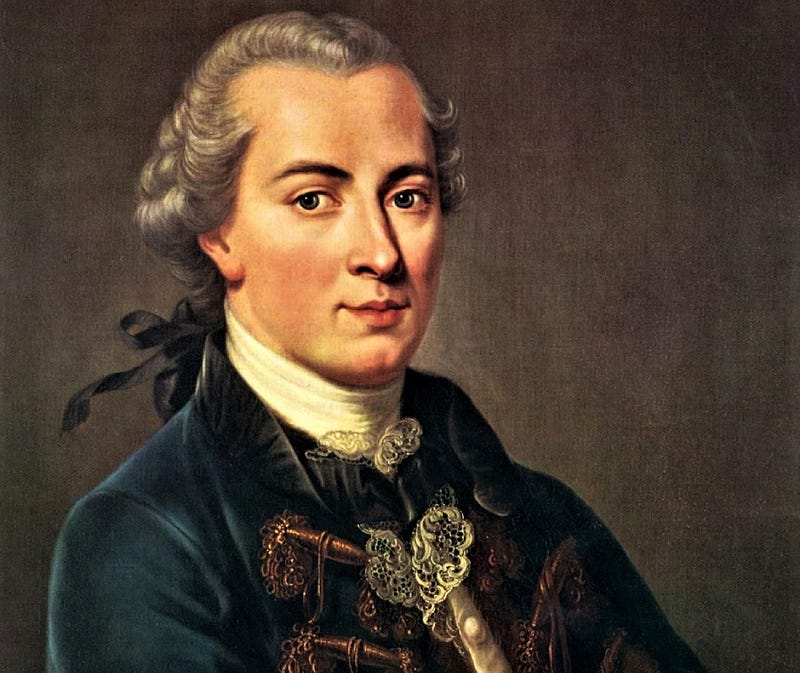
As one of the most influential Western philosophers, he has impacted nearly every philosophical movement since the late 1700s.
His grandfather was from Scotland where the surname Cant is common. Born in 1724 in Prussia he changed his name to Kant to meet German pronunciation and spelling practices.
Immanuel Kant received his doctorate in philosophy in 1755 from the University of Konigsberg. He lived during the Age of Enlightenment, also known as the Age of Reason. During this time the ideas of liberty, progress, fraternity, toleration, separation of church and state, and constitutional government were advanced. He lived to the age of 79, dying in 1804. It is said his last words were “Es ist gut” translated “It is good.”
Kant’s most notable idea is what he termed “Categorical Imperative.” It’s definition in the Oxford Dictionary is: “an unconditional moral obligation which is binding in all circumstances and is not dependent on a person’s inclination or purpose.” Kant published a considerable volume of material that you can find here.
I have gathered some of Kant’s more popular quotes from a variety of his writings arranging them by subject below.
Enjoy!
Knowledge
“I had therefore to remove knowledge, in order to make room for belief.”
“Science is organized knowledge. Wisdom is organized life.”
-
“How then is perfection to be sought? Wherein lies our hope? In education, and in nothing else.”
“But although all our knowledge begins with experience, it does not follow that it arises from experience.”
Reason
“Nothing is divine but what is agreeable to reason.”
“Happiness is not an ideal of reason but of imagination.”
“All our knowledge begins with the senses, proceeds then to the understanding, and ends with reason. There is nothing higher than reason.”
-
“The only objects of practical reason are therefore those of good and evil. For by the former is meant an object necessarily desired according to a principle of reason; by the latter one necessarily shunned, also according to a principle of reason.”
Action
“May you live your life as if the maxim of your actions were to become universal law.”
“So act that your principle of action might safely be made a law for the whole world.”
“A categorical imperative would be one which represented an action as objectively necessary in itself, without reference to any other purpose.”
Religion
“Religion is the recognition of all our duties as divine commands.”
“It is not God’s will merely that we should be happy, but that we should make ourselves happy.”
Ethics and Morality
“Two things fill me with constantly increasing admiration and awe, the longer and more earnestly I reflect on them: the starry heavens without and the moral law within.”
“It is not necessary that whilst I live I live happily, but it is necessary that so long as I live I should live honorably.”
-
“Morality is not properly the doctrine of how we may make ourselves happy, but how we may make ourselves worthy of happiness.”
“Without man and his potential for moral progress, the whole of reality would be a mere wilderness, a thing in vain, and have no final purpose.”
“In law a man is guilty when he violates the rights of others. In ethics he is guilty if he only thinks of doing so.”
Life
“The busier we are, the more acutely we feel that we live, the more conscious we are of life.”
“Do the right thing because it is right.”
“We are not rich by what we possess but by what we can do without.
“To be is to do.”
Concepts
“Intuition and concepts constitute, therefore, the elements of all our knowledge, so that neither concepts without an intuition in some way corresponding to them, nor intuition without concepts, can yield knowledge.”
“Thoughts without content are empty, intuitions without concepts are blind.”
“Genius is the ability to independently arrive at and understand concepts that would normally have to be taught by another person.”
Wisdom
“All false art, all vain wisdom, lasts its time but finally destroys itself, and its highest culture is also the epoch of its decay.”
“There is something splendid about innocence; but what is bad about it, in turn, is that it cannot protect itself very well and is easily seduced.”
“If a man makes himself a worm he must not complain when he is trodden on.”
-
“Metaphysics is a dark ocean without shores or lighthouse, strewn with many a philosophic wreck.”
“Space and time are the framework within which the mind is constrained to construct its experience of reality.”
-
“Truth is the child of time; erelong she shall appear to vindicate thee.”
“Have patience awhile; slanders are not long-lived.“
“By a lie a man throws away and as it were annihilates his dignity as a man.”
“For peace to reign on Earth, humans must evolve into new beings who have learned to see the whole first.”
-
“Out of the crooked timber of humanity, no straight thing was ever made.”
“Only he who, himself enlightened, is not afraid of shadows”
“Enlightenment is man’s emergence from his self-imposed immaturity.”
“Immaturity is the inability to use one’s understanding without guidance from another.”
-
“Always recognize that human individuals are ends, and do not use them as means to your end.”
“Seek not the favor of the multitude; it is seldom got by honest and lawful means. But seek the testimony of few; and number not voices, but weigh them.”
-
“Experience without theory is blind, but theory without experience is mere intellectual play.”
“Even philosophers will praise war as ennobling mankind, forgetting the Greek who said: War is bad in that it begets more evil than it kills.”
-
“He who is cruel to animals becomes hard also in his dealings with men.
“We can judge the heart of a man by his treatment of animals.”
“Man must be disciplined, for he is by nature raw and wild.”
One of Kant’s most impactful quotes requires self-examination.
“All the interests of my reason, speculative as well as practical, combine in the three following questions:
1. What can I know?
2. What ought I to do?
3. What may I hope?”
Ask these of yourself and be amazed at what you can learn!
If you wish to study more of Kant’s works, you can find many of them on Project Gutenberg for free.
Bill Abbate Leadership Writer and Editor in ILLUMINATION.
Thank you for reading this article! If you enjoyed it, please check out others below.