
One of the 2022 AI Trends is Emotional AI (EAI). Turns Out, It’s Already Been In Use For Some Time.
… or how care providers use Emotionalized AI to support patients.
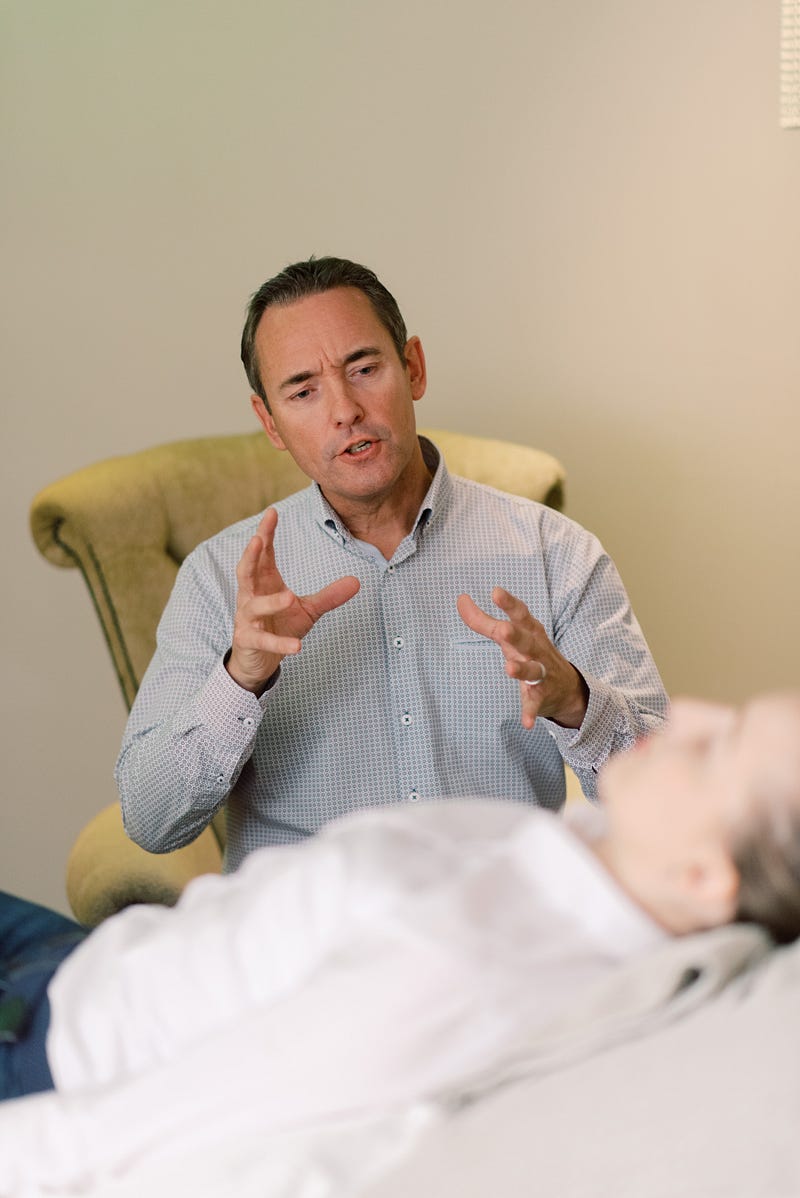
Imagine a psychologist.
I thought of this: someone that will calmly listen to your story, slowly nodding, encouraging you to continue and dive deeper into your thoughts, while monitoring your emotions and psychological state.
And it is a person. Or does it have to be one?
The Pandemic, the Great Resignation, and the crazy high inflation rate, together with continually distressing news from media outlets — 2021 had many challenges for our mental health.
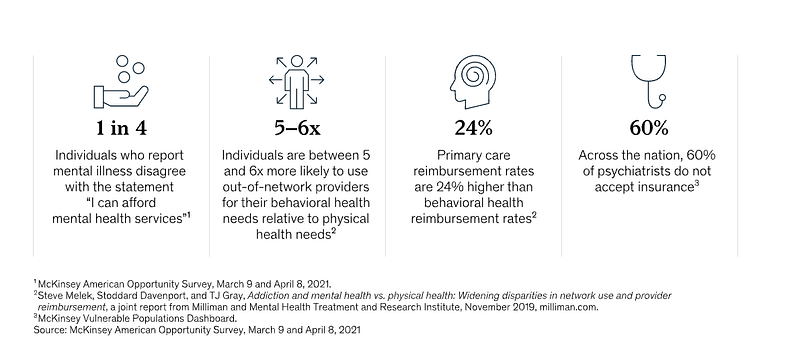
McKinsey & Company’s research has proven that indeed, more people were seeking psychological help, compared to 2019, according to their research. The Mental Health of America Organization has found out that in 2021, 19% of adults are experiencing a mental disorder, which equals to over 47 million Americans.
McKinsey & Company’s research study claims that, from people who have stated they have a mental health condition but have not undertaken treatment, 60% more likely to declare that mental health is unaffordable. This is especially seen in the image, created by McKinsey & Company.
Can Emotional Intelligence (EAI) be an Answer To This Problem?

One of the trends for 2022 is Emotional Artificial Intelligence. This technology has vast potential in building better human-machine interactions and can be used in a variety of industries and sectors. Emotional AI uses machine learning to monitor, analyze, interpret, record, and even, in some cases, predict human emotions.
In 2020, Dr Michael Rucker (2020), published a very interesting article in VeryWellHealth questioning whether Artificial Intelligence can help people tackle mental health problems.
In his article, Dr Rucker was mainly referring to a special Chatbot Psychologist that offers low-cost individual sessions with no appointment required.
This is a working option that can help make psychological care significantly cheaper and affordable to a larger percentage of the population. However, in this case, Chatbot Psychologists must identify the keywords-identificators of the patient’s psychological state and follow a pre-written script.
Dr Rucker also states that, according to specialists, this program will most likely make sense when used in a partnership with a human therapist.
Another interesting AI-powered psychologist's assistant is Ellie, a robot therapist that helps treat troops suffering from Post-Traumatic Stress Disorder (PTSD).
Ellie was developed by the USC Institute for Creative Technologies in 2016. The system reads human emotions, responds to them accordingly, and transfers data about the emotional state of the patient to the human psychologist to proceed with treatment.
Similar to a ChatBot Psychologist, mentioned above, Ellie monitors and detects both verbal and nonverbal expressions of PTSD by using a special pre-made script.
What is different here is that Ellie is also enabled to detect facial expressions, eye gaze direction, gestures and other nonverbal signals of depression.
Here is a short video of the session led by Ellie:
Though these 2 examples are not the most recent innovations, they are the starting point of emotionalized AI. They improve human-machine interactions by recognizing and simulating empathy and friendly sympathetic relationships.
In 2022, the term EAI will be further spread and advanced. Like a few years ago, robot toys, created specifically to psychologically support patients in hospitals, like Paro, a robot-toy looking like a baby seal.
These robot toys and similar innovations formed a lot of controversies back in the day they were introduced, highlighting the question of ethics behind forming an illusion of an emotional attachment and a relationship.
Despite all the discussions, the Paro robot toy has proven to be effective in supporting the psychological well-being of patients with dementia, according to the Journal of the American Medical Directors Association, 2017.
In this video, the Senior Research Scientist of Paro says that the robot remembers the behavior of its owner and responds accordingly to form a relationship with them and develop a personality that its owner likes.
It responds positively to stroking, and negatively when it’s hit. Paro interacts with its owner in the way, it encourages stroking. Paro was already approved by the FDA, and it’s proven that Paro has a similar effect on patients as animal therapy.
Paro proved to be especially effective with dementia patients, helping them to reduce occasional anxiety, settle down, smile and even communicate and socialize. This shows that emotionalized AI is pretty effective and is developing to be spread to other industries and public sectors.

Hi!
If you’re reading this, chances are you’re interested in technology and how it shapes the world of tomorrow.
By signing up for my newsletter and following me on Medium, you wouldn’t need to look through the web to find out how AI changes industries. Just have a look at my articles :)


