
What’s the Meaning Behind this Japanese Rock Sculpture?
The Shinto shrine that acts like a modern installation piece
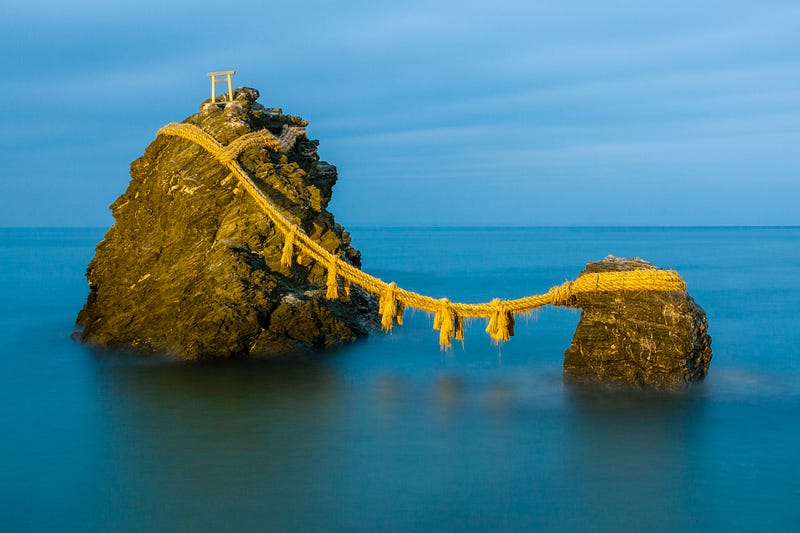
Some artworks move us because of their sheer conceptual simplicity.
The Married Couple Rocks are two small rocky stacks in the sea just off the Japanese coastline. Between the two rocks a thick rope is hung, representing the concord of marriage.
The first time I ever saw an image of these rocks, something profound shifted in me. I found the symbolism deeply appealing, the way the rope is so solid and durable-looking, unmistakably linking the two rocks across their unpassable divide.
Many years later, the Married Couple Rocks still moves me and sends my imagination into a spin.
Two Primal Spirits
This work of religious art — a representation of two primal spirits — sits in the sea of Futami, off the coast of Japan’s main island of Honshū.
Here, the two rocky protrusions lie within easy reach of the tide and can be distinguished from the many thousands of other rocks in the vicinity by the rope that hangs between them.
The symbolism of a rope, with its fibres and knots, keeps the image grounded in the realm of the proverbial or the utilitarian. The rope binds the two rocks together despite the wind and waves that whirl around them.
Like a modern installation piece of art, the rocks become bearers of meaning through a conceptual interplay. Remove the rope and the rocks disappear. Apply the rope, and the rocks rise out of the ocean and cross the seal of significance.
Married Couple Rocks
The bonded rocks are a poetically simple affirmation — of the union in marriage of man and woman.
According to Shinto mythology, the islands of Japan were born of the spirits Izanagi and Izanami in a moment of mystical blending before time itself began.
It is said that the two deities were commanded to solidify the lands that floated like jellyfish beneath their heavenly bridge. From this buoyant pier they stirred the briny lands with a jewelled spear, and then lifting the spear, the substance was allowed to drip and solidify into the island of Onogorojima. The two deities then came together to produce various kami which populated and gave life to the land.
Worshippers at the neighbouring Futami Okitama Shrine believe that this rope should be renewed each new year as a celebration of the matrimony that brought the islands of Japan into being.
Deeply Appealing
The simplicity of the gesture reminds non-native eyes of the Japanese proclivity for the sparseness and elegance that often characterise their religious symbolism. I say non-native, because I suspect the orderliness we often ascribe to Japanese aesthetics is a myth perpetuated by a Western need to abstract the Japanese people into a small number of memorable features.
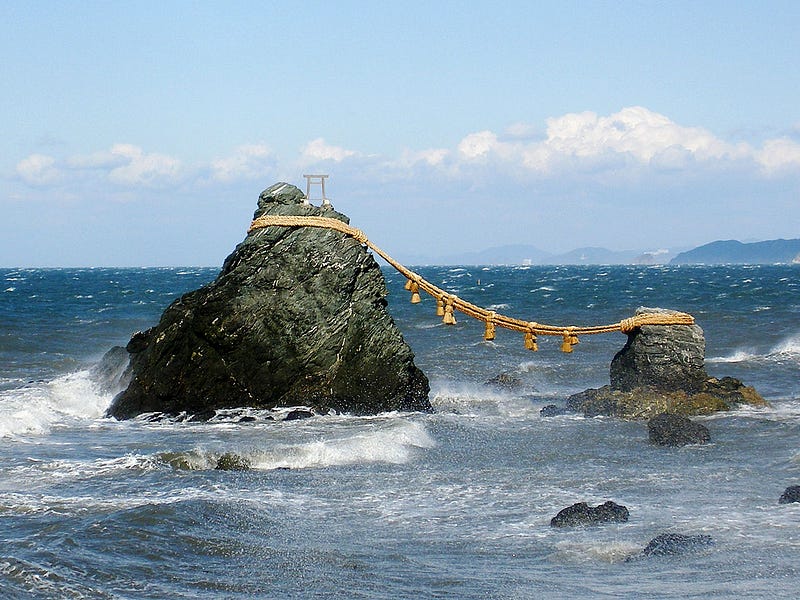
One rock is large, the other is much smaller. This may support us in our inclination to associate the larger with the male, and the smaller with the female. Either way, what is far more important is that the size disparity produces a dynamic: of two similar objects that have a specific relationship with one another.
And the rope that connects them declares, “These rocks are not arbitrary.”
In this sense, through the elevation of the two rocks from the many thousands that surround them, the rope’s renewal is an act of creativity.
Ropes in Japanese culture have a special role. Known as Shimenawa (“enclosing rope”), these lengths of rice or hemp rope are used for the ritual purification at Shinto shrines, torii gates and other sacred landmarks. They often demarcate the boundary between the sacred and the profane.
Shimenawa are believed to act as a ward against evil spirits. Shimenawa are placed on yorishiro, objects considered to attract spirits (kami) or be inhabited by them.
Kami is the Japanese word for a deity, divinity, or spirit. They are found in natural phenomena, in sacred places and in people. Mountains, forests, rain, wind, lightning and sometimes animals are thought to be charged with such spiritual power.
Yorishiro were conceived to attract the kami and then give them a physical space to occupy to make them accessible to human beings for ceremonies.
The Married Couple Rocks is a particular type of yorishiro known as an iwakura: a rock formation where kami are invited to descend and therefore create holy ground.
In the sea, the rocks sit unmoved and unmovable, yet with the rope their union is announced. This symbolic gesture overcomes the otherwise insurmountable problem of their physical immobility, and makes the vow of unity between them a real, visible truth.
The rope gives them a place in the system of human signification.
The connections make the rocks vital, their likeness and relationship perceptible.

If you liked this, you may also be interested in my book Great Paintings Explained, an examination of some of art’s most enthralling images.
Would you like to get…
A free guide to the Essential Styles in Western Art History, plus updates and exclusive news about me and my writing? Download for free here.
Join me…
On Instagram for more great paintings on the go!


