
One Life Many Books
My perspective on Dr. Christiaan Barnard’s autobiography borrowed from a reference library
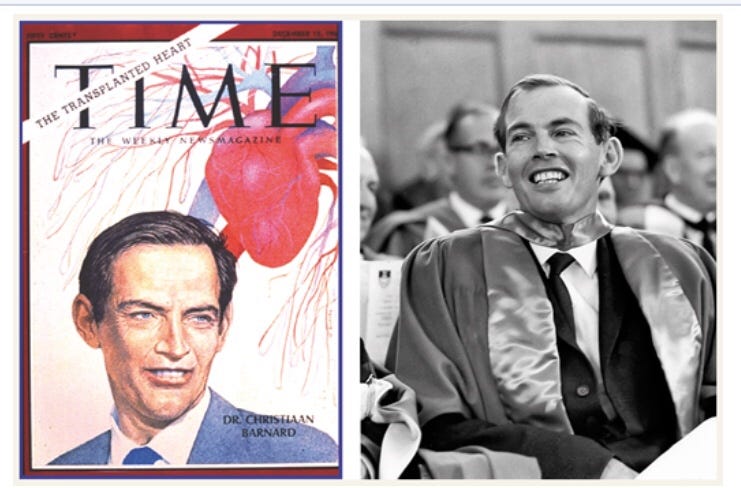
It is infinitely better to transplant a heart than to bury it to be devoured by worms.
The prime goal is to alleviate suffering, and not to prolong life. And if your treatment does not alleviate suffering, but only prolongs life, that treatment should be stopped.
I read One Life in 1989. I smuggled it out of the school library under my blazer and read it at a single sitting. It is a book by Dr. Christiaan Barnard about the world’s first heart transplant, in 1967 at Groote Schuur Hospital in Cape Town, South Africa.
I write this article as a response to a poem prompt, Perspective, by Caroline de Braganza. Thank you for your camaraderie in tagging me.
In this moving, yet funny article, Marilyn Flower talks about Parker, a friend on life support.
Marilyn set off the One Life memory. I resisted, but then Roz Warren wrote this one about how cavalier people are about library books, and I could resist no longer. Here goes.
In One Life, Dr. Christiaan Barnard says, he wants to euthanize a patient in severe pain, and is unable to, because he is interrupted. He’s very tired and goes off to rest, deciding the patient will have to endure some more severe pain before Dr. Barnard will cross a medical line and pull the plug on him.
Overnight, the patient recovers. He eventually walks out of the hospital.
It would have been dramatic, with cymbal-clashing sounds even as fiction… but this was a true story. It made me jump out of bed, clutching the book. Dr. Barnard’s reaction, to the murder he almost committed! As I read, I paced, trying to put my body through the anguish he was describing.
My brother in the next room saw the musty library hardback in my hand and shook his head at my pacing and my twisted morals, smuggling books out to return them the next day.
I felt thankful Dr. Barnard stopped doing surgery long enough to write down what he thought. The book has some medical tech, but the language is clear.
The ending is even more dramatic. His team prays for a white donor for his white, heart recipient patient. He would go ahead with the heart transplant even if the next almost-dead guy who was wheeled in was black, he says. However, he didn’t want to deal with the fallout if so. Fortunately the next guy stretchered in brain-dead-heart-healthy is white. The black white theme is otherwise hardly discussed.
It wasn’t until the end of the book that I realized that the writer wasn’t just any white doctor, he was a white doctor working in Apartheid country. He is the reason why I ended this poem with All Blood’s Red.
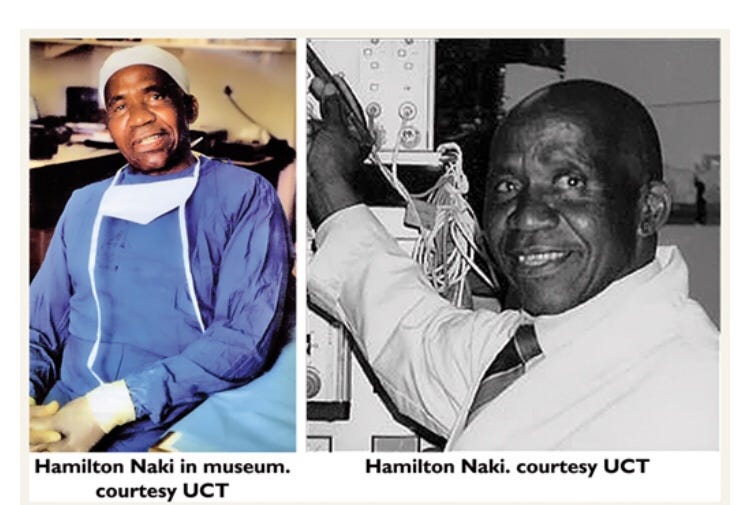
He used to try it on the dog. He had a laboratory where he worked with Hamilton Naki who helped him do canine heart surgeries. Officially, all Dr. Naki was, was a gardener and a lab tech. Dr. Barnard acknowledged his help in countless interviews and much of the book is about him.
‘I stole with my eyes’ Hamilton Naki said about his formidable surgical skills. He received his honorary Master of Medicine degree from the University of Cape Town at the age of 77, just 2 years before he died in 2005. He would have been a surgeon but for apartheid.
The book does not dwell on the color of the doctor or his lab assistant. Dr. Barnard and Hamilton only start to fret about color when they’re waiting for a donor heart, afraid that their recipient patient will die before then.
Before reading that book, in 1989, I used to tar all South Africans with the same brush, with Mandela having been in jail for 25 years. After that book, I decided that doctors are usually fair. Both Hamilton and Dr. Barnard prayed for white-donor-on-white-recipient because otherwise, the hullabaloo would have distracted them in the post-surgical period. During this period they even supervised the recipient's tooth-brushing and flossing to reduce germs.
Doctors have more information than we do. They have ethics but also have decisions to make. When they work, they see the operating area, like William Tell aiming for the apple. Let them work and they’ll pull off the miracles you pray for. If Dr. Naki or Dr. Barnard had sat down to whine, it would have hurt us all.
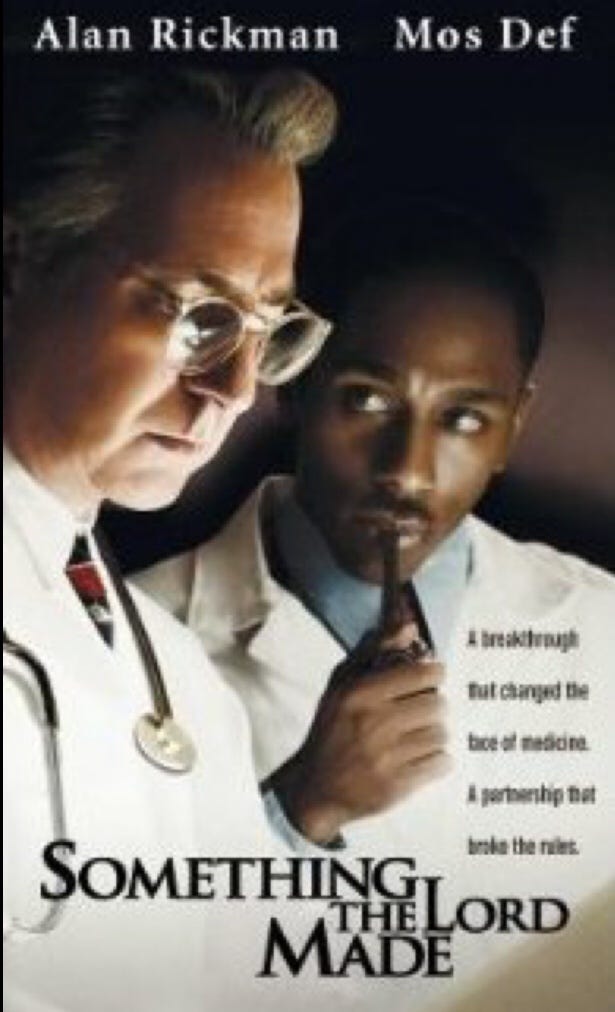
There’s a similar story from the Johns Hopkins Hospital in Baltimore, USA in the 1940’s. The Blalock-Taussig shunt which saves blue babies, is named after Dr. Alfred Blalock and Dr. Helen Taussig. Vivien Thomas, who coached Dr. Taussig, isn’t credited. Thomas had done the procedure on the canine heart. Prejudice against blacks prevented Thomas from getting credit until August 1989, when this article by Katie McCabe- Like Something The Lord Made, was published in The Washingtonian. It was made into a HBO movie in 2004.
- We signed a petition in school to free Nelson Mandela in 1988.
- Our school libraries were All-You-Can-Eat buffets. We couldn’t issue books. After Library period, I used to leave hungry.
- The library books never had jackets. Even NEW books had their jackets removed for filing. We were lucky if the books had both covers. We never used to get any information about the author, due to the missing jackets, unless we were lucky enough to know somebody who owned a Britannica.
- Anybody who did own a Britannica would never reveal the fact, for fear his 33 volumes would be borrowed by 33 people who’d keep circulating the volumes among themselves. So anything an author touched upon was valuable information, kept safely, tight-fisted in your mind, to be opened only when you needed it to shed light on something else.
- I had to force myself to stop using try it on the dog as a metaphor for a trial for anything, because it appealed to my ear but everyone else found it cruel or rude.
More by Tooth Truth Roopa Vikesh


