One Genuinely Great Thing About the Star Wars Prequels: John Williams
The legendary maestro gave these disappointing films a set of scores to die for.
Warning: Contains spoilers for the Star Wars prequels.
The Star Wars prequels have their defenders, but on the whole, they are regarded as a disappointment in comparison with the illustrious original trilogy. I hold that view, and have written elsewhere about how I would have written the prequels, but there is one significant area in which The Phantom Menace, Attack of the Clones, and Revenge of the Sith did not disappoint: The music score. In that respect, John Williams contributed outstanding work, some of the best heard in the entire Star Wars saga. Frankly, this music deserves to score a much better set of films.
Although the prequel scores occasionally quote from older material, in characteristic style, he continued to prove that the only person who can outdo John Williams is John Williams. As such, the maestro contributes stirring new themes for new characters, and many other strident, thrilling anthems for George Lucas’s epic space fantasy saga.
Here are a few selections from each of the scores. I apologise in advance for the excessive adoring adjectives. I tend to go overboard on them when talking about John Williams.
Duel of the Fates (The Phantom Menace)
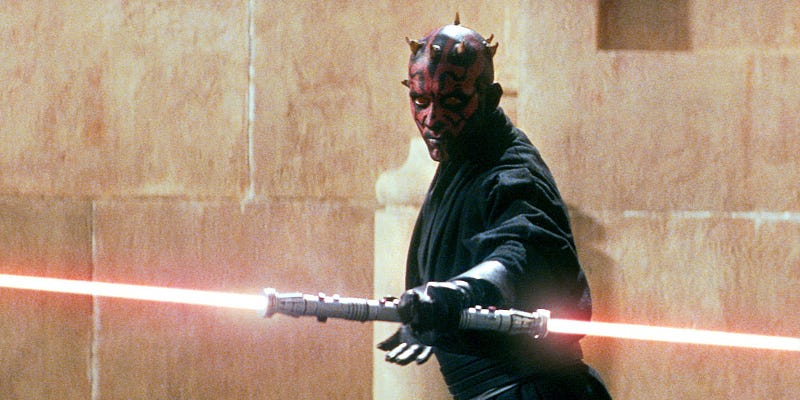
Arguably the most epic and thrilling piece of the entire prequel trilogy, this magnificent theme appears in minor variations earlier in the film, before being unleashed in full during the four intercut battles of the finale. The most dramatic of these is the showdown between Jedi knights Obi-Wan Kenobi and Qui-Gon Jinn, as they face their Sith nemesis, the stunningly evil double-ended lightsabre wielding Darth Maul. It’s an action highlight in an otherwise anaemic film, with Williams at the peak of his powers. Turn up the volume and wallow. Absolute goosebumps.
The Droid Invasion and the Appearance of Darth Maul
Another action highlight, this track comprises segments from various battle droid scenes, with the droid army theme thrillingly rendered on trumpets at around 1:10 in the track below. Listen also for Williams’s sublime use of percussion; a much-underrated scoring skill that often gets overlooked. Again, I listen to this pretending it’s part of a much better film. The latter end of the track cunningly brings in the Emperor theme from Return of the Jedi, as Darth Maul is revealed via hologram in an early scene.
Anakin’s Theme (The Phantom Menace)
This one requires a careful listen. On the surface, it’s an upbeat and heartfelt theme exuding innocence and heroism, mostly played on strings. But we all know what young Anakin becomes, and this is really a clever variation on the Darth Vader theme from The Empire Strikes Back, stripped of its darkness and menace. Well, almost. There’s a tiny hint of what is to come towards the end.
Across the Stars (Attack of the Clones)
I may consider Anakin and Padme’s “love story” to be among the most unconvincing in cinema history, but consummate professional that he is, John Williams ignores that by contributing a theme unworthy of it. The sweeping strings of this score harken back to Hollywood melodramas and romances of the 1940s, and composers like Max Steiner. It’s a lovely piece of work. Just try not to recollect preposterous dialogue about sand when listening.
Main Title and Ambush on Coruscant (Attack of the Clones)
Yes, I’m including the main title here, and yes, it’s still as exhilarating as the 1,000th time you heard it, but what I really want to draw your attention to are the new themes at 1:50 (which often appears in the Kamino cloning planet scenes), and at 3:00 (a sinister motif used for Count Dooku). Both elevate potentially fascinating but sorely underwritten material and characters, in sequences outside the tedious Anakin/Padme romance.
Zam the Assassin and the Chase Through Coruscant (Attack of the Clones)
Here’s Williams in full-blown action mode once more, making exhilarating use of percussion and a few more avant-garde scoring elements (including an electric guitar at one point) to punctuate the pursuit of Anakin and Obi-Wan, as they chase down Padme’s assassin through a Coruscant’s cityscape. It’s one of the better scenes in the film, outside the all-guns-blazing finale, at the outbreak of the Clone Wars.
Battle of the Heroes (Revenge of the Sith)
This sweeping epic piece accompanies the fateful showdown between Obi-Wan Kenobi and Anakin after he has turned to the dark side, culminating in the immolation that results in Anakin’s rebirth as Darth Vader. Punctuated by gloomy choral riffs, this wonderful theme screams thrilling action and epic tragedy. Williams really pulls out the stops here.
General Grievous (Revenge of the Sith)
Another of the trilogy’s terrific but underused lesser villains, the amusingly named General Grievous has an up-tempo, stabby theme consisting of a trumpet fanfare, and a few more choral elements. It’s another piece of casually deployed genius, only to be discarded once the film takes a much darker turn in the second half. The second part of this track is a sadder version of the Across the Stars theme from Attack of the Clones. This neatly brings us to…
Anakin’s Betrayal (Revenge of the Sith)
Possibly my favourite single track from the whole of the Star Wars prequels; a heart-rending, choral masterclass in epic tragedy, as the Emperor finally turns on the Jedi, issuing the Order 66 kill order to the clones. Of the three films, Revenge of the Sith is the best of the three by some distance, but it still doesn’t deserve a score this good. I think of it as a lament for how good the films could have been, as well as a lament for the fallen Jedi.
The Birth of the Twins and Padme’s Destiny (Revenge of the Sith)
Let’s have one more. This sombre theme was first heard in the finale of The Phantom Menace, during Qui-Gon’s funeral. But it is reused far more memorably here, intercutting between the birth of Luke and Leia and the “birth” of Darth Vader. Fun fact: Some of the choral phrases used in these soundtracks are from ancient Sanskrit, including this piece.
If you enjoyed this article, please consider supporting my writing on Patreon or Ko-fi. You can also offer a tip via Paypal (see tip button below). Alternatively, if you want unlimited access to my writing on Medium (and that of many other talented writers), click here to upgrade to full Medium membership. This is an affiliate link. I receive financial incentives for new referrals, so that’s another hugely helpful support to me. Thank you.
For more about me and my writing on Medium, please click here. For information on my writing outside Medium, please click here. For a list of my published novels and other works, please click here.


