
One Flew Over The Card Catalog
A public librarian recalls his work with loopy patrons and power-hungry staff members
Librarians in my town have a bull’s-eye on their backs. We’re about as far south as you can get without swimming with the blacktip sharks in the Gulf of Mexico.
But the would-be book-banners have found us. Last year they began using a hardball tactic library foes have deployed in other U.S. towns.
They objected to LGBTQ+ books on the shelves but ignored the standard procedures for making a complaint, such as writing to the director or speaking up at meetings of the library board, which are open to the public but not usually covered by the media.
The book-banners ambushed the library staff by going straight to one of the town council meetings that attract TV cameras.
Is it any wonder that some libraries are hemorrhaging employees”?
Add book-banning to other issues faced by their staffs — burnout, low pay, the risks of Covid-19 — and you’ll see why the ranks of school librarians alone have dropped by 20 percent in the past decade or so.
Thanks to strong community support, our public library seems to have fended off — for now — the latest challenges to what’s on its shelves.
Yet more assaults are sure to come even in a town like mine, which ignores trends so cheerfully that it installed “walk” and “don’t walk” signals on downtown streets only in 2023.
A modern public library is a cross between a computer lab, homeless shelter, psychiatric ward, babysitting service, and incipient crime scene. Books haven’t yet become an afterthought. But can anybody doubt that they’re going in that direction?
A ‘kind of’ true memoir
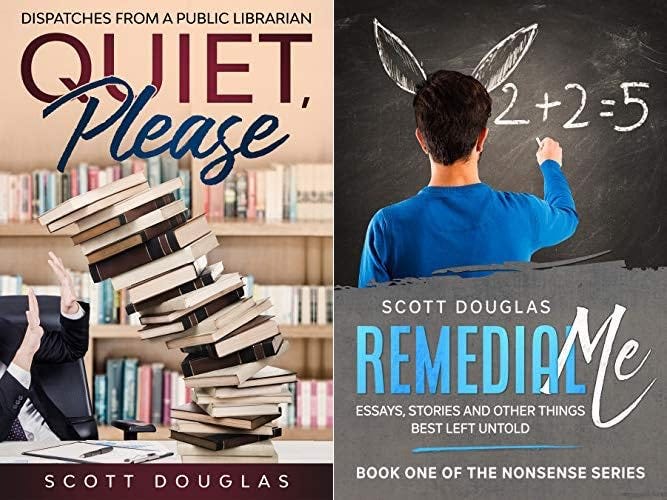
Scott La Counte observed the some of the changes at close range — first as a page, then as graduate student and as a public librarian in Anaheim, California. Writing under the name Scott Douglas, he recalls what he saw in a book he calls a “kind of” true memoir of his life amid the stacks, Quiet, Please: Dispatches from a Public Librarian, first published by Da Capo in 2008.
Douglas uses composite characters and other devices that often make you wonder how much of his book you can believe. But some incidents he describes could have happened at any public library.
Teens on drugs? Check. Power-crazed staff members? Check. A loopy patron who wanted people to listen to her theory that “World War II was thought up by Churchill and Hitler during a game of poker”? Check — unless that patron had told you instead that aliens were sending coded messages through the computers.
Douglas adopts the literary persona of a disaffected public servant who dislikes great swaths of the public. He’s a big-tent humorist whose barbs fly in all directions, including toward people it’s become unfashionable to joke about, such as firefighters and man with a disability who damages a projector cord during a free computer workshop.
The problem with this persona isn’t that it can seem mean-spirited. Many writers get away with occasional meanness because when they’re on their form, they’re hilarious — David Sedaris, P.J. O’Rourke, and Bill Bryson among them. The problem is that Douglas’ humor isn’t funny enough for what it aims to do. Too often, it comes across as smug, not witty.
At the end of Quiet, Please, Douglas suggests how libraries could improve, and at times he’s on the money: Some have implemented a few of his recommendations, such as that patrons be allowed to download material to USB devices.
Douglas may yet be proved right about other recommendations, such as that some libraries would benefit from killing the Dewey Decimal system and using a bookstore model of shelving that would let librarians direct people to the “religion books” instead of “the 200s.” He develops his ideas about libraries further in his Remedial Me: Essays, Stories, and Other Things Best Untold (SL, 2020).
But overall, Quiet, Please is less persuasive than Marilyn Johnson’s better-written and -researched This Book Is Overdue: How Librarians and Cybrarians Can Save Us All (HarperCollins, 2011). Johnson’s book is also more sympathetic to librarians. Douglas writes:
“I’d like to dispel the cliché that librarians are boring, but that simply just doesn’t seem true to me.”
You might prefer his book if you privately sympathize with the book-banners in my town who implied that our librarians were on a hydroplane to hell. But you’ll favor This Book Is Overdue if your view of librarians lies closer to Johnson’s (and mine), as summed up in the New York Times Book Review:
“They are the guardians of all there is to know. It doesn’t matter whether they carry on their efforts in analog or digital format. For they are waging the holy battle to resurrect the entire world, over and over again, in its entirety — keeping every last tidbit safe and acid free.”
Janice Harayda is an award-winning critic and journalist in the Deep South. She has been a writer and editor for Glamour, the book editor of a large U.S. newspaper, and a vice president of the National Book Critics Circle. She has written for many major media, including the New York Times, the Wall Street Journal, the Washington Post, Newsweek, and Salon.