
One Belt One Road What the Chinese learned from Victorian era British
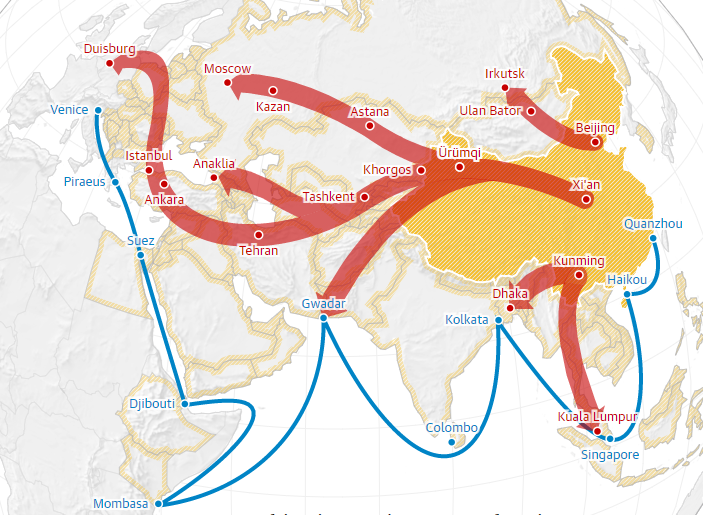
China’s One Belt One Road (OBOR) policy has taken the center stage of global politics in recent times.Dubbed as the modern silk route connecting the East and West. Its an initiative by China by lending money to countries for infrastructure projects for a long term minimal interest loans covering 60 counties. Countries use the money to develop infrastructure and expect to pay back the loan through the revenue from the infrastructure built. When the plan fails it spirals the entire economy of the country into a disaster, This ends in a simple way of leasing or lending the infrastructure to China in return for the loan payment. This is better coined as
“Debt Trap Diplomacy”
Lets take the example of Sri Lanka which got a loan of 361 million from EXIM bank of the People’s Republic of China to construct a Port of Hambatota in its southern region. The Colombo port is busy so the government thought a second port can ease the traffic and bring in revenue.Construction started on January 2008 and was completed by November 2010. Hambatota port was not making enough revenue as thought and the government ended by taking the revenue from Colombo port and paying the Chinese banks for the interest.In 2017 it was decided that the port will be leased to a Chinese merchant company for 99 years lease period to get wavier from loan. This secured the Chinese government a port in the busy Indian ocean trading route and a base of operation close to India .
Sri Lanka is not the only country which is in turmoil loosing their land to China for a loan they didn't ask in first place.
1)Pakistan is looking for a bailout and cutting short in the OBOR initiative with China.
2)Djibouti gave up a port in the strategic Suez canal for a huge loan which it owes to China. 77 percent of the entire debt of Djibouti is to China
3)Malaysia’s new government is pulling out of OBOR policy as it finds no significance for Malaysian government in the project
4)There are some countries in Africa whose 1/3 GDP is Chinese loans
By trapping these countries in loans China is stepping up its game in New age colonialism- “”Debt Driven Colonialism” and its not a new concept in the game. Chinese might have learned it from one the worst colonial power in the world “Great Britain”
East India Company a private enterprise from Britain when set foot in Indian sub continent was merely a trading company with the backing of the Queen and the parliament. In a mere 100 years then ruled over the entire Indian sub continent following these 3 steps of the British version of Debt Trap Diplomacy.
1.Helping Nawab of Arcot in War against French
When East India company settled in Madras they had a not so friendly neighbor,The French in Pondicherry. The quarrel between the European rivals pulled in the Nawab and his opponents ,Everyone took a side either with the British or the French. East India company leased their war machine to Nawab and waged the war against the French (which was bought on by the British to the Nawab of Arcot )and put up a huge bill to Nawab of Arcot after the war the over. Nawab of Arcot was not able to pay the war expenses. The Nawab ended up getting hefty loans for private British financiers in Madras. When he was not able to repay the financiers ,he was forced to give up the land revenue collection rights to the British. By lending their war machinery for a war which the Nawab was not responsible, trapping the Nawab into a debt trap British took their first step towards Debt Trap Diplomacy.
2. Forcing Nawab to pay for conflict during revenue collection
With the new guy in town the British went around making new enemies who were in good terms with the Nawab of Arcot. Now the new wars which the British got to the doors of Nawab has to be fought and the Nawab had no other option but to call for British. British started quelling one rebel after another and it was not going to end soon. The new war bill also ended up in the Nawab revenue. Literally it was a
“Free War”
for the British with conquering new territories reducing their enemies funded by the Nawab who didn't ask for this in the first place
3. Maintaining the rule
With the wars almost over the huge armies of the British needs to be paid and the East India Company was in no mood to touch its treasury. The Nawab’s were forced to pay for the standing army in their region. The Nawab’s lended huge sums of money from private British bankers fearing a mutiny. There is a famous saying by British officers when they indulge in extravaganza
“Poor Nizzy will pay for it”
4.Emptying treasury
After taking complete control over the sub continent the British started to further empty the treasury, The cost of laying a railway track in India was 4 times costlier than in Britain. Cotton was manufactured in India was sent to textile industries in Britain only to be sent back as clothes to be sold in India. India was becoming a raw material mine which is extracted to Britain and the finished product is sold back to India. In this way Indian GDP was falling record low.
To link the neo and victorian colonism.
Step 1) China built a port in Sri Lanka which Sri Lanka never wanted in first place
Step 2) Unable to pay back the loans Sri Lanka had to give up a port in its sovereign land to China
Step 3) China spend 361 million dollars and has control to a port in Sri Lanka . Even if China was willing to buy a port it would have been impossible
Step 4) Dumping Chinese goods in Sri Lanka
Its true history does repeat itself.