
One article generated 10,000 leads
Here’s what you can learn from it

Most people think “free information” on the internet is good, I personally believe it’s made us collectively dumber.
Now, you have every Tom, Dick and Harry who acts like they’re an “expert” — when the majority of them simply focus on “tactics” without understanding how they work.
In this case, I’m talking about all the “content marketers” out there, ones who believe you can generate leads by merely “creating content”.
This is the same reason why you see everybody fall for the “LinkedIn trap”, posting stuff on there everyday, just hoping people will eventually reach out — doesn’t necessarily work like that.
I mean, sure, you might finally get a few leads — but it’s rarely ever worth it.
The only people who tell you otherwise, likely have some sort of LinkedIn Course to sell, and here’s the funny part about content marketing:
It’s been a staple of advertising since the 1940’s
The longer I work in the advertising space, the more I realize how nothing is actually “new”.
This is the same reason why I couldn’t help but laugh at the “funnel craze” years ago, as everybody acted like it was the greatest invention since sliced bread.
It’s almost as if they thought it was this “brand new” tactic that’d never been used before, what they didn’t realize, is how people have been doing this for nearly 100 years.
If anything, the only item that’s changed during that time, is the “media” we’re able to deliver this with.
Back in the day, business owners offered seminars, then followed-up with attendees via “direct mail funnels”.
Today, business owners use “webinars”, then follow up with attendees via “email funnels”.
It’s literally the exact same thing, simply different mediums, and that’s why it’s funny for me to see how “bad” content marketing has progressed (well, regressed) over the years.
To give you an example of what I’m saying, one of the greatest “content marketing” pieces ever created, happened back in 1948.
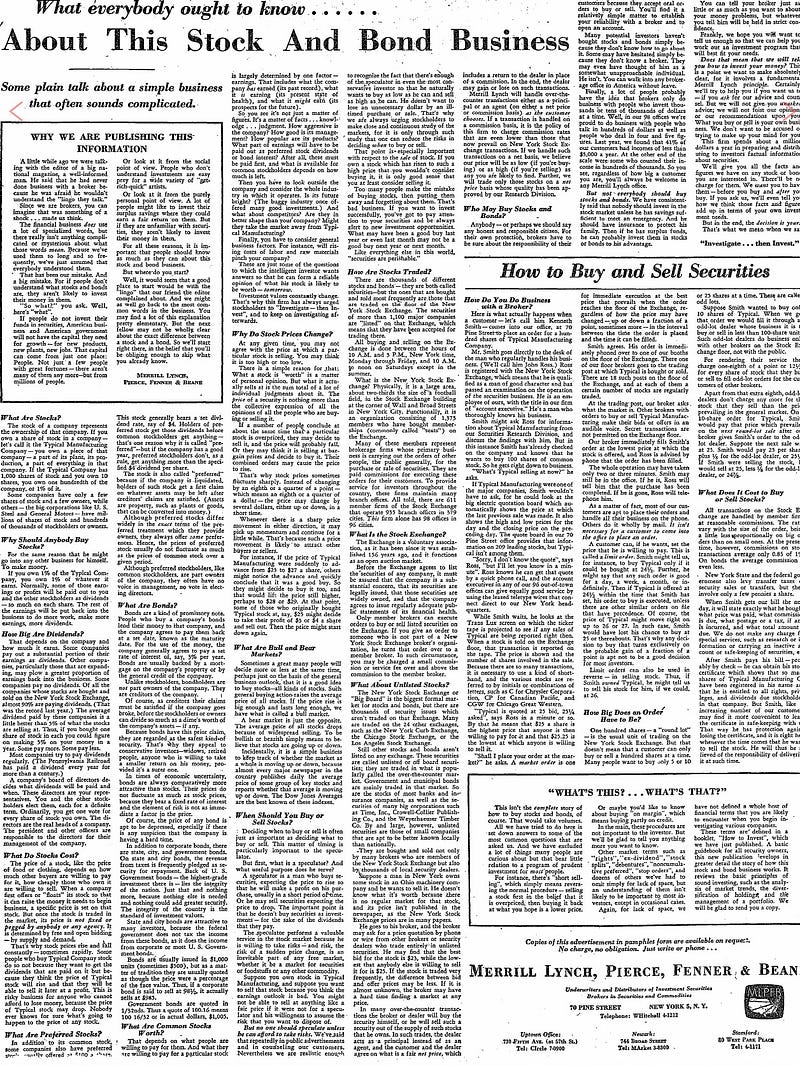
This article was written by Louis Mengel, and the company he produced this for was a “little-known” firm called Merrill Lynch.
I’m sure you’ve heard about them by this point, but back in the day, they were nowhere near the size they are now.
Instead, they were a fledgling company that was trying to get their name out there, and since Louis was always “confused” by the stock and bond business — he figured others might be in the same situation.
Seeing that, he then wrote a 6,540 word article, titled:
And as the kids say, the rest is history.
After writing this article, he paid to place it in the New York Times, having great success because of it.
It’s hard to find the “actual” results of this campaign, some big name influencers claim it generated well over 3,000,000 leads during the 20+ years it ran, but 10K is all I can confirm — and it still gives us a great understanding of how well this “worked”.
In his case, he didn’t focus on creating “content” everyday, he simply wrote one great piece and then paid to place it in front of thousands of people.
A setup that might sound “unattainable” now, as you may not have the ability to pay for “advertisements” in the New York Times, but here’s the thing:
Today’s technology has made it accessible to nearly every business
As I mentioned earlier in this article, there’s really no “new” marketing method that takes place, it’s simply different mediums for us to use.
Back in the day, all they had was “newspapers”, now — we have a gazillion different options.
- Quora
- Taboola
- Etc…
It’s almost overwhelming, but the general “logic” behind it doesn’t change.
If anything, all you really need to do is create a great piece of content, then pay to “boost” it in front of your audience.
If you don’t do this, you likely won’t get the traffic “necessary” to see results, but it’s more than worth it when done correctly.
I’ve personally done this in many different ways, generating leads that say this:
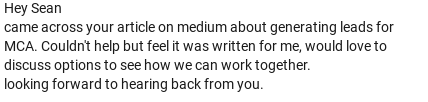
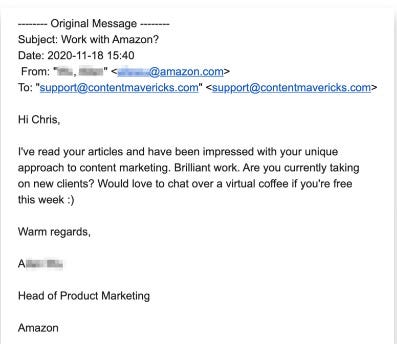
But I also know a guy who’s used the same setup to land large clients, such as:
Amazon:
And Shopify:
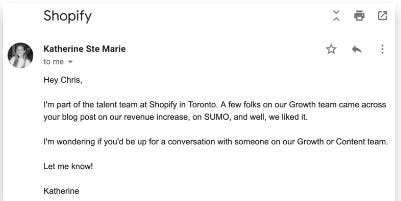
So it works on any type of business.
For the most part, you just need to get the “foundation” right:
Here’s how to accomplish that
One thing I hate about the human brain, is how we tend to look for “hacks” and “shortcuts” in the beginning stages of anything new.
It merely helps us “simplify” the process, making everything look “easy”, that hardly works.
This is the same reason why you see everybody hear about “content marketing”, then proceed to write a bunch of 500 word articles on their website, and eventually complain about how they’re not getting results.
In fact, that type of content will actually “hurt” your business, as it tends to kill SEO rankings — but I’m not here to talk about that right now.
Want to discuss the concept of generating leads with one piece of content, doing so via “paid advertising”, and it all starts with:
Step #1 — Positioning
With the term positioning, it’s something that can be perceived in multiple different ways, but in this case I’m talking about simply being “different”.
That’s actually easy to do anymore, as most people have a “sheep mentality”, and the first place you want to start is by doing “research”.
If you’ve worked in your industry for more than 3+ years, you probably already have a great grasp on this, but it never hurts to do a little extra “data collection” either way.
In the beginning stages, the first thing I do is try to see what competitors are talking about.
For example, if I found a bunch of ads (or content) that talked about:
“How to generate leads”…
Then this is something I’d want to stay away from.
Not “completely”, as I can still tie my lead generation services back to the article, but I’d never start there.
Once your market gets so used to a certain “headline”, or “main promise”, they get burned out on it — so that’s the first thing I look out for.
After that, I then like to speak with my market about the issues they’re going through, that way I can truly understand what they need to hear.
You’d be surprised with how “different” this is from what most people think as well, primarily because very few business owners take time to speak with their audience.
They always take everything at the “surface level”, saying:
“Accountants just don’t want ads for their business, they think it won’t work for them”…
When in all reality, there’s a lot of other “false beliefs” that go into it.
You simply need to ask the right questions, such as:
“Just curious, but why don’t you think it’ll work for your business?”…
Eventually getting to the root issues from there.
Maybe they heard of another firm getting burnt, so they don’t want to try it.
Maybe they’ve been burnt themselves, so they don’t want to do it again.
Maybe they think it costs $30K to run advertising, and it’s not in their budget…
Etc, the options are endless, but once you start to understand all this — “positioning” becomes very easy.
Now, you can simply let your brain “stew” on it for a few days, then have ideas start popping up after that.
I know that probably sounds a little too “simple”, but it’s how things work, and the right “positioning statement” will guide everything else you do from there.
For example, let’s go back to our “lead generation” scenario, and assume the main content revolves around:
“How to generate leads”
From there, after speaking to our target market, we begin to realize how they don’t necessarily care about “generating leads”.
Our ideal prospects already have leads coming in, but they hate the quality of them.
Seems like 50% of their calls are with “tire kickers”, wasting time everyday, and after getting this information in place — days later we start to have some “interesting” ideas pop into our minds.
Things like:
“How to generate better leads”
“Tired of tire kickers? If so, here’s how to eliminate them upfront”
“This asset not only generates extra leads, but ensures over 80% of them are your ideal prospect”…
Etc, you get the hint.
The actual headline should be much better, I’m just writing this off the top of my head, but it gives you a good idea of what “being different” would mean.
In this scenario, you’re still “generating leads”, but you’re solving a different problem with it.
You’re figuring out what they “don’t want”, which is bad leads, and then addressing that specifically.
Of course, you should be able to actually execute on this promise, but I hope that’s a given.
If you’re not skilled enough to do any of that, you either need to get better or find a different route.
Anyway, that’s one way of looking at it, but it’s far from the only option.
In some cases, your market might be completely “unsophisticated” on a topic, meaning you can keep things simple and merely write a “how-to” article.
The majority of this will depend on the “quality” of marketing that happens in your industry, as that generally translates into “market sophistication”.
Most fields are terrible about this, so it’s very easy to stand out, but some are a little tougher.
From my experience, “marketing” is probably the most difficult anymore, but even with that — it’s still easily doable.
Anyway, this is how you want to look at “positioning”, and I generally like to write my headline before moving forward anymore.
If it helps, I always do this with a “two-step” process, one that starts with a Plain English Statement.
This Plain English statement is essentially the “elevator pitch”, trying to explain my article in 1–2 sentences.
Going back to our lead generation scenario, that’d be something along the lines of:
“Most leads suck because you’re not pre-selling them upfront. You need to have a conversion asset, here’s how to create one”…
Then I’d turn that into a (customer-facing) headline.
I’d never show my Plain English Statement to the public, as people would think I’m insane, but if I turned that into a more “friendly” headline — saying:
“Tired of generating bad leads that waste all your time? If so, here’s the one asset that’ll fix this”…
Then it’s a little more “sane”, while still encapsulating what I was trying to say with my Plain English Statement.
Seeing that, we have the start of our content in place, which then takes us to:
Step #2 — Writing the actual article
When it comes to “teaching” this part of the process, it’s very hard to do, as it’s something that happens intuitively anymore.
Remember, I’ve been doing this for over 8 years now, so I have a lot of the “experience” stored in my brain — but here’s the best way I can explain it.
To start things off, you want to act like you’re “speaking” with your ideal prospect.
Don’t worry about using “proper English” or anything like that, people actually hate this type of writing.
It’s VERY hard to read, generally just puts you to sleep, but they’ll gladly read “conversational” writing.
Sure, it might not hurt to make sure everything is “spelled” correctly, but I personally don’t even think that’s TOO important.
Instead, it all comes back to the “messaging” of your content, along with hitting the main points people need to hear.
For example, if you were selling “Advertising for Accountants”, and one of their biggest concerns was:
“We just don’t want to spend $10K without getting anything in return”…
I’d begin by addressing that obstacle right from the start.
Maybe say something along the lines of:
“In this article I’ll explain how you can generate better leads, and not risk over $500 in order to accomplish that.
The main reason why most people spend more than this, is because they use “brand awareness”…
Etc, you get the hint.
Again, you’d need to make sure you can actually accomplish the main goal, but if that’s not implied by now — I don’t know what to tell you.
From there, you want to give away all the information necessary in order for them to make a decision, but you don’t want to get too overboard either.
I’ve seen other companies try some “form” of this system, generally doing so with “seminars” and all that, then killing conversions by simply giving away too much information.
Not because their prospects are “taking the information” and running with it either, but because they’re confused.
They didn’t need to know the “exact steps of creating a Facebook Ad campaign”, they just wanted a brief overview of what goes into it.
For the most part, I like to cover “strategy” here, that way they can understand what’s going on — but not get into the weeds too much.
Remember, great prospects never want to do anything themselves, they just need enough information to make a good decision.
From my experience, the best “outcome” is when you can get people to say:
“Wow, that makes a lot of sense — can you help me with this?”…
As that’s the ideal setup.
In this scenario, they’ll automatically be a “great lead” upfront, as they understand what’s going on — but there’s also minimal “selling” involved.
You’ve already accomplished that with “education”, which is a “win-win” by itself, and it never hurts to have a call-to-action at the end either.
Doesn’t need to be anything complicated, you can say:
“P.S. That’s everything you need to know, but if you’d like us to help you with this, sign-up for a call here”…
Allowing them to take the next steps after that.
This is really all you need to know from a “logistical” standpoint, you can always incorporate advanced items, such as:
- Framing
- Contextualization
- Etc…
But assuming you did the research upfront, and understand your market fairly well, then you’ll be able to “naturally” cover a lot of those topics anyway.
Seeing that, this is how you want to view your content, and don’t worry about “length” too much.
I know there’s a lot of idiots out there that say:
“Attention spans are getting short, your content needs to be quick!”…
Assuming you pick something they’re interested in, and work with people who have half a brain, that’s not the case.
Anybody will gladly read a 6K word article, if it’s actually helpful to them, the main obstacle is simply finding that.
If you write an article titled:
“How to generate leads”…
But then put this in a market who doesn’t necessarily care about “generating leads”, they just want better leads, it won’t convert that well.
On the other hand, if you say:
“Tired of generating bad leads? If so, here’s an asset that’ll fix that”…
Then you probably have their attention, and can use whatever length is necessary in order to explain everything from there.
If it takes you 3K words, use 3K words.
If it takes you 6K words, then use 6K words…
I never advise focusing on a “certain length”, as that either causes you to write fluff, or exclude important details — so just say whatever you need to say.
After that, publish your article as a “blog post” on your website, then go onto:
Step #3 — “Boosting” this content
As I also mentioned earlier in this article, one of the hardest parts about “marketing” today, is merely choosing from all the options that are available to us.
Anymore we have dozens of different ways to get our content out there, including:
- Quora
- X
- Etc…
And to make things better, there’s a good chance any of these platforms will work for your business.
Don’t know too many industries who couldn’t use:
- X
- And Facebook…
So there’s really a couple things you need to consider here.
For the first part, I like to look at what (if any) platforms you’re already active on.
If you occasionally post on Facebook, and have somewhat of a “brand presence” there, then that’s a great place to start.
I’m not saying this is “necessary” in order to get results, but it certainly helps.
A lot of people will read your initial piece of content, then go try to do a little bit of “research” on you, primarily making sure you’re real — so any form of “brand presence” will enhance your results.
After that, the second thing you need to do, is merely making sure the platform allows for targeting on your “ideal” audience.
For example, if you had to target “Accountants” specifically, then Facebook isn’t going to be your best option.
There’s certainly ways to come “close”, but they don’t have specific demographics like that, meaning there’s going to be some “waste” involved.
Seeing that, in this scenario, I’d consider LinkedIn instead.
They’re very good about allowing you to target demographics, such as Accounting firm owners who are doing over $1M/year in revenue:
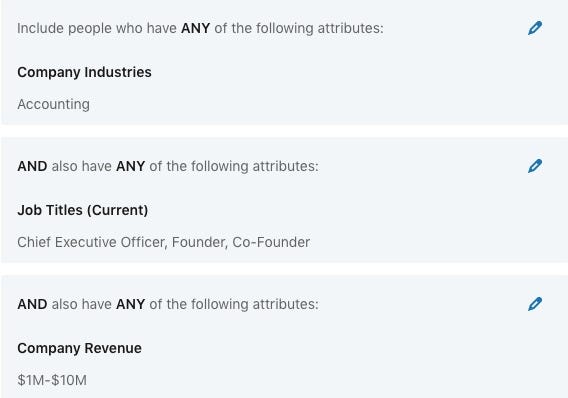
Which creates a scenario where it’s likely your best bet, even if “ad costs” are higher over there.
Anyway, I could talk about this for days, but that’s the two things you want to consider when it comes to “boosting” your content.
If you have a lot of videos on YouTube, consider creating this type of “content”, then placing it as an ad on there.
That’ll allow people to view your “ad”, like what you’re saying, then go check out other videos to make sure you’re real.
On the other hand, if you have a little bit of presence on LinkedIn, then consider that.
It’s very hard to “mess this up” anymore, as most platforms can work for your business, so simply ensure you can reach your “ideal” audience with “boosted content” — and you’re already off to a great start.
After that, you’ll want to begin with a “test budget”, which is anywhere from $10 — $50 per day.
This will also depend on the platform you choose, as Facebook is okay with small budgets, where LinkedIn or YouTube tend to “penalize” you for only spending $10 every day.
From my experience, every platform is generally okay with $30 minimum, and you’ll want to provide some time for your ad to “get data”.
Most people spend $3, don’t see results, then think their ad isn’t working.
In some cases that’s true, but most of the time, you just need to give it more time.
For me personally, I like to let my content run for at least 2 days, then begin by analyzing “clicks”.
This will make a lot more sense after we get through the next steps, but as a head’s up now, we can still get “benefits” from people clicking — even if they’re not moving forward right away.
Of course, that’s something we’ll want to analyze later on, as we should be getting some “direct” leads — but that’s not the first thing I look for.
At this stage, I simply want to make sure people are clicking on our article, and doing so in an “efficient” way.
This is something that’ll change by platform/market, but generally speaking, you want a 1% click-through-rate.
That means if your content received 1,000 impressions, you should AT LEAST have 10 clicks.
I’ve had scenarios where it’s much higher than that, but it’s a good benchmark, and the second thing I look for is “cost-per-click”.
This metric isn’t necessarily AS important, because it’s not all under our control, but it can be an indicator of targeting that’s “too narrow”.
For example, if I went onto LinkedIn and selected:
- Accounting firm owners
- Doing over $1M in revenue
- Interested in marketing services
- Etc…
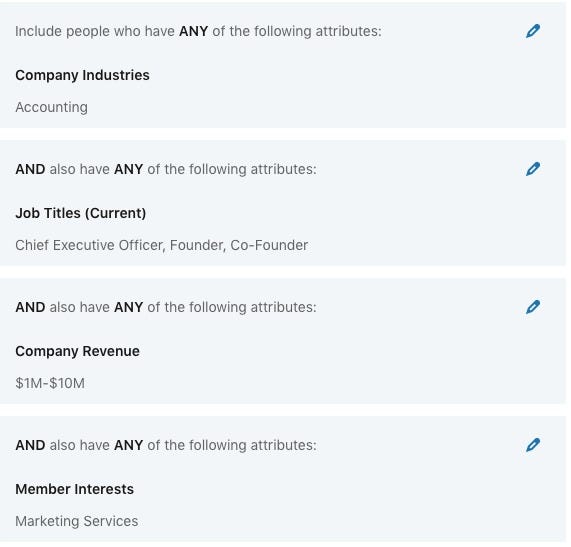
Then it’s going to be my “ideal” market, but the problem is how the more targeting options you choose, then the higher your CPM (cost per thousands of impressions) is.
In some cases, it’s worth it, but a lot of times you can “drop” a few of the advanced options and make things cheaper (while still getting similar results).
All things you’ll have to play around with, but for the most part, I don’t like clicks that are over $5.
If it’s less than that, you can still make everything profitable, but once it creeps over this mark — it’s a little harder to do.
Of course, like everything else, that will depend on your “offer” though — as some markets require this.
If you sell a highly specialized service, one that has to be shown to a specific group, charging $100K for it — then $10 clicks are fine.
Easy to make up for that, but you get the hint.
Use a little common sense here, but either way, that’s what I look for at first.
Want to make sure my article is at least getting “clicks”, before spending too much else on it, then if it is I’ll let it keep running until I get 100 clicks.
This is also a “bare minimum” benchmark, as I like it to be slightly higher, but worst case scenario — you want your article to have a 1% conversion rate.
That means if you get 100 clicks, you should have AT LEAST one direct lead reach out.
At the surface, that sounds expensive, as you feel like you’re paying for a “$500 lead” — but that doesn’t tell the entire story either.
For starters, when you have people reaching out and saying this:

The chances of them becoming a client are very high.
Most like to brag about “$10 leads”, but then have a 5% closing ratio on these leads.
That means if they spend:
- $1,000
They’ll generate:
- 100 leads
But then only close:
- 5 deals…
And I can assure you, that “extra work” is very costly.
It’s never fun wasting time with 95 “tire kickers”, and for the 5 who do move forward, they’re going to take a lot of work.
They don’t know anything about your business yet, or how you can help them specifically, so it’s going to be a drawn out sales process — one that has a lot of “hidden costs”.
Seeing that, I’d rather take more expensive “pre-sold” leads upfront, and as I mentioned a second ago — that $500 cost per acquisition doesn’t tell the entire story either.
Right now we’re only focused on the “first metric”, but we’re not even considering the dozens of other people who are “90%” sold.
Just because they didn’t move forward yet, doesn’t mean they’re not interested, which brings us to the last step:
Step #4 — Retargeting Ads
As I mentioned a second ago, one of the first metrics I look for is “clicks”, primarily because we can still get benefits after that.
One thing most people don’t realize with advertising online, is that whenever somebody clicks on your ad, they automatically turn into an “invisible lead”.
These are people who maybe haven’t reached out to you yet, but they’ve automatically been put into a “retargeting audience”.
Seeing how they clicked on our initial article, we know they’re interested in the service, and we can then follow-up with them in different ways.
For the most part, the main thing you’ll need to consider here, is “minimum” retargeting audiences.
Every platform is different with this, meaning:
- Facebook requires a minimum audience size of 100
- LinkedIn requires a minimum audience size of 300
- YouTube requires a minimum audience size of 1,000
- Etc…
Before you can run “retargeting ads” to this group, but once you reach that point, you’re set.
In addition to that, you can always “combine” ads as well, so it’s not like this minimum audience size needs to happen with one ad.
For example, if you run a first article and it gets 100 clicks, but no leads — then you’ll want to switch things up.
Maybe just need to improve your article a bit, maybe need to find different targeting, it’ll be something to test — but you can do something different and then combine the “new” clicks with “old” clicks.
That means you’re getting some benefit no matter what, even if the first article doesn’t produce any “direct” leads, and the retargeting ad process will differ from there.
Generally speaking, what I like to do is start off with a “traditional” ad at first.
Said differently, if your first article was:
“Self-employed and making over $50K/year? If so, here’s how you can save thousands on tax”…
Then my retargeting ad would piggyback off that.
Brownie points if you have a “low-friction” offer here, saying something along the lines of:
“Ready for your free tax estimate?
We’ve noticed how thousands of self-employed individuals pay too much in tax every year, we’re here to fix that.
To start things off, we provide a free tax estimate, primarily to see how much you’re overpaying.
From there, if it makes sense, we can talk about how much it’d cost for us to lower your tax liability — but that’s talk for a different time.
Right now we’re trying to see how much you’re overpaying, so if you’re interested in this, then please click on the link below:
(Insert link)
Follow the simple instructions, and we’ll take care of everything from there”…
Etc, you get the hint, but it’s not necessary either.
In other cases, you can run a similar ad, but then have a “Free Consultation” call at the end.
It’s going to differ by offer, but that’s how you think about it, and the metrics on this ad are a little harder to measure.
Generally speaking, a lot of this is going to depend on how “good” your initial article was.
If it was done correctly, a good majority of your clicks are nearly “ready” to move forward, meaning a very simple ad can generate plenty of great leads.
Not unheard of to recoup $30 “ideal” leads at this stage, which lowers our initial cost per acquisition even more, but that’s obviously not going to be the case if our first article wasn’t “great”.
Now, we have a bunch of leads who are certainly “interested” in our offer, they wouldn’t have clicked if not — but they’re still not 100% sure how you can help them.
In that case, the initial retargeting ad isn’t going to produce the best results, so I like to let this run for approximately 5 days and then measure after that.
The “beauty” of retargeting ads is how you actually don’t want to spend a lot of money on them either, primarily because your audience is so small.
If you did run a large budget, such as $20/day, you’d inflate your ad costs — so you want to keep the initial budget very low.
Again, that all depends on platform, but for Facebook specifically — $2/day is the max at this point.
You can always increase later on, as you get more people in your audience, but if it runs for 5 days and you’re not getting a lot of leads — that’s generally a good sign that you need to switch things up.
Generally speaking, I’d probably launch some form of “sales letter” ad here, where I just cover my services on autopilot.
Say something along the lines of:
“We can likely save you $3K (or more) every year — here’s how”…
Then get into the specifics from there.
“Since you’re here right now, we know you’ve read our article about how to save tax, but we want to give a brief review of how this happens.
For the most part, self-employed individuals pay too much in tax every year, simply because they’re not structured the right way”…
Etc, essentially coming at it from a different “angle”, then trying to recoup some leads that way.
If this works, great, keep it going — but you can also “enhance” the process by having some form of “retargeting content” as well.
To give you a brief overview of why this works, when you have multiple “touches” with a crowd, it’s easier to convert them.
I’m not saying this is “necessary” either, I’m just saying that “more frequency” can help overcome “mediocre marketing”.
We do trust people (or brands) we’ve seen more often, meaning your ads can become more effective (even if they’re not great), so at that point I like to write short-form content and then “boost” it in front of my retargeting audience.
If you’re not familiar with short-form content, it’s something that looks like this:
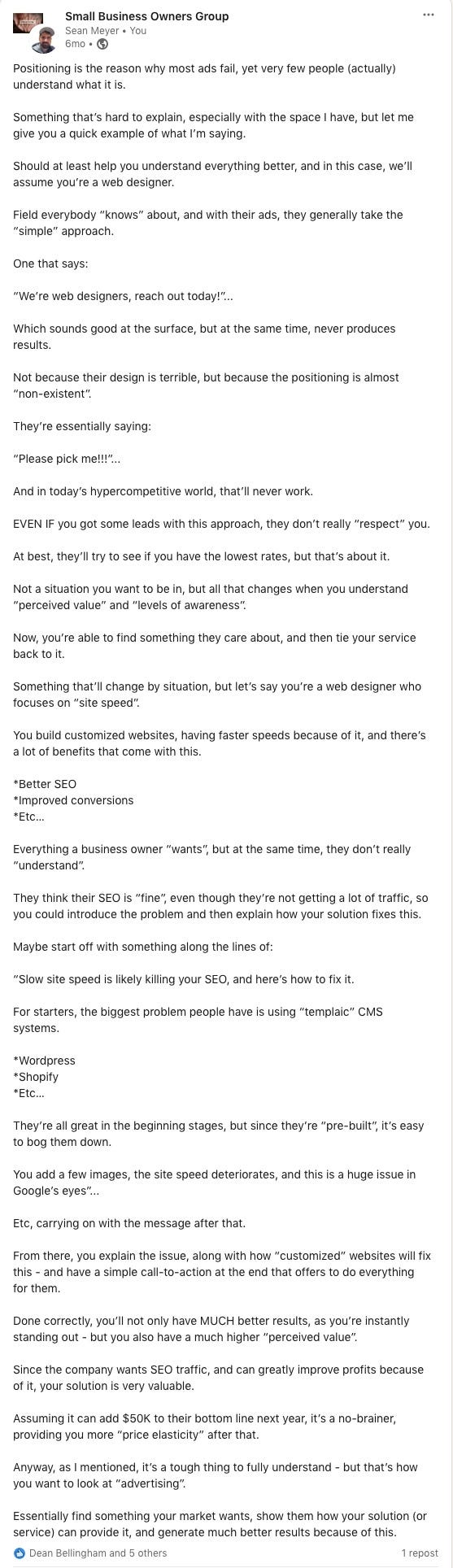
And if you do 1–3 of these a week, you’ll eventually reach a point where your audience is starting to become very familiar with you.
Doesn’t require a large budget to do this either, you can generally reach all of your audience by spending $5 — $10 on a “boosted post”, and during this time — you also want to have some form of retargeting ad running.
That means they might:
- Log-on Monday, see your retargeting ad
- Log-on Tuesday, see your retargeting content
- Log-on Wednesday, see a different piece of retargeting content
- Log-on Thursday, see your retargeting ad again…
Eventually reaching out because they’ve not only seen you so many times now, they also have a general understanding of how you can help them.
Again, I don’t recommend this as your “primary goal” either, I’m just saying this as it does mitigate some risk upfront.
Most companies try to run typical brand awareness ads, ones that look like this:

And in turn, don’t receive a lot of benefits from it.
People HATE ads, so when they see something that looks like an ad, they run.
On the other hand, people love helpful content, so they’re more apt to click on a “boosted” post.
Done correctly, that’ll start generating great leads right away, but even if it doesn’t — you can then implement an “efficient” follow-up system that turns them into leads later on.
Do this long enough, your cost per acquisition tends to get cheaper and cheaper, all done with a system that looks like this:
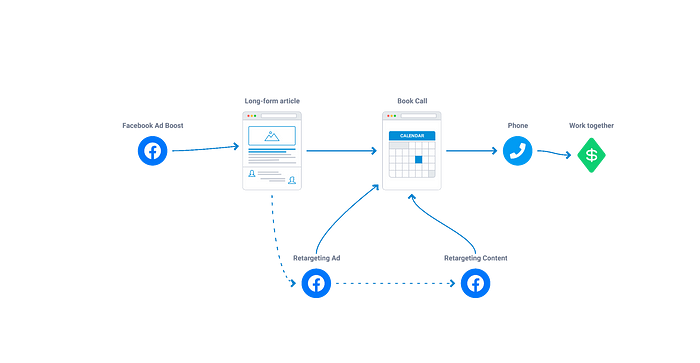
And that takes us to:
The recap
Long story short, content marketing is extremely important in today’s world, but not how most people use it.
Everybody is under the impression of how they need to “create content” everyday, then just “hope” somebody will eventually reach out, generally doesn’t work the best.
Even if you do finally get “some” leads in the door, it’s never time efficient, so I advise going back to the principles where content marketing REALLY worked — then leveraging this with today’s tools.
- Create a great piece of content, one that should convert by itself
- Use social media platforms to “boost” this content in front of your ideal audience
- If people don’t move forward right away, recoup these leads with “retargeting funnels”…
And when done correctly, that’s the best way to not only generate leads with content marketing, but “paid advertising” as well.
-Sean


