avatarEnrique Dans

Free AI web copilot to create summaries, insights and extended knowledge, download it at here

2110

Abstract

on Meta's behavioral advertising to most of Europe</h2> <div><h3>European privacy officials have widened a ban on Meta's "behavioral advertising" practices to most of Europe.</h3></div> <div><p>apnews.com</p></div> </div> <div> <div style="background-image: url(https://miro.readmedium.com/v2/resize:fit:320/0*5zR2rLTaKWWGUDso)"></div> </div> </div> </a> </div><p id="bbbc">This is precisely what I have been pointing out for many years: you CANNOT GIVE CONSENT for a company to collect certain data, because it is private and thus cannot be shared, it is not legal to do so. Therefore, when some technology companies began to collect such data, they violated a clear social consensus: that advertising should be based solely on generic data such as that used by a newspaper, a TV station or a billboard, information that simply characterizes who buys a newspaper, who reads certain sections of it, who turns on the TV at a certain time or to consume a certain content, or who walks or drives past a billboard. This information makes it possible to segment users according to some of their preferences, but it does not make it possible to identify them, much less to store this information, subject it to processing by consolidation with other services, creating a picture of users that is more complete than they themselves would be able to piece together.</p><p id="6e19">In the same way that I cannot give my consent to actions that harm me, that injure my dignity as a person or that violate my fundamental rights, it should be completely illegal for people to give their consent to receive ultra-targeted advertising. The option of <a href="https://techcrunch.com/2023/10/30/meta-ad-free-sub-eu/">avoiding this in exchange for 12.99€ per month</a> is not the issue: the practice is illegal because it forces people to give up their fundamental right to privacy and share personal data subject to special protection. <a href="https://www.nytimes.com/2023/09/01/technology/meta-instagram

Options

-facebook-ads-europe.html">The data cannot be sold</a>, because it is illegal to do so. It’s not about putting a price on it. <a href="https://www.wsj.com/tech/meta-pauses-ads-for-users-under-18-in-europe-as-it-rolls-out-subscriptions-5696c5a0">And for those under 18, even more so</a>.</p><p id="8517">That, and nothing else, is what is at the core of European laws: certain fundamental rights are IRRENUNCIABLE, and that, therefore, Meta — or whoever — cannot base its business model on that kind of advertising. Generic advertising is fine, and means competing under the same conditions as television, newspapers or radio… as indeed, it should be, and that responds to the social consensus we had before certain criminal organizations appeared on the scene, abusing our most basic rights.</p><p id="6b4f">Therefore, offering a subscription as a way to avoid hyper-segmented advertising is no solution, because it isconsidered illegal in European countries. It’s either generic ads that are not segmented according to user variables (sure, the user’s profile, and always non-identifiable and non-collectible), or nothing. What is illegal is not the failure to offer a subscription as an escape route, but <a href="https://techcrunch.com/2023/07/04/cjeu-meta-superprofiling-decision/">surveillance capitalism</a>. And Meta’s model and that of other companies is still based on exactly that.</p><p id="d8db">If I will continue to be subjected to hyper-segmented advertising because I won’t pay 12.99€, we have made no progress: Meta is still allowed to offer an illegal product and, worse still, European citizens are still allowed to give up what should be an inalienable right. If Meta believes, as it claims, that the Internet should be free and that it should be financed by advertising, it should do so through legal advertising models that do not spy on users and do not collect their privacy. Paying for the right to one’s privacy is little short of extortion.</p><p id="4e92"><i>(En español, <a href="https://www.enriquedans.com/2023/11/quiere-usted-hacerse-dano.html">aquí</a>)</i></p></article></body>

Once again, Meta flouts the law and thinks it can get away with it
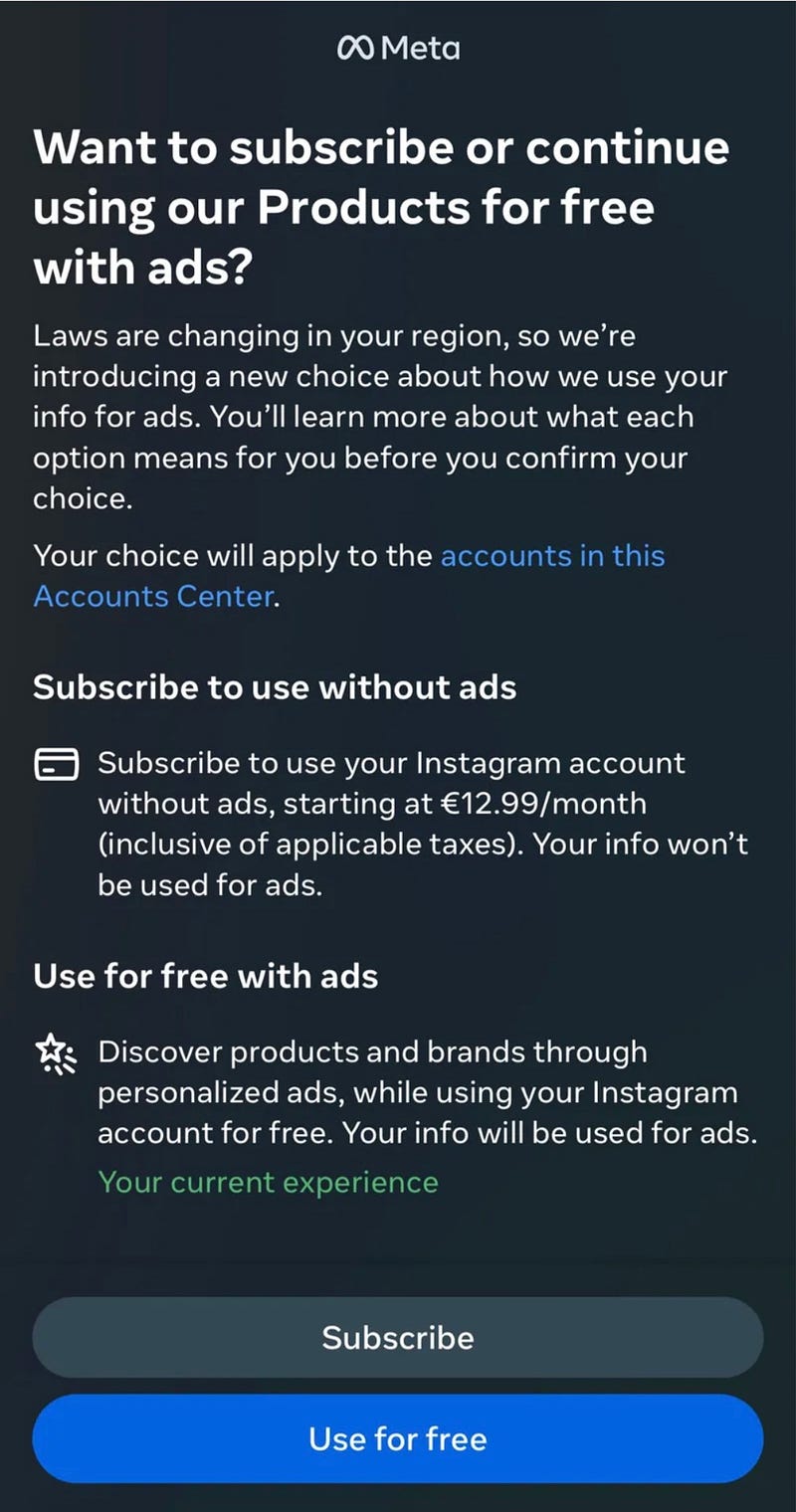
IMAGE: Meta

I’ve just come across the statement that appears when you open Meta applications such as Instagram or Facebook, offering users the ‘choice’ of paying 12.99€ a month for an ad-free experience or carry on being subjected to ultra-targeted advertisements.

As can be seen, Meta claims the need to choose one or the other is due to EU regulations. What Meta is actually doing is deliberately misinterpreting the law so it can continue doing what it was doing, knowing that very few people will take up the offer, and thus being able to argue that people are quite happy with a free service in return for ads.

It’s worth unravelling what’s going on here: European law, specifically Norwegian law, has stated, under threat of a fine, is not that the company has to offer an ad-free option, but that the type of advertising it displays is harmful and illegal, and that the data it collects is private and must be protected. This is precisely what Europe is saying, and that Meta seems to be unable to understand and seems to be ignoring like if it was written in some foreign language

This is precisely what I have been pointing out for many years: you CANNOT GIVE CONSENT for a company to collect certain data, because it is private and thus cannot be shared, it is not legal to do so. Therefore, when some technology companies began to collect such data, they violated a clear social consensus: that advertising should be based solely on generic data such as that used by a newspaper, a TV station or a billboard, information that simply characterizes who buys a newspaper, who reads certain sections of it, who turns on the TV at a certain time or to consume a certain content, or who walks or drives past a billboard. This information makes it possible to segment users according to some of their preferences, but it does not make it possible to identify them, much less to store this information, subject it to processing by consolidation with other services, creating a picture of users that is more complete than they themselves would be able to piece together.

In the same way that I cannot give my consent to actions that harm me, that injure my dignity as a person or that violate my fundamental rights, it should be completely illegal for people to give their consent to receive ultra-targeted advertising. The option of avoiding this in exchange for 12.99€ per month is not the issue: the practice is illegal because it forces people to give up their fundamental right to privacy and share personal data subject to special protection. The data cannot be sold, because it is illegal to do so. It’s not about putting a price on it. And for those under 18, even more so.

That, and nothing else, is what is at the core of European laws: certain fundamental rights are IRRENUNCIABLE, and that, therefore, Meta — or whoever — cannot base its business model on that kind of advertising. Generic advertising is fine, and means competing under the same conditions as television, newspapers or radio… as indeed, it should be, and that responds to the social consensus we had before certain criminal organizations appeared on the scene, abusing our most basic rights.

Therefore, offering a subscription as a way to avoid hyper-segmented advertising is no solution, because it isconsidered illegal in European countries. It’s either generic ads that are not segmented according to user variables (sure, the user’s profile, and always non-identifiable and non-collectible), or nothing. What is illegal is not the failure to offer a subscription as an escape route, but surveillance capitalism. And Meta’s model and that of other companies is still based on exactly that.

If I will continue to be subjected to hyper-segmented advertising because I won’t pay 12.99€, we have made no progress: Meta is still allowed to offer an illegal product and, worse still, European citizens are still allowed to give up what should be an inalienable right. If Meta believes, as it claims, that the Internet should be free and that it should be financed by advertising, it should do so through legal advertising models that do not spy on users and do not collect their privacy. Paying for the right to one’s privacy is little short of extortion.

(En español, aquí)

Meta
Mark Zuckerberg
Europe
Advertising
Subscription
Recommended from ReadMedium