
BOOK REVIEW | STRATEGY | POLITICS
On 'World Order' by Henry Kissinger
Distinct identities and attitudes of great states and empires
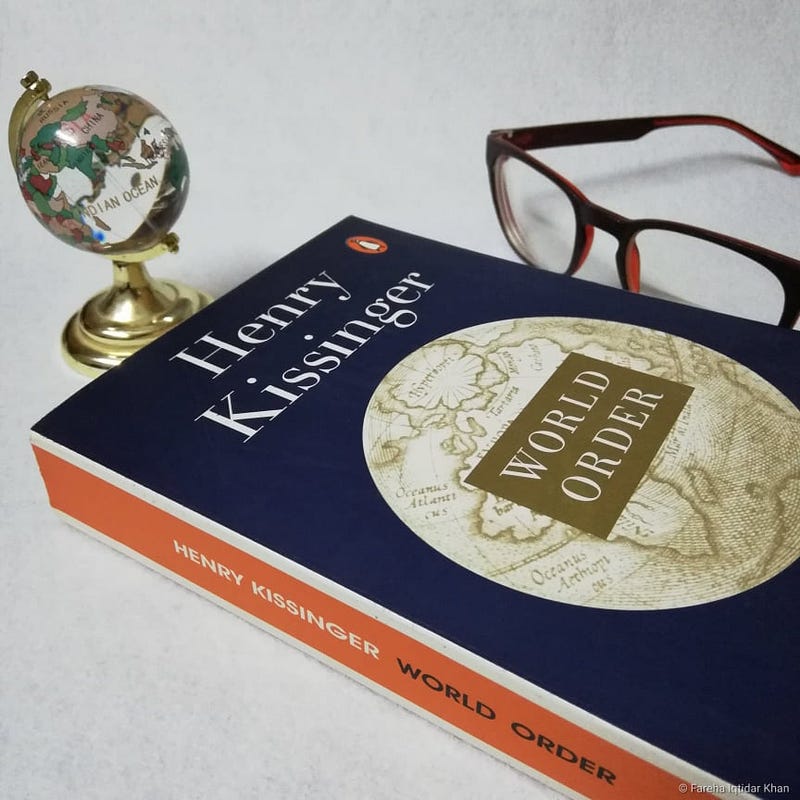
The book “World Order: Reflections on the Character of Nations and the Course of History” is written by Henry Kissinger. It was first published in 2014 by Penguin Press, USA. The book has nine chapters and 420 pages.
About the Author:
The author served in the American army during World War II and has been the secretary of State and foreign policy advisor during various presidential rules. He is also a Nobel Peace Prize laureate and currently the Chairman of Kissinger Associates Inc.
Central Questions:
World Order is an easily comprehensible and well-structured book. It revolves around three central questions.
- Are we living in a time when powers outside the check of some kind of “order” define the forthcoming scenario?
- Can geographical areas with diverse backgrounds and customary notions of order, claim the acceptability of any shared “system”?
- Whether the leaders of current world would be able to strike a balance between maintaining an international order and allowing freedom?
World Order:
The term ‘world order’ explains the ideas espoused by a geographical area or people; regarding the kind of ‘just arrangements’ and distribution of power, considered valid for the whole world. It includes the literal use of these ideas on a significant area of the world.
The book opens with an overview of all the world orders that have existed in history. No essentially ‘international’ order has been there though. United States, one of the mightiest powers of today have struggled to strike a balance between expanding its might and upholding its principles. From the system of Westphalia, Russian, Chinese and Islamic order to the current notion of New World has existed. The author argues that all these systems had certain aspects of the system of Westphalia. In order to design a world order for the current world, there is a need to formulate a balance between restrain and ‘freedom’. Also an order roots itself on a couple of constituents. First, it needs to be based on a group of rules that is agreed upon by all. Second, a ‘balance of power’ that imposes limits when rules are overridden. Besides, regional orders have the same dynamics applicable on a smaller area of land.
Key Theme:
The central thesis of the study is that power is in constant flux. It has never been the case before. ‘Claims to legitimacy’ have diversified. The reasons of crisis faced by every international order are also investigated. It has been elucidated that every global order has to address a couple of issues after a certain span of time. Firstly, the re-demarcation of legitimacy and secondly the changes in power balance. In the current world, rules have been constructed but are rendered ineffectual due to lack of rapid implementation. The founding principles of global mechanisms have essentially changed. Today people face asymmetric threats, for instance constant surveillance, extreme climatic changes and terrorism.
The author has elucidated the regions whose concepts of order have mostly shaped the evolution of the modern era. The author argues that in constructing a ‘world order,’ a fundamental problem is that of its uniting values. The problem is how to inculcate diverse backgrounds and ethos into a shared order. For instance, Islam distributed such an ‘order’ in to a sphere of peace, tenanted by believers and sphere of war that is populated by nonbelievers.
1. Multiplicity of European Order:
Kissinger describes how Europe progressed on the basis of its divisions and accepted its own fragments. The first chapter explains that such multiplicity gradually turned into an essential element of the international system. The system unified in the era of enlightenment. Fresh thought took the place of rigid ideas and convictions. The same was reflected in the installation of a global order.
2. Balance of Power in Europe:
The second chapter explores the impact of emerging nationalist drives and revolutions in Europe. The region had supremacy over international order about a hundred years ago. Presently, it faces the threat of getting out of the current pursuit of determining the international order since it needs to recognize its internal dynamics with its ultimate geopolitical purpose. If Europe continues to look within the region, it might exclude itself from the process of shaping the international system. Thus it faces the dilemma of finding a balance between a past it has to get over and a future that is still uncharted.
3. Islamic World Order
The author has explored the role of Middle Eastern region in the international order. The region currently appears to be juggling with every experience of its past concurrently; kingdom, holy war, external dominance, a sectarian rivalry of all versus all, before it determines a steady notion of world order. The Islamic order has been moving between egalitarianism versus expansionism. Moreover, two contrasting trends have remained in the region. First was ‘Pan- Arabism’ which approved of the idea of ‘state-based system.’ Second; ‘Political Islam’, focused on the reliance on shared faith as the greatest driver for a contemporary Arab distinctiveness. The Islamists espousing the idea disregard multiplicity and secular global order. Currently, the situation in Iraq and Syria signal towards a critical future situation that might comprise of state disintegration into tribal and factional entities.
4. Different Approaches of U.S. and Iran on World Order:
While investigating the U.S. and Iran dynamics, the author has highlighted how the phenomenon of Arab spring has been interpreted as an Islamic Awakening in Iran. The fourth chapter also highlights the viewpoint of Khomeini, who considers state only as a tool for a wider religious quest. Iran’s legacy comprises of three approaches towards global order. Firstly, the policy before Khomeini worked for state interests according to ‘Westphalian’ rules. Secondly, the view of Kingdom considered Iran as the epicenter of enlightened world. Thirdly, there is the Iran with the idea of Jihad. Although the doctrines of forceful subjugation are detrimental for any hopes for a world order, yet as U.S gets to interact with Iran and the mechanisms of dominance are disillusioned, there can be a hope for a vision of tomorrow.
5. Pluralistic Nature of Asia
In ‘Multiplicity of Asia’, the author has investigated how a plethora of religions co-exist in the region. Other than Japan, Asia was a target of global order enforced by colonization. Asia has appeared as one of the most significant bequests of the ‘Westphalian’ systems. People are arranging into independent states and the states are taking the form of regional forums. The quest of Japan to redefine its wider role in the world has also been discussed. The country will analyze its role on the basis a few choices; stress on association with America, adaptation to China’s emergence and dependence on a progressively ‘national foreign policy’.
6. Rise of Asia
Another significant feature of the present world order is the characteristic of Asian states to present themselves as rising. They work with the resolve that the rest of the states have still to accept their justified complete role. In the case of China there is a need to balance between their legacy of an old kingdom, ‘technocratic’ transformation and their pursuit for the fusion between the two. With respect to the global order, America has a practical outlook towards policy while China has an abstract approach. Another area of debate is the fate of North Korea. It will be a vital determinant of the “new type of great power relations” towards which the two often refer.
7. Role of U.S. in Designing the World Order
The book promotes the notion that U.S. has played the role of prime importance in carving the global order. In addition, its foreign policy is reflective of the belief that’s its internal principles were universally applicable. It implies that the actual challenge of U.S. presence abroad was the task of disseminating principles it considers the rest of the world aimed to copy. Another implication of this belief renders the states not following American principles less legitimate. Besides, Wilson’s idea of idealism led to participatory governance.
8. Role of U.S. as a Reluctant Superpower
In ‘The United States: An Ambivalent Superpower,’ the author highlights that the future U.S. needs to work on a “new endeavor.” It needs to work for a “new world of law.” It will be an international collaboration against the “common enemies of mankind.” In the past, U.S. ‘idealism’ and ‘exceptionalism’ have been the vehicles for creating a ‘new international order.
9. World Order during Rapid Development and Nuclear Era:
Lastly, the impacts of rapid advancement in the current international order are discussed. Human communication of the world today is now forced into the cyber world. Scientists now foresee that by 2020 there will be an “Internet of Everything” implying omnipresent computing and interconnection. This will tempt entities to use the arena for strategic benefit.
Critique:
There are certain critiques on the author’s arguments. The book presents the American foreign policy in a way too positive light. U.S. is presented as a ‘neo-crusader’ force. Moreover the challenge of China’s ‘rise’ is not deliberated upon explicitly. Clear correlations in the conciliation policies of the West in the present times are also not discussed. The current world comprises of disputing realisms that won’t resolve automatically. States have developed safeguards against certain elements of the rapidly globalizing world.
Conclusion:
Overall, the initiative of creating a world order; that has been under work through many generations, has in many forms attained fulfillment. Its success can be seen in the form of numerous ‘independent sovereign states’ comprising most of the globe. The world in the twenty-first century mostly shares the goal of upholding partaking government and democratic systems. Technological advancement has ensured rapid exchanges and communication. Mutual efforts to address the effects of climate change are undertaken. Moreover, global community centers its attention on resolving the issues of well-being and different ailments that were earlier thought of as a given by nature.
The ultimate task for the leaders of the world is the rebuilding of a global order. It will need a joint plan to define order inside the different regions and to relate the orders of those regions with one another. The parts of the world system; while sustaining their principles, have to attain a secondary culture that pertains to the globe or structure. Currently, modernizing the system of Westphalia according to the present realities can be one of the solutions.


