
On Ulysses: Joyce’s Book of Memory [P4]
Final part —
Penelope: A Hero in Bed
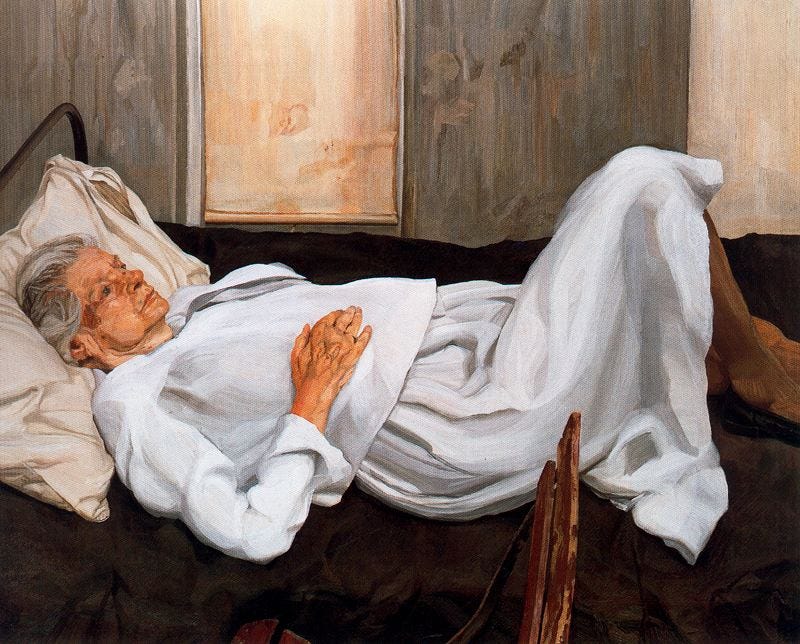
Molly is an Odyssean hero, and the bed is her ship. In “Penelope,” Joyce achieves the unfettered “torrent of consciousness” (Steinberg 1973, 277) composed of fantasies and memories. In this state, Molly becomes “the fragmented image in a cubist painting seen from a number of simultaneous but conflicting perspectives” (Henke 1990, 126). Yet, as French argues, “Penelope” is told in a single voice, devoid of the structure and narrators in the rest of Ulysses. Molly is unaware of ambiguity, and is able to sail through “the void,” thinking and acting simply whereas “Stephen is paralyzed by equal and intolerable opposites, and Bloom hotfoots his way through a maze of ambivalences” (French 1976, 245).
I believe that the crucial symbol of “Penelope,” that represents how Molly incorporates the distinct qualities of Bloom and Stephen yet resolves their faults, is the bed. According to the Gilbert schema, the bed is the “scene” of the chapter. I would argue that the bed is the nexus of mind and body, between the Earth and space, where flesh interacts with dreams. The bed also represents home, a place where Bloom and Molly can reconnect, even if in a superficial way. To go further, I contend that the bed is a revealing structuring principle for Ulysses. One can imagine the pillow as Stephen, or the Telemachiad, a resting place for the heavy intellect and the possibility for artistic creation. Next is the mattress as Bloom, or the Odyssey, the undiscriminating foundation that supports the body. Finally is the blanket as Molly or the Nostos, the shroud that Penelope weaves in The Odyssey, which covers the rest of the bed connecting the bottom to the top. “Penelope” entangles the components of consciousness into one, infinite, spontaneous sheet that nurtures the newborn Ulysses. Molly sheds the “artificiality of style” and “unremitting intellect that causes human torment,” becoming what “Joyce’s retrospective presence requires to complete both the Irish epic and his nominalistic fictionalized account of the crucial day in his life” (Schwarz 1987, 262).
Molly sees all of reality, like Bloom, as long as it is relevant to her, like Stephen. However, Molly is completely unashamed. Unlike Bloom, Molly takes no responsibility for the death of Rudy or her own sexual desires. She focuses on survival and continuation in the present. In contrast to Stephen, Molly embraces her body and sexual fantasies. Her self-interest comes from a sense of pride, rather than a desire for gain.
Molly lives for the present but thinks in the past too. When she contemplates the Boer War, she does so by remembering a former boyfriend (18.867). In fact, all of her opinions about people, including of Stephen, are based on her memories of them. It is through her memory of the Howth that Molly acknowledges Bloom’s humanistic virtues, that she does ultimately love and care about him. Spontaneous, unhindered memory is the skeleton key to understanding conscious experience and “the big word,” which is so often thwarted by the abstract baggage of intellectual thought or the frustrating automaticity of everyday life.
Conclusion
Ulysses is an attempt to recognize the isolating condition of modern society, in which a lack of coherent personal identity and the pressures of collective identity paralyzed and discouraged normal people. Joyce seems to suggest that love and a common sense of humanity make empathy and connection possible. That hope is within everybody, even the narcissistic Stephen, the starving Bloom, and the unaware Molly. It is the merger of individuals into communities that allows them to transcend being merely a “fractal of Western civilization.”
Joyce teaches us that memory is at least a significant factor in that process, as a powerful force in daily life that we all share. Memories can be painful, even traumatic. They can be suffused with nostalgia and reverie. Without an understanding of the past, the present and the future are inaccessible: “Coming events cast their shadows before.” (8.526) We must wander into memory, like Odysseus, if we want to better know ourselves and others, just as Joyce did in writing Ulysses.
Bibliography
Bergson, Henri. Matière et Mémoire (Matter and Memory). Trans. Nancy Margaret Paul and W. Scott Palmer. London: Allen & Unwin, 1962.
Birmingham, Kevin. The Most Dangerous Book: the Battle for James Joyce’s Ulysses. New York: the Penguin Group, 2014.
Budgen, Frank. Myselves When Young. New York: Oxford University Press, 1970.
Butler, Judith. Gender Trouble: Feminism and the Subversion of Identity. New York: Routledge, 1990.
Ellmann, Richard. The Big Word in ‘Ulysses’. The New York Review of Books, 1984.
French, Marilyn. The Book as World — James Joyce’s Ulysses. Cambridge: Harvard University Press, 1976.
Henke, Suzette A. James Joyce and the Politics of Desire. London: Routledge, 1990.
Jung, Carl G. The Relations Between the Ego and the Unconscious. Princeton: Princeton University Press, 1966.
Kenner, Hugh. Ulysses: Revised Edition. Baltimore: The Johns Hopkins University Press, 1987.
Lawrence, Karen. The Odyssey of Style in Ulysses. Princeton: Princeton University Press, 1981.
Rickard, John S. Joyce’s Book of Memory: The Mnemotechnic of Ulysses. Durham: Duke University Press, 1998.
Schwarz, Daniel R. Reading Joyce’s Ulysses. New York: St. Martin’s Press, 1987.
Steinberg, Erwin R. The Stream of Consciousness and Beyond in Ulysses. London: Media Directions Inc., 1973.