
On the Transformative Potential of Talking to the Dead
Reflections after observing the psychic medium, Fleur, live in Burbank, California last month
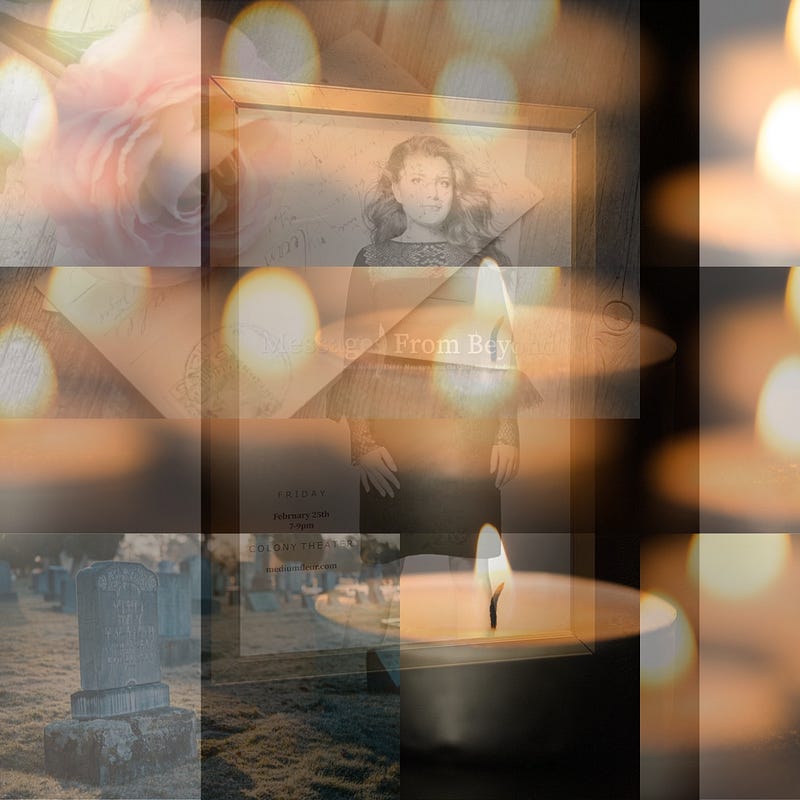
My first “post-Omicron return to the world” event was to observe a psychic medium named Fleur as she offered her readings live at the Colony Theater in Burbank last month. I attended with my best friend, who had seen her twice before. I will say that I was eager to go, but I had no idea what to expect.
I will also offer that I am not interested in writing about what I believe or do not believe about her psychic abilities.
But I am still haunted by the event, especially this week as I’ve had a desperate desire to talk to my mom, who died almost fifteen years ago.
In retrospect, it was a bit of a bizarre space as my first point of reentry to a room packed with my fellow humans. Two hundred and fifty of us were shoulder to shoulder, and it was a bit of a shock to me after two years of not experiencing anything close to this many bodies inside in one place.
In the past two years, more than six million people have died worldwide, almost a million here in the U.S., two in my family (my step-dad’s brothers, both in 2020). We have isolated from the prospect of death, hid from the prospect of death, cried at the prospect of death, protected ourselves and our loved ones from the prospect of death.
So yes, it was an odd thing — but I didn’t realize it until Fleur started her work — specifically, that of communicating with the dead. And not just any dead, but the passed loved ones of audience members.
I guess previously, before the pandemic, she would ask for volunteers, but in her current work, she reads the energy of the space and dials in — as she describes it, like tuning into radio channels — to be able to talk with and listen to the dead. She begins by scanning the rows of audience members and offering reflections of what is going on inside her mind like, “I am getting father energy from the back row” or “I’m sensing that someone over here lost someone tragically to a murder.”
Once she chooses a person to hone in on, Fleur asks questions — and only wants “yes” or “no” answers. Only a few had trouble with this — some wanted to share everything about their loved ones’ lives.
And this is the part that has left me haunted.
Many of the stories that unfolded were deeply, deeply sad.
There were some heartwarming connections: a middle-aged man whose joyful elderly mother had recently died and she just wanted him to know she loved him and his brother; an older woman whose immigrant grandmother who had long since passed wanted her to visit the old country, to see where she had come from, to honor her family’s legacy.
But oh, the other stories. My heart.
A woman whose cousin had been murdered. Somehow, Fleur knew or heard or intuited that, yes — that cousin had been murdered — but also he had a huge personality and loved to party, and that even though the woman and her family weren’t able to make it to the hospital in time to say goodbye, he knew they loved him; he knew they were on their way; he felt their love. Fleur knew or heard or intuited that her cousin had a lot of tattoos — like a lot — which made the woman laugh happily — and that the woman was the middle child of many siblings and that a few of the younger ones who were previously tattoo-averse were going soon, with the woman, to get shared tattoos to honor their cousin’s memory. Fleur said that their cousin was so tickled by the prospect of them all getting matching tattoos — and that he also wanted them to know that he was okay, that he was spending his time in the “beyond” [my words] partying and enjoying his state of being.
Another woman had lost her father when she was very young. Fleur knew or heard or intuited that the woman didn’t really know him at all, that he had died in Iraq, having served in the special forces and he was killed in action. Fleur knew or heard or intuited that this loss was blinding to the woman, that the woman felt lost in her life because of this disconnect. Fleur knew or heard or intuited that the woman’s father wanted her to know how proud he was of her and that he knew that she had been writing recently and that he wanted her to continue writing, that her writing would be a way to honor his memory.
Another woman had lost her teenage son to a drug overdose. Fleur knew or heard or intuited that it was not suicide — though that was a question that the mother had held — that this assumption was a mistake. Fleur also knew or heard or intuited that her son had been involved in sports and that he loved to skateboard and that he had been looking forward to attending college. Fleur knew or heard or intuited that her son wanted them to have a gathering to honor his memory, to decorate a skateboard as a family, to cover it with their memories of him. Fleur knew or heard or intuited that he also wanted his mother to know that he was not alone, that he had made friends in the “beyond,” that he, too, was okay.
As Fleur scanned the audience, I found myself wavering between two desires: one that she would pick me — that my mother or my father or both would push their way through what, I could only imagine, were swarms of the dead surrounding us, trying to get Fleur’s attention. (In a 2017 interview with Fleur for Vice, Fleur says they line up, but I could only imagine them hovering around us.)
Fleur even said she doesn’t know why some dead voices tune in louder than others — she even described the one man’s mother as pushy and loud — that she elbowed her way to the front of the line — which made him laugh in agreement. My mom could be pretty pushy when she wanted to be. I found myself wanting to hear from her — and wondering why she wasn’t first in line.
The other desire I held? That she would not pick me. I don’t know why. Fear of being in the spotlight? Fear of her getting it all wrong and me feeling embarrassed for her? Fear of her getting it all right and hearing truths or judgments that I don’t want to know? I don’t even think Fleur would communicate unkindly — that is not her style — but what if something stuck to my heart and left me worried about whether I’ve disappointed them? Even 45 year-old me worries what my dead parents might think.
Or what if it left me missing them even more?
Is it even possible to miss them even more than I already do?
This week I have felt a desperate desire to talk to my mom. I haven’t felt this in a while, not even that during that evening with Fleur when I was taken in by the energy of the room.
I noticed a few patterns from the evening:
- There were men and/or male-presenting people present, but the majority were women and/or female-presenting. The vast majority.
- Every single person who was picked by Fleur had a loss that defined their lives — and they were longing to receive messages from those they had lost. It was, then, I assume (except for perhaps other audience members like myself, who had no idea what they were getting into), a self-selected group of those who are believers and/or in grief and/or both.
- As I mentioned previously, Fleur was never unkind in her offering. If she was able to communicate with the dead who are angry or resentful, she did not let us know. There was a narrative arc to her moderation of each channeling: first, verification of correct person; second, unearthing of the specifics of the history of the loss; third, validation that the loved one who had passed was doing okay in “the beyond” and/or a message to the loved ones who are still alive; finally, an invitation to honor and/or memorialize the dead in some meaningful way (visit the homeland, tattoos, journaling, the skateboard).
A few years ago, I did a deep dive into research about the American Spiritualists of the late Nineteenth Century for a writing project. According to Nartonis (2010), “thousands and perhaps millions of Americans participated in Spiritualism — defined here as talking with the dead.” King (2015) states that “contemporary estimates suggest that as many as twenty million people embraced Spiritualism in the mid-19th century.”
A few additional patterns emerge that are parallel to what I observed during my evening with Fleur:
- Women were incredibly active and played highly prominent roles in nineteenth-century American spiritualism. As Shreve (2018) notes:
Mediums were assumed to be “passive,” “impressionable,” and “extremely sensitive.” These very traits had long been used to justify excluding women from participating meaningfully in public life. Yet mediumship, precisely because it was so bound to these qualities, opened a narrow professional avenue for women, without disrupting the era’s assumptions about gender. Most mediums, in fact, even embraced this definition of womanhood and attributed their vocational pursuits to spiritual forces rather than deliberate choice.
- During the nineteenth-century, many women had been diagnosed with “melancholia” or “hysteria” and had been given the treatment of a “rest cure” during which they were forced to be bed-ridden for as much as six-weeks or more (Herndl, 1998). One of my all-time favorite short stories, “The Yellow Wallpaper” by Charlotte Perkins Gilman, illustrates the insanity and inhumanity of these “rest cures,” how they were forms of abuse and gaslighting, designed not to alter the stressors that were making women experience what were also known as “nervous disorders,” but that ultimately women to the edge of psychological despair. In other words, their pain and grief was ignored or misbelieved.
- As a related historical note, I find it interesting that Spiritualism, “with its roots in Quakerism,” offered “direct knowledge and individual sovereignty” in opposition to the “top-down structure” of traditional religion (King, 2015). Spiritualism also “opposed slavery, capital punishment, appropriation of Indian lands, and traditional man-woman relationships. In other words, they rejected all types of usurpation of autonomy as unjust” (King, 2015). In other words, the practice allowed a space for believers, especially women, to question American hegemony.
- Mediums of the nineteenth-century provided comfort to a post-war, insecure nation that was filled with grief. In fact, one of the most famous people to rely on the work of Spiritualists was the First Lady Mary Todd Lincoln, while they grieved the death of their son Willie in 1862. As Nartonis (2010) notes:
Even though talking with the dead is endemic in most cultures and occurred among both native and immigrant Americans (Emmons 2003:57, 63), the sheer amount of Spiritualist activity during the third quarter of the 19th century calls for special explanation…Spiritualist activity…increased rapidly in America at a time when bereaved citizens were seeking new assurance of continuity and justice after death and when traditional religion was becoming less able to offer this assurance.
So then, many women found communal spaces to hold and honor their grief and pain.
In the 2017 interview with Fleur for Vice, she states that she receives messages from people, “— things like, ‘You changed my life, you helped my healing, I’m no longer in a continuous state of grief, I can sleep at night’” (Bassill).
Nineteenth-century American Spiritualism doesn’t sound too different what I observed during my evening with Fleur.
I’ve been silently talking to my mother all week, asking her for guidance or a sign or a message that she is close and watching over my family and that everything is okay and will be okay.
I don’t know if she can hear me.
I don’t know if there is a “beyond.”
I don’t know if it matters.
I do know that last night, after my daughter (they/them) awoke from a six-hour nap post-migraine, their ninth one within the past month, and pointed out that they can’t help but wiggle their toes constantly, that their toes and feet and ankles always have to be moving, that they always have this subconscious need to dance.
“Just like my mother,” I said. It was a running joke when I was growing up — my mother’s constantly moving feet — but it was one that I hadn’t thought of in years, nor that I had previously shared with my daughter.
As Fleur says, “At the end of the day, if you suspend the idea of believing or disbelieving or whatever, what’s more intriguing to me and the most amazing part of the work is the after-effects — the transformation. I believe in the work but I don’t think you have to in order to see the effects it has” (Bassill, 2017).
I can’t help but agree. I know that the energies of those we have lost, whether via genetics or behavior or memory, stay within us and pass on to those we love.
My daughter’s toes wiggle just like my mother’s even though mine do not, and sometimes I talk to my mother, even though she has been dead for fifteen years because I miss her and I love her and I wish that she were alive.
And even in writing this, I have honored her memory.
I have been transformed.
Sources:
Bassill, R. (2017). Meeting Lana Del Rey’s Psychic Medium, Translator for the Dead. Vice. https://www.vice.com/en/article/ywngnx/lana-del-rey-psychic-medium-fleur-interview-2017
Gilman, C.P. (1892). The Yellow Wallpaper. https://www.nlm.nih.gov/exhibition/theliteratureofprescription/exhibitionAssets/digitalDocs/The-Yellow-Wall-Paper.pdf
Herndl, D. P. (1988). The Writing Cure: Charlotte Perkins Gilman, Anna O., and “Hysterical” Writing. NWSA Journal, 1(1), 52–74. http://www.jstor.org/stable/4315866
King, C.S., (2015). Given a Bad Rap: The Women of Nineteenth-Century Spiritualism. Women’s History in the Digital World. 5. http://repository.brynmawr.edu/greenfield_conference/2015/Friday/5
Nartonis, D.K. (2010), The Rise of 19th-Century American Spiritualism, 1854–1873. Journal for the Scientific Study of Religion, 49: 361–373. https://doi.org/10.1111/j.1468-5906.2010.01515.x
Shreve, G. (2018). When Women Channeled the Dead to be Heard. JStor Daily. https://daily.jstor.org/when-women-channeled-the-dead-to-be-heard/
E. Katherine Kottaras holds an M.A. in English and an M.S. in Kinesiology with a focus on Integrative Wellness, and she is a contemplative writer and holistic teacher, having worked at the middle, high school, and community college levels for over two decades. She is a yoga teacher, personal trainer, and health coach while also living with invisible illnesses and neurodivergence, and as such, she is passionate about mindfulness, bodily self-determination, and health equity. As the queer daughter of an immigrant, Katherine believes that holistic and inclusive approaches to expression, healing, and growth should be accessible to all.
Connect with Katherine on all the social medias: IG, YouTube, FB, LinkedIn, Twitter, or at katherinekottaras.com.
Check out Katherine’s new series, Yoga with Eleonora on YouTube, which helps kids of all ages calm their minds and bodies so they can respond to and communicate their feelings in healthy ways.
Read every story from Katherine (& thousands of other writers) by signing up for Medium. Your $5/month membership directly supports writers (ad free!).


