On The Road From Lhasa To Gyantse
I visited India and Nepal for the first time on a Buddhist pilgrimage led by Shantum Seth in 2007. The following is from my 2008 trip to India, Nepal, and Tibet and is about Tibet.
I had a rather less than pleasant dream in which my mother was criticizing how I was dressed and making me feel humiliated, quite a talent of hers. Not something I should have in mind while in Tibet.
Not realizing that Bina didn’t reserve my return ticket is making me feel incredibly stupid. I’m sure I made it confusing by making some of the reservations myself and letting Bina make other reservations. Next time, I’m only going to one country! Keep the trip simple. Of course, knowing me, I’ll think: Gee, since I’m going to Thailand, I may as well zip over to Cambodia and see Angkor Wat. And what about visiting Borobudur in Indonesia?
Perhaps I shouldn’t be worrying — that’s a Buddhist teaching, or at least a Shantum teaching. I have a plan and will go through with it. Yeah, that sounds like something Thubten Chodron wrote about.
Now we’re in the minivan or jeep or whatever it’s called — and I told Gyantzing — he said no problem, he’ll take care of my return ticket. Whew — what a relief!
As usual, all my worry is for nothing. That seems to happen quite a bit on this trip: I have intense worry, and I do whatever must be done, and once it’s over, it seems like I didn’t have anything to worry about. Or I don’t even bother worrying and remain equanimous and do it.
Most of the foo dogs in Lhasa are alive. On the sidewalks, circumambulating around temples, and even exploring the Sera Monastery with humans, cute little fluffy dogs are everywhere. I especially see them on leashes on the sidewalks, and I saw several as we passed the Potala and Lukhang Park this morning. Many are yellow, or white and black, or white and yellow. I recognize many as Lhasa apsos and Tibetan spaniels.
I’ve seen large shaggy stray dogs, probably Tibetan mastiffs. We just passed a black pair that was fighting. There was a blonde one that I stroked on the head at the Sera Monastery — lying down, it was mellow.
Once I even saw a cat on a leash on the sidewalk. Its human sat at a circular café table with a couple other people. The cat did not look pleased. “What do you take me for? A subservient, worshipful, stupid, drooling dog? We are not amused.”
I haven’t written about the rats yet. In Sera Monastery we discussed this. The monasteries have rat problems and I said, “Maybe they could have more cats,” thinking of the ones I’ve seen. But cats can’t catch all the rats, because they get inside the walls. Mice are native to Tibet — little mice — but rats came with Chinese immigrants. I’m sure the butter lamps and offerings of fruits and grains feed rats well. And of course, water offerings.
“Outdoor pool” has a whole different meaning in Tibet. Pool tables are outdoors, in front of buildings, at least some of which are probably bars. The pool tables look entirely too large for the tiny shops behind them. I wondered whether the pool tables are taken inside or how they are kept out of the elements, until I saw roof-shaped green metal lids that are put on the pool tables at closing time.
I jotted messy notes on the road today:
The Yellow Tzange is a river in Gyantse, the same as we saw leaving the airport.
Chomo is a river goddess, 5500 m high, edge of river — high point with mass pass.
Down below a slope, we saw prayer flags marking a water burial place. Fish eat the bodies, instead of vultures that eat them at sky burials, a tradition for which Tibet is known.
We just passed some traditional buildings, and there was a man and woman wrestling in the road, pulling at each other. It looked like they were smiling or laughing, so maybe it wasn’t as hostile as I thought. Other people were sitting in front of a café or shop and watching with amusement. I think all of them were male. I did not feel comfortable with the situation.
I have seen countless bare willow trees with stumpy trunks that are harsh and gnarly, not like droopy elegant North American willow trees. The only reason I recognized them as willows is because they resemble the Whomping Willow in the Harry Potter films. The Whomping Willows of Tibet. Maybe if I look at one of these trees out of the corner of my eye, I’ll catch it swinging a branch at a passing vehicle.
A herd of sheep crowded in the center of the road, and I laughed. “It’s like Ireland!”
We stopped, and I got out to take pictures of the herd, but it didn’t take them long to move off to the right of the road. A young woman was herding them; she wore Western clothes, including jeans, but she had a mask over her face similar to a surgical mask, like so many women I’ve seen in Tibet, although it doesn’t have much pollution. It’s striking that I’ve only seen women, not men, wearing masks. Machismo b. s.
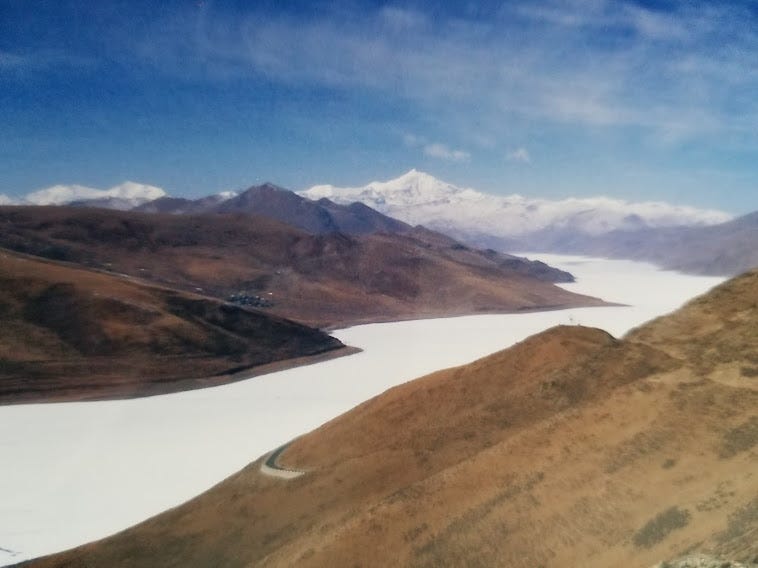
After our encounter with the herd of sheep, we came to a holy lake by Khambhala Pass, which is 4700 meters at the top. It’s a road that winds around a mountain. Actually, since “la” means “pass,” it seems a bit redundant to call it “Khambhala Pass.”
I rode a yak above the sacred lake. I kid you not. I rode a yak!! An elephant last year, a yak this year… maybe next year I’ll ride a camel… although I didn’t last year in Rajasthan.
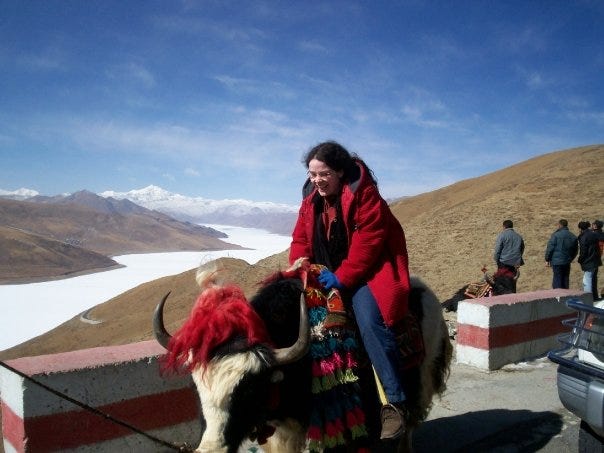
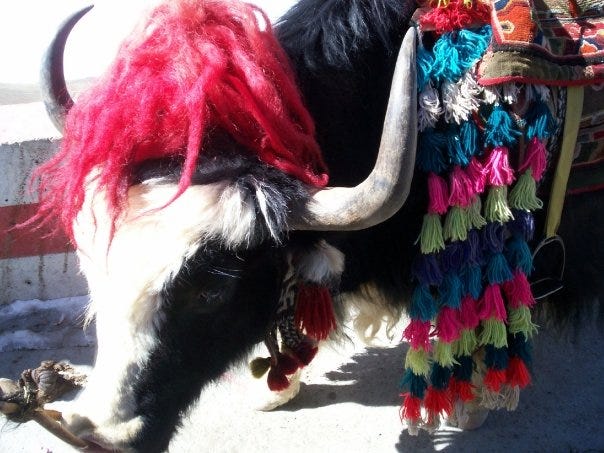
We pulled over at sight of two yaks wearing colorful saddles and bells and accompanied by a small number of people. An old guy asked me if I wanted to ride a yak.
I said, “Oh, I don’t know, I’m afraid of heights — oh why not.” I climbed on.
It was a bit scary, since my feet were so not on the ground, but it wasn’t nearly as high as the elephant last year. The yak moved forward a few yards. Gyantzing used my camera to take a couple pictures of me, and I was genuinely laughing. It seemed like such an odd situation, and I did it so casually. “Just do it,” has been my attitude on this trip. I didn’t even know if I’d survive Kathmandu.
A large, shaggy dog jumped onto a precarious concrete perch at the edge of the pass, and I took a picture of the dog. A young woman wearing one of those homemade cloth surgical-style masks held onto the other end of the leash. I paid for both the yak ride and the dog (because of course I took a picture of the doggy), and we moved on down the road.
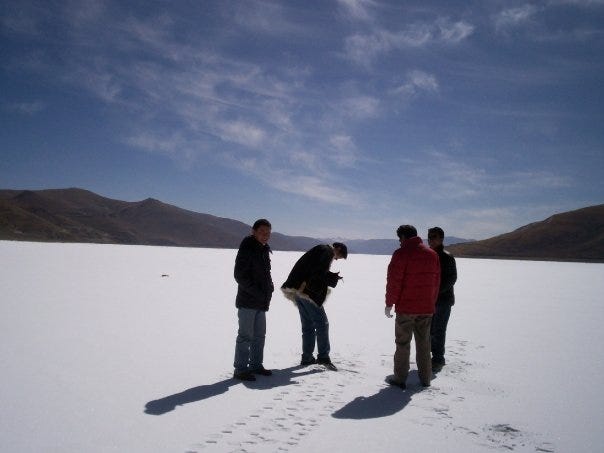
Normally the lake is turquoise, but today it’s white: frozen over and covered with snow. It is associated with dakinis, manifestations of female spirituality in Tibetan Buddhist tradition.
I’ve read about dakinis, especially in the book The Dakini’s Warm Breath: The Feminine Principle in Tibetan Buddhism by Judith Simmer-Brown. They can be old women whom a meditation practitioner runs into on the side of the road, or they can be young women, or they can be goddesses or ghostly spirits. They’re guides who help you head in the correct direction on your spiritual journey.
We stopped and approached the frozen sacred lake, where a group of Chinese guys (presumably tourists) stood directly on the ice; one had a camera with a tripod. Also out on the frozen lake was a tour guide with a tall bald guy from Holland. When he told me where he was from, I said, “I’ve been to Holland, but only at the Amsterdam airport, on the way to India last year.”
He smiled. “Most people say they’ve only been to the airport.”
I chuckled.
I shuffled snow around with my feet to form a bodhi leaf in the snow on the ice. Gyantzing used his feet to spell out: “Tibet,” “U. S. A.,” and “Netherlands.”
Back in the jeep, I continually gawked out the windows at the breathtaking scenery, the mountains and the lakes and the huge bright blue sky with fluffy white clouds. Occasionally, we stopped so I could take pictures.
We came to a small town called Nangatse, which consisted mostly of traditional houses, buildings with pool tables outdoors, and shops. One building was one story tall and made of stone, and it housed numerous shops. I also saw some plain modern buildings that housed more shops. Many women wore chupas, traditional Tibetan jumpers. This was the first full day in Tibet that I didn’t wear my homemade chupa but instead wore jeans. I’m glad, because of the yak ride. I saw a goat standing in a doorway, in front of a red door.
We stopped in this town for lunch, at a little restaurant where our round table practically filled the room.
I ordered a tofu and mushroom dish but apparently mushrooms are out of season, because they brought me a soupy dish containing big slabs of tofu, chives, and red peppers. I ordered coconut juice, and they didn’t have that either, but they brought me a can of lychee juice, which I’d never had before. It was delicious.
We were all served tea in, strangely, Dixie cups each in a blue plastic filigree-like cup holder that has a handle. The tea was hot water with bits of leaves floating in it, and the waiter kept refilling my cup, even if it was more than half full.
For the most part, it was a day of driving, driving, driving, with occasional photo stops — most notably the walk onto the frozen surface of the sacred lake.
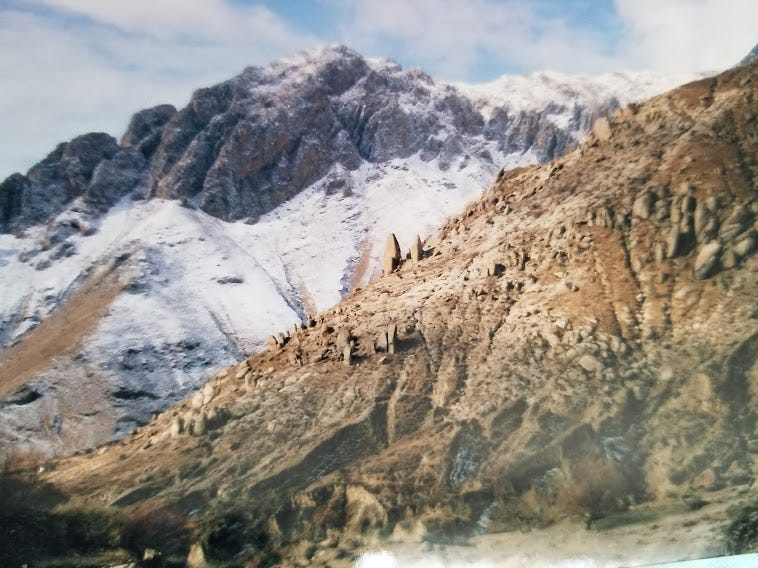
I saw frozen water, a waterfall that wasn’t falling, on the side of a mountain. It looked as though it stopped in time, something that could happen in Doctor Who. We came to the Kharla Pass, at 5500 meters, with some snowy mountains and one summit like a pyramid.
To the right of the road, I saw a charming white stupa, rather like a juniper stove, with a dramatic mountain backdrop. The driver pulled over so I could take a picture of it.
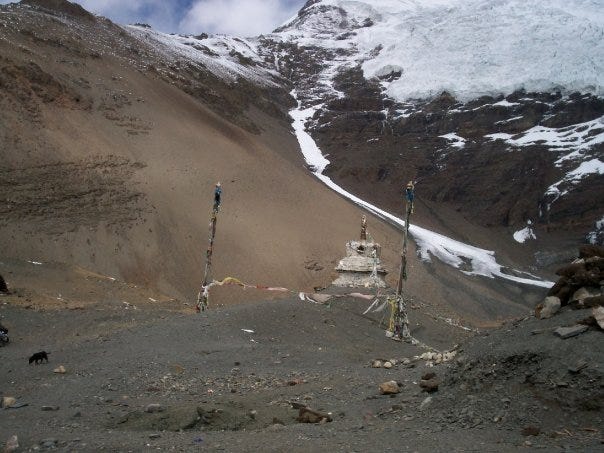
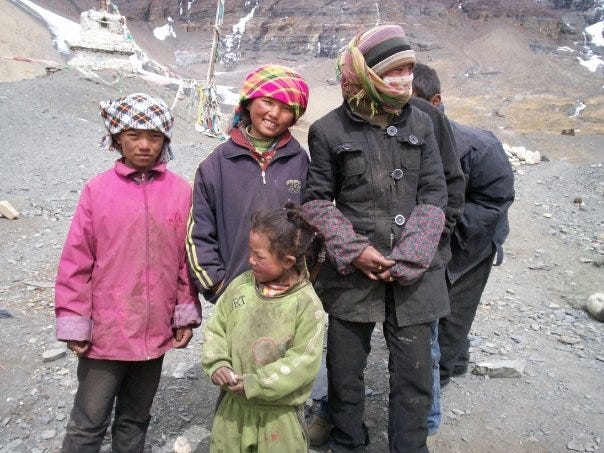
I got out and aimed the camera, when a swarm of children ran up and stood before the stupa so I’d take their picture. They asked for money, and I pulled some out of my wallet and proceeded to hand each of them a small bill. They were noisy and grabby — some expected me to give them money a second time. One of them nearly snatched the entire bundle of bills out of my hand, but I was quick. I felt overwhelmed, exactly like when I gave fruit to kids in Rajgir, India, last year. They were behaving the same way and have probably seen quite a few tourists.
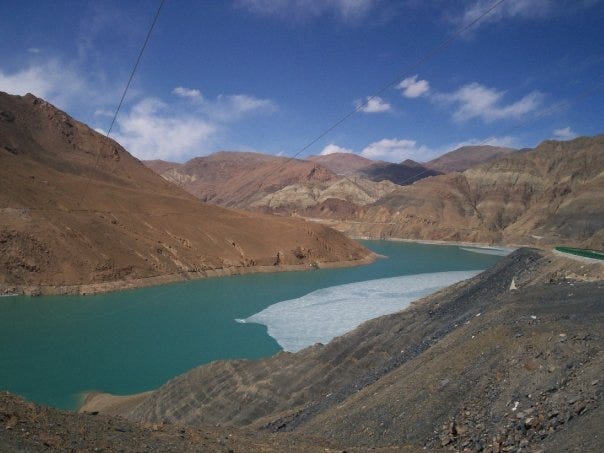
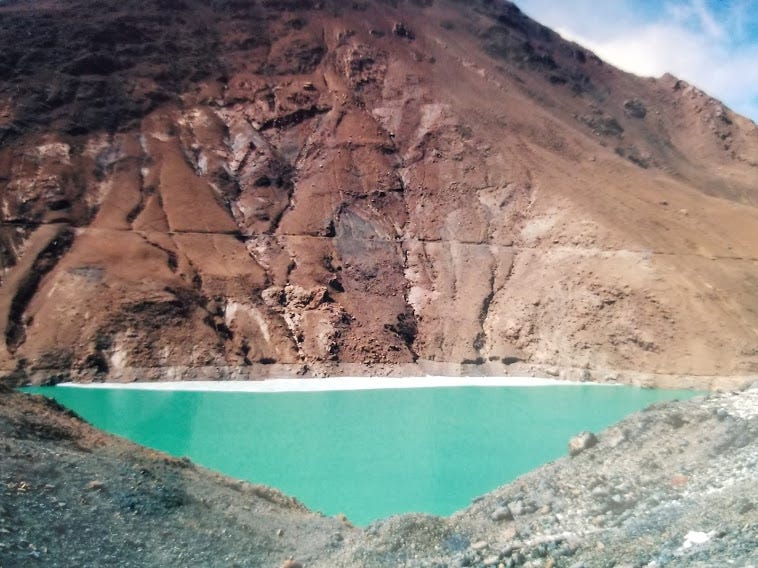
We went through a similar pass at 4200 meters and saw an artificial turquoise lake caused by a flood (perhaps thanks to the Chinese plot to cut down all the trees in Tibet). We also saw a real turquoise lake, where we stopped and I admired the view, wandered a short distance, and took pictures.
Prayer flags fluttered on a telephone pole on a mountain. It was so cold and windy. The wind sounded frantic and whispery and fast, as though it was trying to tell me something. I noticed that the wind sounds exactly like it does in the film Kundun, which is about the Dalai Lama; that wind is the last thing you hear at the end of the film. The howling and whispering wind is a haunting sound.
Bibliography
Allione, Tsultrim. Women of Wisdom. Snow Lion Publications, Ithaca, NY: 2000.
Chodron, Thubten. Taming the Mind. 2004.
Dowman, Keith. Sky Dancer: the Secret Life and Songs of the Lady Yeshe Tsogyel. Snow Lion Publications, Ithaca, NY: 1996.
Edou, Jerome. Machig Labdron and the Foundations of Chod. Snow Lion Publications, Ithaca, NY: 1995.
Gyatse, Geshe Kelsang. Guide to Dakini Land: the Highest Yoga Tantra Practice of Buddha Vajrayogini. Tharpa Publications, London, England: 1999.
Norbu, Thinley. Magic Dance: the Display of the Self-Nature of the Five Wisdom Dakinis. Shambhala Publications, Boston: 1999.
Simmer-Brown, Judith. The Dakini’s Warm Breath: the Feminine Principle in Tibetan Buddhism. Shambhala Publications, Boston: 2002.
My travel memoir Every Day is Magical: A Buddhist Pilgrimage in India and Nepal is available on Amazon here: