
On the Ramifications of Being Both White and Other
As Jewish on my mom’s side and first-generation Uruguayan-American on my dad’s side, I have always been both white and other.
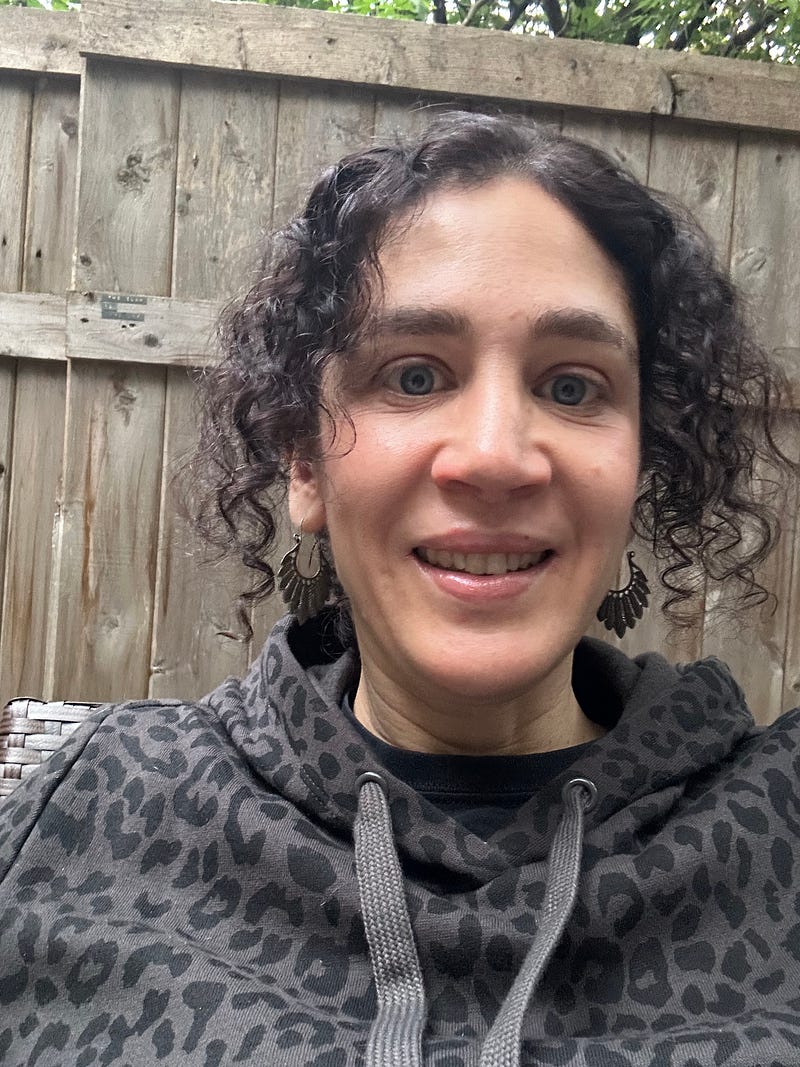
For as long as I recall, I have always felt “othered.” As a child, I was identified and labeled by many teachers and peers as Jewish simply because I look Jewish; but my features also are equally derived from my Uruguayan descent, which is mostly of Italian and Spanish heritage. Italians and Spaniards traditionally were considered swarthy and non-white.
I struggled with my feeling of being othered for much of my childhood because I also was (and am) white, with pale skin and blue eyes. Why did I feel so out of place, so othered when I also had and continue to hold white privilege? Part of it was that many of my peers and teachers immediately labeled me as Jewish, and being as I was both a secular Jew and a first-generation American whose parents took the more assimilationist approach of the times, I was largely estranged from my ancestry — from my cultural, spiritual, and ethnic roots. If I was white, why did I feel so different, I would ask myself.
My identity as both white and other continues to be a point of tension and contention. I will not deny that I experience and benefit from white privilege. I do not generally fear being profiled by the cops, by TSA security, or otherwise targeted.
Yet everything from my hair that has always been unruly, my larger features, my undeniably Jewish sensibilities, my deep-seated sense of spirituality, my tendency to lean toward humor, and my affinity with urban living continues to remind me that my Jewishness is a deep and integral part of my selfhood and identity.
I am also consistently reminded that my identity and my natural rhythms are distinctly in tension with the industrialized, puritanical, and Christian-informed ways of American culture. Jewishness is not only a religious identity; it is an ethnic and cultural identity as well, and this I’ve come to appreciate and embrace over time.
My journeys with earth medicines have further contributed to my sense of being deeply rooted in my Jewish identity, in my spirituality, in my devotion to a consistent gratitude practice, and in my sense of self.
I recently came across this podcast episode, “Eddy Portnoy on Jews and Cannabis” (available on Spotify), and in addition to the fascinating insights I’ve learned on connections between Jews and cannabis, I’ve also been reminded that Jews have a long, storied history of being persecuted as outsiders. They were restricted from many occupations, including agriculture, as both peasants and landowners, through the 20th century. Their exclusion from many sectors of society was what led many Jews to pursue working in grey markets as well as in emerging technologies.
Reading about the systematic legal and cultural persecution that Jews faced for centuries (and continue to face even in the U.S.), and considering the mass genocide of the Holocaust and the anti-Semitism that continues globally today, I am reminded that I have inherited a legacy of profound trauma, but also of immense, even superhuman, resilience and self-determination.
So when I face micro-aggressions from people because of their presumptions of my white privilege, I especially feel the sting of how people from marginalized groups can continue to perpetuate racial, ethnic, and cultural hostilities toward each other. My own experience as someone both other and white — remember, Italians historically were also not considered white — has taught me that we can have overlapping identities, and that privilege and persecution can overlap and intersect; it has also taught me tremendous self-compassion both for myself and for others, particularly those who also struggle like myself with multi-layered identities and ethnic histories.
A young woman I helped last summer who eventually extricated herself from me because she did not want to be beholden to me and knew I could not sustain how deeply I’d been helping her later tweeted that “a white [woman]” had her raising her (my) kid like the mammy figure. I’d found this young woman and read her story via Twitter, seeing that she was struggling and trying to exit sex work, and as a woman who has similarly tried to survive in capitalism while minimizing my reliance on the 9–5 work hustle, I felt compassion for her. Yet, while I was able to help her briefly stay safe and housed, in the end, she left, writing her perspective, for instance, as follows:
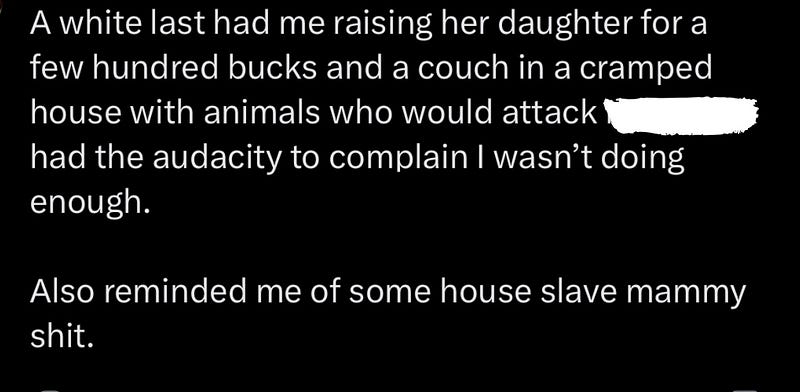
While I could have compassion for where this young woman was coming from, and, like her, I’ve struggled to make a living for myself outside of the 9–5 system, her analogy is so flawed that I also have to laugh/cry about it. I’m Jewish and a single mother, not a privileged Southern white woman who could afford a mammy to raise her child.
My child is also visibly not white. I’m only left with sadness that, in a capitalist, racist, and xenophobic culture, a desire to help a young woman while being a mom myself left this woman in the end feeling alienated. Though I helped her for two months far beyond normal or average compensation for household and childcare work, in the end, this young woman chose to block me and return to an unstable life on the streets. Her life was a sad combination of poor financial literacy, multi-layered systemic oppression, and stigmatization, and sadly she only chose to keep digging her hole deeper. Breaking out of victim mentalities and cycles can be difficult, if not impossible; as someone who struggled with coming out of the other side, I’ve realized how, while circumstances do matter, mindset is also key, especially when working to transmute trauma to power and transformation.
I’m lucky enough to never have been on the brink of homelessness, but I have experienced systematic oppression and trauma, as well as childhood neglect that only exacerbated my shyness and social awkwardness as a child. I’ve arrived at my work as a healing practitioner and advocate because of my own personal journey, and because of both my ancestral and individual traumas. I’m white, but I’ve also always been other, and othered, as well.
When people label me as white and presume privilege upon me, they negate my other identities; the assumption of privilege negates the fact that I come from a people who suffered from a horrendous, systematic genocide. The way in which I am both white and non-white, and how my Jewishness has come to be regarded as white is perhaps best exemplified in the case when Whoopi Goldberg mistakenly asserted on her show, The View, that the Holocaust was not about race. She later tweeted an apology, “On today’s show, I said the Holocaust’ is not about race but about man’s inhumanity to man.’ I should have said it is about both.”
Yet before the apology and correction of her statement, Whoopi had also stated on the show, “This is white people doing it to white people. Y’all go fight amongst yourselves.” As we see, whiteness is a construction; while Jews, Italians, Spaniards, and others who were historically not considered to be white may be considered white today, our historical oppression also exemplifies our non-whiteness and the ways in which we have been systematically othered and persecuted.
Identity is multi-faceted, and oftentimes, identities are more complex than they may seem on the surface. I’ve had mentors consider me to be “white-passing” and not white because of my Latino heritage, and I’ve also dated guys who considered me Jewish rather than white. My dad chose to not identify as Latino during his lifetime, as we are light-complexioned and of European heritage; yet my curly hair is actually from his side of the family, and clearly, my Uruguayan side is also an ethnic component of my identity. My father’s choice not to identify as Latino was also less about rejecting his heritage (which he did not), and more about wanting to show that his success was wholly merit-based, which it was. The struggle to not want to be labeled is understandable. To some people I will always be white; to some people, I never will be white, and I am not white. Identity is both self-defined and constantly presumed and bestowed upon us.
The increasing multiplicity of identity reminds me of Spike Lee’s documentary, “1,000% Me,” which featured how children of multi-racial identities have come to reconcile their disparate identities, choosing to celebrate both their heritages as well as their individuality. As multi-racial children become increasingly common, it is important that we understand that we can hold multiple identities and that we need not be confined to identifying with a singular identity.
We can be part of a marginalized group and also privileged; we can hold privilege but also recognize our ancestral and/or individual discrimination and oppressions. Identity is both self-defined and defined for us by others. So before you assume someone’s privilege or lack of privilege, please try to check your implicit biases and assumptions. When it comes to race, ethnicity, identity, and privilege, there is more than meets the eye.