
On Power and Authority in The Workplace
In which an essay I wrote five years ago about coercion in the workplace is just as relevant today, if not more so.

Waaaaaaay back in the 1960s and 1970s, before university ethics committees stamped out these kinds of experiments, two researchers wanted to know more about how human beings reacted to authority, and how positional power impacted relationships.
Stanley Milgram, a researcher at Yale, was interested in how Nazi Germany came to be, particularly the horrific and tragic treatment of Jews during this time. He wanted to understand how normal, decent people could be involved with or tolerate or turn a blind eye to state sanctioned cruelty (even psychopathy) of an appalling scale. He was interested in what part authority and obedience to authority, irrespective of whether this authority was real or perceived, had played in Nazi Germany’s genocide of Jews and their sympathisers.
Milgram’s 1961 experiment was this: a subject was asked to perform an act that would conflict with their conscience. The catch was that they had to obey an authority figure in order to perform this act. His study measured the participant’s willingness to obey the authority figure when the participant knew that they personally would be inflicting harm on the test “subject”.
You can read more about Milgram’s experiment here (or watch the video) but the main findings were that if an authority figure commanded the participant to do something — even if this clearly caused harm to another human being — there was a high incidence of obedience. Milgram found that 65% of participants would inflict harmful electric shocks to a protesting victim because a person in authority told them to do so. Authority — or the perception of authority — meant that blame could be shifted in a “the devil made me do it” kind of way.
Another researcher, psychologist Philip Zimbardo from Stanford, was interested in authority and positional power, in particular the psychological effects of being a prisoner or a guard. In 1971, in conjunction with the US Office of Naval Research who funded his project, he set up a makeshift prison in the basement of the Stanford University Psychology building and recruited twenty four male students to play the roles of “guards” and “prisoners”. The roles were arbitrarily assigned, with Zimbardo assigning himself (not so arbitrarily) the role of prison “superintendent”.
The experiment was halted after six days, when it was clear that the “prisoners” were in danger of escalating physical and psychological harm at the hands of the the “guards”, who were becoming more and more sadistic the longer the experiment went on. You can read more about Zimbardo’s research here (or watch the video) but the main findings were the “roles” or “positions” to which they were assigned caused people to behave in certain ways, depending on the social expectations of these roles. Even Zimbardo himself, in his role, was not immune.
Why we should care about the work of Milgam and Zimbardo
So why am I talking about Milgram and Zimbardo? How are experiments from the 1960s and 1970s relevant to life in 2015? Why should we care about vintage social psychology experiments, when we are so much more aware of our human weaknesses and foibles when it comes to this kind of thing?
Let me explain, because it’s to do with work. And a couple of incidents that have really got me thinking about this authority — and obedience to authority — thing in the workplace. And it’s to do with me saying… no.
I’m like to think of myself as reasonably accommodating. Within reason, and with the right approach, I am happy to pull my weight and contribute to the team effort. I say “within reason and with the right approach” because I don’t like being told: you will do this and you have no choice. I especially don’t like being told: you will do this and you have no choice when it is someone who has less experience, skills or knowledge than me in my area of expertise telling me to do something that I know is just plain wrong. Or unreasonable. Or silly. Or stupid. Or makes no sense. Or is opening a can of worms no one wants opened. I will say no and I’m not afraid of saying no (I never have been), and rarely will I budge from this position. But that’s me. Authority, in particular authority based on positional power, is not a good enough reason for me to do something.
What I have noticed of late is a curious phenomenon about positional power in the workplace: even if the person in the position of authority is incompetent or unqualified or inexperienced or incorrect, his or her subordinates will do whatever he or she asks, even if the subordinates know that the person in authority is incompetent or unqualified or inexperienced or incorrect. Sure, there’s dissent, but it’s more in the form of quiet rumblings of dissatisfaction around the water cooler, or hushed conversations in the cubicle, rather than a full on face-to-face challenge.
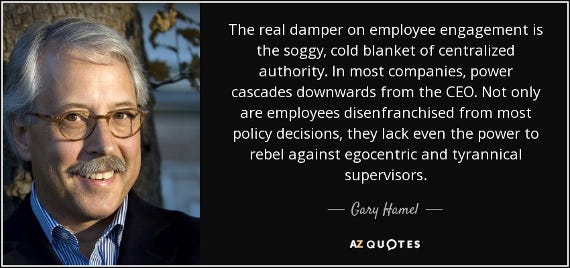
Rarely (now) will an individual subordinate take the authority figure on over his or her incompetence or lack of qualifications or incorrectness or inexperience because the repercussions are often too great: individually, socially and economically. Even rarer is the coup: where a group of subordinates (and we all know a group is often more powerful than one individual, lonesome, solo voice) challenge the authority figure — or the authority figure’s manager — and hence, force some kind of change.
What is going on in workplaces where this systemic failure to call people in authority out is the rule rather than the exception? We are quick to point our fingers at authority figures in politics or religion or education who get it wrong. Social media is full of people screaming: You’re incompetent or unqualified or inexperienced or incorrect, but we can’t seem to afford our managers and workplace leaders the same treatment. Why? Are the repercussions and risks too great to speak up and out, even when we know we should? Have we forgotten the lessons of Challenger and group think?
Diversity in name only
Our workplaces, despite diversity, anti-harassment and equal opportunity policies and promotion on merit, have become almost fascist regimes where dissenting voices are silenced via threats of economic sanctions (contract non-renewals, redundancies, sackings etc.) and corporate propaganda (behaviours aligned to values, performance agreements etc). Those in management positions are likely to be sociopaths or narcissists or your average, garden-variety bullies.
While I certainly don’t endorse message dissemination via a head on a nasty spike, as a manager, you only need to make an example of one subordinate via the aforementioned head on aforementioned nasty spike, and you get almost automatic and across-the-board compliance. It’s a very effective for managing dissent, because after all, who doesn’t subscribe to and value self-preservation? Especially in this uncertain economic climate? And especially when jobs are scarce and mortgages are huge and the cost of living is high?
Managing risk, but not really
What I also find curious is that many of the workplaces talk a lot about “managing risk” and “good governance”. Good governance should be setting up reporting frameworks to manage the business well, but in my experience, it rarely happens. Risk, in this context and again from my experience, is merely a reason not to do something. Conversely, anyone who speaks up about workplace “issues” (risk management and good governance at essentially a grass roots level) is often labelled “negative” and portrayed as a “trouble maker” and shut down, silenced or forced out.
It disappoints me that workplaces have become places where dictators (and not the benevolent kind) rule. Instead of innovation, there is control; instead of a range of views, a dominant view is forced onto subordinates; instead of creative problem-solving, there is blame and finger pointing. Instead of transparency and accountability, the dark arts* of psychological force and manipulation are practiced. Managers resort to positional power rather than real, proper leadership because they know they aren’t real, proper leaders. I guess when people in authority are incompetent or unqualified or inexperienced or incorrect, they don’t have the time or inclination or self-awareness to work on their emotional or social intelligence. Dunning-Kruger effect and all that.
Fraud, plain and simple
I will say that people who are appointed to positions of authority when they have no right to actually be in those roles (because they have neither the competence nor capability) are frauds. Nothing more, nothing less. Sure, they like the corner office and the executive assistant and the power and the “I’m so busy and important doing busy and important things” that go with the position, but everyone knows they got there by nefarious or dubious means. And unfortunately, with our workplaces in a constant state of chaos, morally bankrupt opportunists advance quickly through the ranks, bringing their cronies along with them. And they sit in those roles, wreaking even more havoc. It’s like the corporate version of A Game of Thrones, but worse, because it’s real.
No wonder people just go along with things and don’t choose to challenge the status quo. It’s almost as if they realise that the battle has been lost, as has the war. You care less. Why bother, when caring about your work, the workplace and your colleagues is not rewarded in the way it should be? So you cut your losses, and pour your energy into pursuits where you know you’ll get a better return on investment for your efforts: where you will and can make a difference. Sure, work pays the bills, and if you are lucky… very lucky… you get to work with some nice folks, but overall, I think people are starting to wise up to the fact that work is just not worth worrying too much about. There are other things that are more important or interesting or fulfilling that need attention: family, friends, creativity, social causes, the environment, to name a few. Let the sociopaths or narcissists or your average, garden-variety bullies fight it out among themselves for whatever ultimate prize they think is worth having.
Distance is golden
Unfortunately, my make up is such that I can’t just go along with a wrong, unreasonable, silly, stupid or nonsensical request. I experience a revolt at a cellular level, and I just cannot say yes. I just can’t. I wish I could, because it would make my life a whole lot easier. And maybe, just maybe I would have had a career instead of a series of loosely linked jobs that masquerade as a career. And I know I’ve made quite a few career limiting moves by saying no or not good enough. Where others have sucked it up, I’ve spat it back out. Where silence would have been the better option, the words spark in my brain, slide onto my tongue and jump out of my mouth, unstoppable and eager to wreak their nay saying havoc on my “superiors.”
What I have been able to do, in lieu of not being able to keep my mouth from spouting my words of unwelcome dissent and thereby raining pestilence and plagues upon me, is distance myself from the various managerial goings on. It’s a relatively easy thing to do because I work part-time, and my writing and publishing demand a lot of my time and energy — as does my running.
My time is spent on investing in pursuits that have a creative pay-off for me. Work is a means to an end, and pays the bills and bolsters my travel fund. I observe the various managerial goings on with both curiosity and bemusement and mirth; frustration and disappointment and anger rarely rears its Medusa like-head now. I’m not involved. Involvement is a choice, and I don’t need to be involved. More to the point, I don’t want to be involved.
I remind myself that that is not my circus.
They are not my monkeys.
This article from Psychology Today suggests that the dark arts require less cognitive energy and brain power. It’s “easier” and takes less effort to be morally bankrupt.
Fast forward to June 2020. George Floyd, as as we know, was killed by police officer, Derek Chauvin while three other police officers did nothing to intervene. All four police officers were sacked and have been charged with murder.
One of the other cops, Thomas Lane, was a rookie and had been on the job for only a few days (he had undertaken his requisite training). Lane’s defense, according to his lawyer* is:
Gray said Lane questioned his superior’s decision to keep the clearly distressed suspect pinned down — but felt he had to follow his superior’s commands.
“Now, if you’ve ever been in the military, you ask your sergeant should we do something and he says no, are you going to say, ‘Well no, I’m going to do it anyway’? I don’t think so,” Gray stressed.
I am not in anyway excusing any of those cops, or justifiying in any way what they did. They killed a man. What I am saying is that disobeying your superior is not easy, particularly in institutions like the police force or the military where officers are trained to obedient and not question orders. This is a complex situation with no easy answers. And unfortunately, tragically, a man had to die to finally highlight how dysfunctional these organisations are, and continue to be.
*The same lawyer also blamed bystanders for not intervening. Do not get me started on Bystander Effect, although in the case, intervening would probably have come at great personal cost. Recommendations are that you don’t intervene, even if you could because you could be charged with hindering police. And no good will come of that.


