
On Our Way to The Queen’s Jubilee
Did you know that the Ladies in Waiting are unpaid?
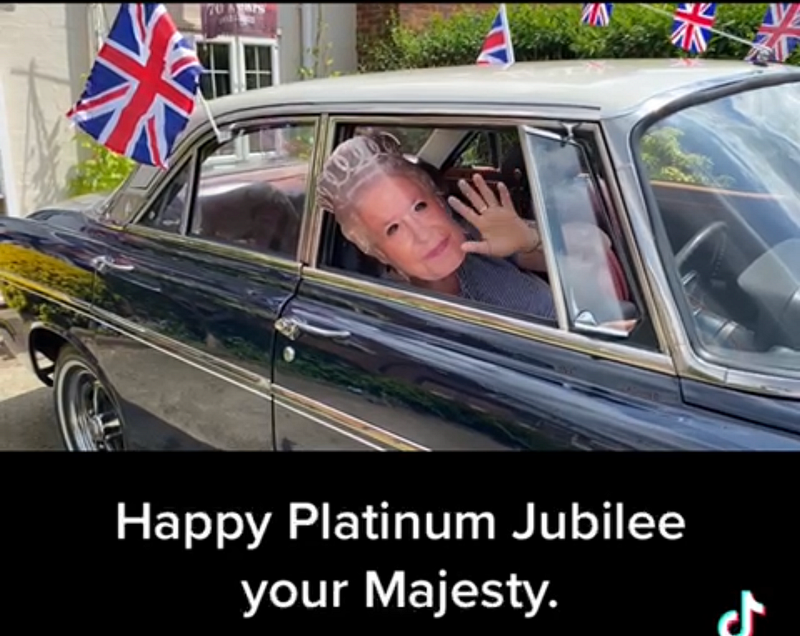
The Café Eiffel is an old Parisian coffee house, with no hint of a multinational, with cast iron tables on the sidewalk and a short distance from the tower it is named after. Jenny and I are on our way to celebrate, with my son’s family, the Queen’s Jubilee.
We decided at the last moment to stop over in Paris. There’s nothing quite like Paris in the spring, though earlier this morning, a small rain freshened up the grass alongside the sidewalks and the baskets of flowers that adorn the whole street, hanging from posts on both sides.
Two Frenchmen sat at a table near us, having coffee, were playing chess, and smoking. Jenny politely requested a different table, one farther from the two gentlemen who are oblivious to us arriving or leaving.
The new table is smaller, still outside but next to the window. Ce sera bien; Merci, Jenny says, smiling at the server. I felt saddened we didn’t remain close to the two men but understood Jenny’s reluctance, as neither of us smokes and I only blow smoke when necessity dictates, and generally in the direction of someone’s arse!.
Romantically, without intention, we reminisced about the times we’d seen the Queen. Having served the Crown, I have always kept a fondness for Her Majesty, though the family has proved itself prone to scandal and unsavory moments they hoped would never become exposed.
But not Her Royal Highness. I don’t know anyone who has been in service for their country for 70 years. It is both remarkable and a testimony to the dedication of the Queen’s service. It is not a role she asked for or even wanted, and without the footfall of history taking a misstep, she may never have been Queen at all.
As we sat chatting together, a threatening cloud began to form above us. I asked Jenny if she wanted to move inside. Paris in the rain, no way, she laughingly answered. We weren’t carrying anything to cover the springlike clothes we were wearing, and the hotel was a mile away. If it rained heavily, we could fall back on Uber.
Jenny is a great fan of the monarchy, having British parents who moved to the States when she was two years old. Jenny is not alone in her love of the British monarchy in the United States. I’m always surprised when hearing my British accent; Americans ask if I’ve seen the Queen. There is great interest in the United States for Her Majesty, though I suspect not as much as there was for Princess Diana.
When I tell Jenny that the monarchy murdered Diana, she was outraged. The facts pointed that way, she was pregnant when she died. (Why would she be embalmed in France before her body was returned to England? Answer: So there would be no autopsy. And if that baby was anything but good, strong, and not British white? Pure speculation.)
I was heading down to the south of England, passing through the rough end of Whitehawk. There were motorcycle cops at every junction, which sometimes happens if someone important is being buried and a large cortège is on its way to the burial site.
In the middle of the town, a cop sitting astride his motorbike, with arms outstretched, motioned me to pull over with a pointed finger. Best to do so, I thought. Along the route and behind me, a long convoy of different, equally shining Range Rovers and twelve motorcycle cops riding alongside a Roll’s Royce. About a hundred yards up the road, I watched as gathered students, looking bored out of their skins, started waving frantically. Then a group of paint-splattered builders, waiting to cross the road, did the same. As the procession neared me, driving slowly and respectfully through the town’s narrow main street on a pleasant spring afternoon, the most famous woman in the world was looking at them and waving a gloved hand. Everyone had stopped in their tracks, looked at the other people standing around them, and dropped their jaws without even thinking about it.
I doubted the people Her Majesty rode passed were manic loyalists. On the contrary, they were townsfolk who, without any warning, or new hairdos, new clothes, or waving miniature Union Jacks, had seen the most familiar face known to them; the face appearing on every postage stamp, coin, mug, a dinnerware for as long as they’d all been alive.
Wow! The rain fell like stair rods, straight and heavy. Jenny and I jumped up and ran inside, ordering two more café crème.
When I looked out the window, the two Frenchmen had not moved. The chessboard was being pelted with drops of rain the size of South Sea pearls and drenched their shirts in seconds. Not a movement, so intense was the moment, I guess. Perhaps it was all down to the next move, maybe a knight checkmate?
By the time the server had brought us new drinks, the sun was shining, steam rising off the pavement and the shirts of the chess players. Their ashtray was a pond with six or eight stubs floating.
Paris is, without doubt, the literary destination nonpareil for self-exiled writers. I am well known to Paris, as is she well known to me. Looking around the coffee shop, I tell Jenny to look at the women surrounding us. Every Parisian woman was wearing a hat, beautiful.
Do you see how they wear them? I asked Jenny.
Her first question back was to ask if I was disappointed that she wasn’t wearing one?
Do you see how a Frenchwoman wears it low over her brow, as if not wanting to be recognized so that only half her face is showing?
Yes, and…? Jenny queried.
I would never want you to wear such a hat, never. Your face is too beautiful to be half-hidden, I told her.
Harry, are you writing a story in your head while we are talking?
What do you mean, love?
That is an answer to my hat question that you would write in a romantic story.
I’m a stoutly but gentle Scotsman who smiles easily. I’m wearing shorts and t-shirt. Jenny, jeans, and a beautiful silk blouse, with her favorite Allbird, tree runners. This woman I’m in love with has worked through every crinkle of my nature. Then she smiles and forgives me them all.
I look at her and know what a princess she is to me in my heart. Not your everyday princess, one of those eaten by fire-breathing dragons, or one saved by a knight with a lance and tin face, but a woman to whom my life is devoted.
But yes, I admit, it was a pretty line, and yes, so that I could include it in this story.
Look, I love romance; when I’m writing, I’m always trying to be the best man in her life.
Changing the subject quickly, I asked Jenny if she knew what smell the Queen knows best?
It has to be flowers, she said.
No, not flowers; want another try?
I have no idea.
Paint, I said. Whenever the Queen attends a designated engagement, the place has been completely repainted. Everywhere, no matter where, new paint!
Hmm. I never thought of that. Do you think the Queen uses the restroom?
We call it a toilet in England. So yes, a new throne is always brought in.
Shut up!
I start giggling and drinking my coffee, only to see the two Frenchmen get up and kiss each other’s cheeks twice. I cannot tell who won the game.
Okay, do you know this? There can never be a civil war in Britain, do you know why? I ask.
Why would there be? It’s not like you’re all Americans.
Oliver Cromwell overthrew the monarchy, putting his signature to the beheading of Charles 1st. Sometime around 1649. Cromwell died in 1658, and they buried him, can you believe, in Westminster Abbey. With Cromwell gone, George Monck, once a general under Cromwell, mounted a coup.
Charles’s son, Prince Charles, was put back on the throne and crowned King Charles 2nd in 1660. When you see the Trooping of the Color in a couple of days, it is a ceremony of great importance. It is when Her Majesty’s armed forces renew their sworn allegiance to the Crown and not the government. There can be no civil war.
Why on earth was Cromwell buried in such a sacred place as Westminster?
Ah-ha, I said with glee. When Charles 2nd was king, Cromwell’s body was ordered dug up in Westminster Cathedral, hung up with chains, and beheaded.
Poor Cromwell, Jenny sighed. I wonder if we will do that to Trump?