
Leavening Dough, Fast and Slow
There’s no wrong way to leaven homemade dough. But among your options, one is certainly better.

As a trained cook and food writer, it’s hardly surprising that all things cooking hold a special place in my heart. Cooking for me is not just a livelihood but a means of self-expression. It’s my source of joie de vivre, if you will. Yet, of all cooking methods, baking is the one I hold most dear.
I find it nothing short of magical how four ingredients — a bag of flour, a pinch or two of salt, some water, and a sachet of yeast — can be turned, with a bit of kneading and a few hours of patience, into the most airy, fluffy, outright delicious baked goods imaginable.
Much of that magic can be attributed to the activity of the yeast.
Yeasts are tiny, single-celled creatures that feed on sugars and starches, both of which are found in abundance in dough. Once fed, yeasts fart out gas bubbles containing carbon dioxide as waste. Rather than escaping out into the open air, those gas bubbles get trapped in the gluten strands of the dough, leavening it.
That’s what well-leavened bread is, in a nutshell: Its lightness, its airiness comes from the gas bubbles trapped in the dough — all thanks to the yeast.
To indulge in their feast, yeasts require the right conditions.
The sustenance, already present in the flour, satisfies condition number one.
However, they also need the appropriate temperature (a.k.a. warmth) and the correct level of humidity (a.k.a. moisture).
Yeasts thrive at warm room temperature, go into a state of hibernation but stay alive at temperatures of 0 °F (-18 °C) or below, and die at temperatures of 120 °F (49 °C) or higher. Their activity significantly slows down in the fridge, but it doesn’t stop altogether.
The ideal humidity for yeast is at least 75%. This is the humidity level that’s maintained in commercial dough fermentation rooms, where store-bought baked goods are leavened. It’s also the reason my great-grandmother, may she rest in peace, used to cover the bowl holding a freshly kneaded dough ball with a damp kitchen towel.
The good news for home bakers aiming to make their own bread or pizza is that such a level of precision isn’t really required: I bake all the time, and I never worry about the temperature of the humidity level in my kitchen.
Which brings me to why I wrote this story.
There’s one final factor that goes into making airy, fluffy, well-leavened baked goods. That factor is time.
Most baking recipes underestimate, or intentionally understate, the time needed for the dough to rise — partly to get you to pick them, and partly because not all cookbook authors are skilled bakers. Unfortunately for the readers who follow along, the results are anything but good! Dough that hasn’t been given time to rise turns out dense, hard to digest, and lacking aroma and flavor.
A good rule of thumb is that most doughs take about 3 to 4 hours to rise at room temperature, and 24 to 48 hours to do so in the fridge. (You can freeze a dough for long-term storage of up to a few months, as long as you remember to leaven it at room temp or in the fridge once it has thawed.)
Leaven your dough at room temperature if you’re short on time. However, if you really want your dough to have aroma and flavor, rest it at room temp for 15 minutes after kneading, then transfer it to the fridge and keep it there overnight.
Just as quickly cooking a tomato sauce lacks the depth of flavor achieved by simmering it slowly, dough that’s rushed through the leavening process lacks richness.
(So, don’t rush your dough.)
The best part about this slow-leavening technique?
As long as you’ve got the time, it’s ridiculously easy to do.
After kneading the dough, place it in a lightly oiled bowl and cover it with plastic wrap or a damp kitchen towel. Allow it to rest on the counter for 15 to 20 minutes before placing it on one of the upper shelves in the fridge, and come back the following night come dinner time.
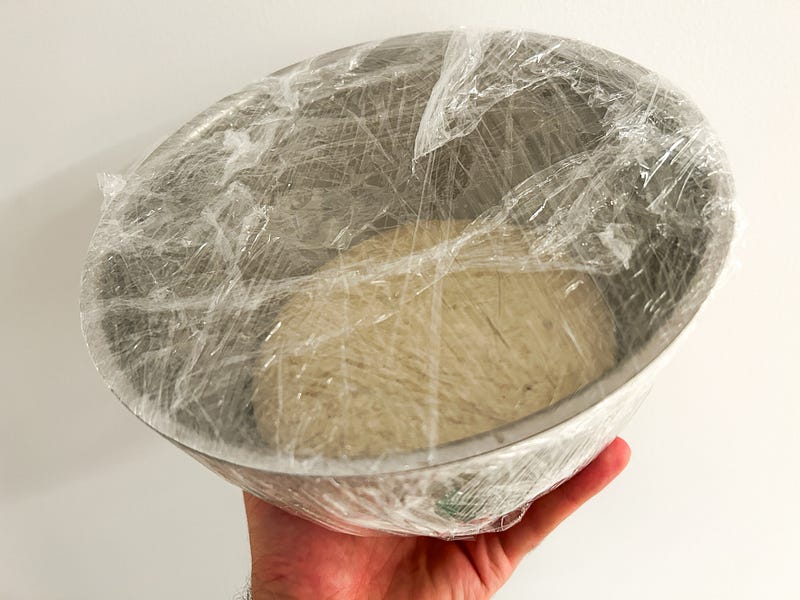
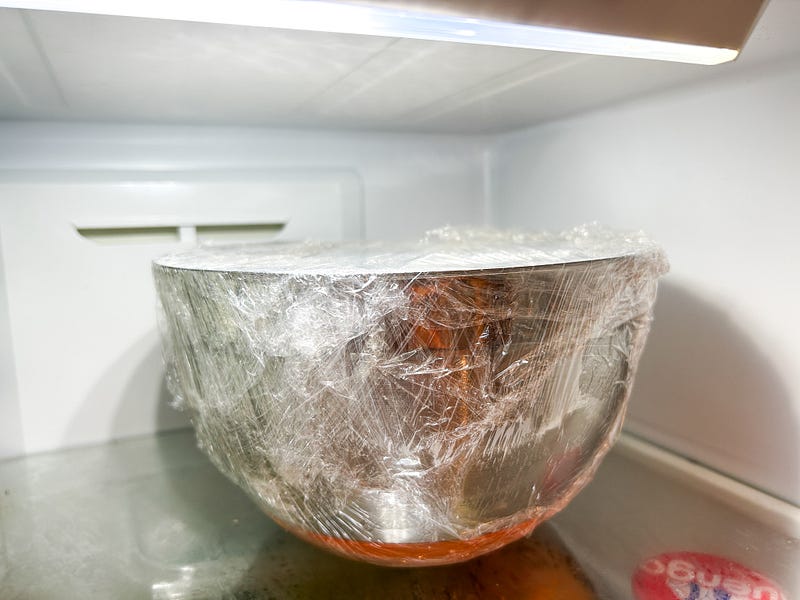
(Since cold air sinks and warm air rises to the top, the upper shelves of a refrigerator are cold, but not too cold.)
If you haven’t tried this before, trust me when I say you will love the result.
The dough will be airy and light, but also stretchy and workable. Your baked goods will turn out more aromatic, more delicious — just better. And everyone on the dining table will be in awe.


One more thing: Overnight leavening in the refrigerator also works wonders with store-bought dough. When I’m pressed for time, I buy pre-made dough, wrap it tightly in a bowl, and refrigerate it. The next day, it’s almost indistinguishable from homemade!
P.S. Thanks for reading! I post on Medium every week. Get an email whenever I do by going here →
You can also follow my Medium publication called Tastyble, where I — and other food writers — publish stories that get you cooking.


