
On Keeping a Notebook
Yes, yes, Joan Didion, and goodbye and hello to all that
This story is behind Medium’s membership paywall, which means the writer earns through our Partner Program. To become a Medium member, click here.
In her now-legendary essay “On Keeping a Notebook,” Joan Didion writes:
Keepers of private notebooks are a different breed altogether, lonely and resistant rearrangers of things, anxious malcontents, children afflicted apparently at birth with some presentiment of loss.
And later:
How it felt to me: that is getting closer to the truth about a notebook. I sometimes delude myself about why I keep a notebook, imagine that some thrifty virtue derives from preserving everything observed.
Didion is adamant that it’s not a diary and that it may be full of lies. But ultimately it’s about “keeping in touch” with oneself. I like all of this. I was once a big Didion fan. I still love her for all that she opened up for personal essayists. I don’t find her to be a journalist at all, but that’s okay.
I’m also really fond of Myriam Gurba’s brilliant homage and takedown of Didion, “It’s Time to Take California Back from Joan Didion,” which begins with these perfect sentences:
Amado Vazquez, a Mexican botanist, named an orchid after Joan Didion. While that was a chic gesture, I don’t think of her as an orchid. I think of her as an onion. She’s very white, very crisp, and she makes people cry.
Ha, you will love Gurba’s essay. If I were ever to teach Didion again, I would only teach her with Gurba.
Back to notebooks. You should keep one if you are a writer of any sort. You should keep one if you don’t feel comfortable calling yourself a writer but you like notebooks or pens or lists or markers or paintbrushes or cats or motorcycles or TikTok or really if you have likes and dislikes of any kinds.
Notebooks are good for keeping track of shit and making yourself more observant of both yourself and the world around you. Writers need these skills. Observation in and observation out.
Notebooks are perfect for freewriting, which is what you should be doing quite a lot of; freewriting can also stave off writer’s block, you know.
I don’t keep a diary, although my parents gave me my first diary when I got out of a very scary and too-long-for-me stay in the hospital when I was in the third grade. It was small and plaid with a matching plaid pencil. To say I loved it would be an understatement. I wrote in it the day I got home from the hospital and then read it to my family that night at the dinner table. You see where this is going.
I also kept one in high school, and my dad used to sneak into my room and read it, so that was kind of it for me and diaries.
But a notebook is where I do what my former colleague and friend Sandie Friedman calls “parking.” It’s for the freewriting before and after a writing session, so I know where I was and where I am going. Parking is the notes you take to find the car of your novel in the very big Target parking lot.
I used to keep a tidy notebook, but after reading The Artist’s Way a couple of summers ago, I got into morning pages for a bit and the whole idea of making a big mess. Now I write really sloppily, which for me was a wonderful, freeing shift.
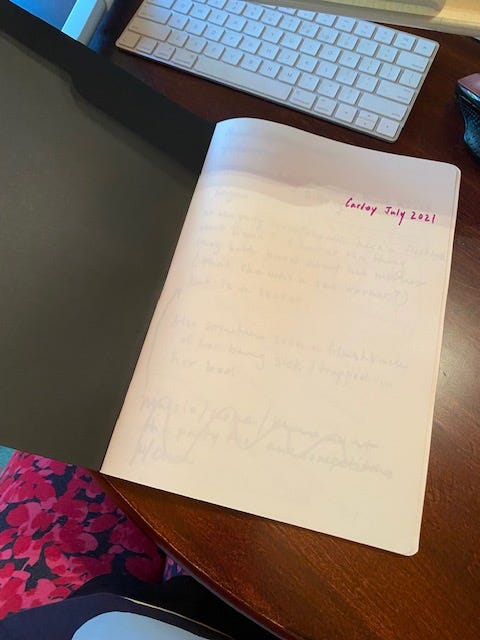
I keep a big notebook. I like blank pages and watercolor-like markers. Sometimes I draw things even though I’m not an artist. It doesn’t matter. The pen moving freely on the paper without self-censoring or fixing is what matters. Here’s mine:
You should buy a notebook and pen or pencil that pleases you, whatever that happens to be. You also probably shouldn’t get super fetishy about it, but hey, that’s your business.
I don’t have separate notebooks for separate things because it slows me down, and I don’t want to have to worry about having the right notebook at any given time.
This also fits in with my #OneCarley theory which is for another post perhaps.
Some things to keep in your notebook:
- Overheard language
- Imagery/descriptions of what you see, hear, smell, taste, and feel around you
- Rants
- Plot ideas
- Dialogue
- What scene is next, though not too much ahead of that
- Outlines, if you must, though I’m not a big outline person myself
- Things you ate that made you happy
- Fantasies for the future
- Poems
- Sexy thoughts
- Misery/rage
- Letters you won’t send
- Reflections on things you fucked up and/or patterns you are working on
- Reminders to be nice to yourself and/or not be a dick to others
- Political actions
- Fashion
- Freewriting!
Send me pics of your notebooks?!


