
On How Mindshifts, Cultureshifts & Worldshifts Catalyze Regeneration
Over the past month, I’ve been part of a new media experiment known as “Clubhouse”, an invite-only cross between talk radio, an audio-only conference panel session favored by Elon, Oprah, Meghan, and a host of celebs — but that’s not why I’m there.
Some friends and I have been running 3 sessions a week on Mondays, Wednesdays, and Sundays at 18:00 hours Central European time, 09:00 Pacific Time, and 12:00 Eastern Time so do drop in when you can. We’re talking about many things, including our visions for a regenerative economy, what integral leadership means and how it is showing up, tipping points and acupuncture points in the global transition, as well as how mindshifts can catalyze culture shifts and worldshifts.
Starting with 3 hosts and their friends, we’ve now had conversations with over 60 people from all four continents chiming in. And what deep, rich conversations they have been! So, today I’ll share with you some gems from our last call on how mindshifts can catalyze culture shifts and worldshifts.
“Hi, thank you, and let’s begin. On robinshandouts.com you’ll see a slide that explores how mindshifts can catalyze culture shifts and worldshifts. Our overall theme is integral leadership. Our moderators and co-hosts Eric and Jeremy are editors of Integral Leadership Review. What I’m going to say this evening focuses on this particular slide called mind shifts and culture shifts because it occurred to me as we were planning for today, that we haven’t really talked about the fundamental law like nature of human development, change and transformation that underpins what we call tipping points and acupuncture points.
Part of the challenge of doing any kind of work in the transformation or change game is that you have to actually understand not only the world out there, the context but also the perspectives that you’re using to see the world and what we call a multi-perspectival approach. So, to begin with, we all start off with what we might call a default mindset. This default mindset shapes who we are being, what we enact, and what we sense and prioritize in the world. It also limits what we see, feel and touch- sometimes becoming a form of tunnel vision and rigid attachment to dysfunctional opinions, attitudes, and beliefs.
That clearly has a huge impact on what we will see as potential tipping points and acupuncture points in the global transition- especially our ability to accurately position a needle in the social body to unblock some of the energy and information trapped in the blockages that stop change and prevent transformation. For example, one of the most acute blockages we’ve seen in the past few decades is the failure of fossil fuel companies to adapt to a future powered by renewable energy, electric vehicles, and ultimately hydrogen power sources.
Let me begin with a quick overview of some of the basics of psychological development and how we can understand ourselves and others better in order to understand the world better and understand those tipping points and acupuncture points.
There are roughly 400 scientifically validated studies and schools of research that map human development and they agree on circa eight stages of development. In the center of the diagram below, which I developed for a new series of online training programs I’m doing with some amazing people, you can see a human head and at the bottom, you can see a beige sort of cloud in the brainstem just above the throat.
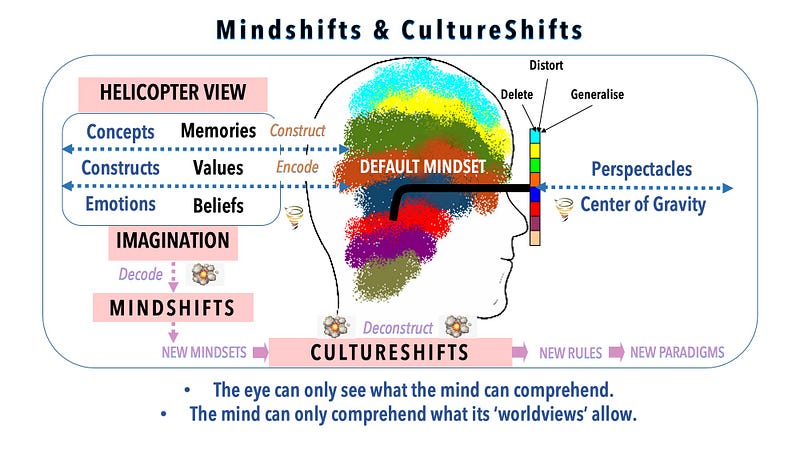
When we looked at the four interacting layers of evolution about a week ago we saw that there were four levels of evolution, starting with the brainstem. In nature and most species that have ever existed, evolution has been a Darwinian process- for example, the fish at the edge of a shoal of fishes being eaten by dolphins, whales, and larger predators generally don’t reproduce as they get eaten before they can do so. This applies generally to all species relying on instinct and speed of flight to escape predators.
Moving up from the beige to the purple and red shaded levels, we get to the limbic system which came later in evolution. Here we find Skinnerian evolution based mainly on conditioning. Most species with limbic systems show their young behaviors that are conducive to improving their chances of survival. In humans, we use this form of conditioning to establish some of the basic rules and principles of a healthy society.
For example, most education systems effectively condition children (set rules, rewards and punishments) to behave in certain ways both in the classroom and on the playground. If that does not work, the criminal justice and prison systems have to deal with anti-social behavior for those too traumatized to learn in traditional educational environments.
Then, moving up to the blue and orange shaded areas, higher mammals have a neocortex that enables us to develop hypotheses to compare and contrast options. This forms the basis for scientific exploration of ourselves and the exterior world, where we learn to experiment and prototype new ways of doing things and build on successful experiments.
As we go through these different stages of evolution and development in ourselves we move through various worldviews, from the Tribal to the Imperial to the Traditional, then modern and postmodern worldviews. After the first six worldviews, what emerges next in adults that have done the hard work of personal development, is the yellow/teal or integral worldview. This is the first worldview in which we can see all the other worldviews and understand we need to meet people where they’re at, and that we cannot change people, we can only support them to develop themselves.
Our integral leadership colleague Brett has talked much about that in our last few calls and so when we get to Globalview, the turquoise shaded area at the top of the head in the diagram, we find we’re much better at seeing and empathizing with very different perspectives. As a result of being more open and more aware of others and our shared contexts, we get much less distortion, generalization, and deletion of perspectives at this level.
Opening up to a much wider variety of perspectives while also appreciating and building on what is working for them, is one of the characteristics of our conversations about Leadership here in this Clubhouse group. We’re coming at these conversations from a global perspective where we are evolving a planetary civilization that is regenerative, inclusive, and developmental.
This is the first time in history that a planetary civilization has become possible, but it also comes with all sorts of drawbacks and issues not the least of which is climate change and global overheating. At the same time, we notice the clash of worldviews that occurs frequently every day, whether we’re reading the newspaper or touring around social media.
We notice the conflicts and compromises that characterize our world most. Only very seldom do we see the synergies that can emerge between diverse cultures with great effect. I believe this might explain the popularity of fusion cuisine and shows that feature the chefs of the world creating spicy, tasty dishes that make our mouths water as we watch.
When we become more open to all of the upsides of a tolerant, curious, imaginative planetary civilization that brings together the synergistic aspects of wildly different cultures, we also find ourselves being enriched in ways we could not even imagine before. This matters, even more, when we seek to change and transform the many challenging, negative features of our globalized planetary systems and the entrenched beliefs that we often find in response to those challenges. Understanding the values and beliefs of ourselves and others who are very different from us is a key that unlocks many closed doors.
A fundamental idea that’s recently become established in cognitive science is that emotions are actually constructs and vice versa. Until EQ (emotional quotient) and emotional intelligence came along in the 90s, psychology and cognitive science often treated emotions as a problematic thing- something that human beings have, but if you become too emotional, you’re not being rational, and if you’re not being rational that’s very bad because the whole of modernism is based on people being rational and constructive. Perish those troubling emotions!
When, however, you have pre-modern, modern, postmodern, integral, and global perspectives coming together all at once, the common language all of those worldviews speak is emotion. For those who are emotionally literate, it is possible to identify and empathize with others without having to express complex thoughts using language. Welcome to the world of emojis, likes and claps on social media, and cat videos. Social media companies have learned how to generate dopamine hits for users of their services, which is addictive. The perils of addiction can be avoided, however, with a combination of willpower and a sense of context, which allows us to remain detached from the emotional storms the media profit most from, whether an endless series of tweets from a sociopathic, emotionally deranged President or the latest kerfuffle around a conspiracy theory or an unfolding disaster somewhere in the world. Unbridled emotions are very powerful things indeed.
This brings us back to global transitions, blockages to change and transformation, and in particular, acupuncture points. The metaphor of acupuncture points is powerful precisely because has at its core the phenomenon of blocked energy, something which we encounter at all scales in the universe, from black holes trapping immense amounts of energy and light through their massive gravitational fields to locked-up, rigid muscles in human beings where toxins have accumulated and where muscle tension is preventing release and healing through normal means.
We also find trapped energy in suppressed memories and phobias, where individuals have suppressed certain experiences and feelings due to their being too painful or charged for them to handle. When you actually put a needle in an acupuncture point where there’s great pain with locked up muscles, the acupuncture needle, if it’s put in the right place, unblocks the energy trapped in that painful set of muscles.
This also works because that specific acupuncture point is located along a meridian of energy that receives and transmits information to and from the rest of the body. Our bodies process information all the time through our cellular and nervous systems, something that has also recently been validated by science.
And so too, in families, teams, communities, and societies, we find flows of energy, information, matter, and meaning, which when blocked or attenuated become sources of dis-ease in the body politic. We tell ourselves many stories about life, the universe, and everything to make sense of what otherwise appear to be random or capricious events and phenomena, that enable us to accept things as they are, as change takes energy and courage while following the path of least resistance is much easier- until things get bad enough when people start seeking ways to unblock the system, as the pain of the status quo mounts.
Human minds create their own personally constructed realities, and out of those personally constructed realities emerge socially constructed realities, which either help or hinder us in terms of shifting our culture towards one that would be regenerative and inclusive. Until the pain and suffering implicit in a degenerative, exclusive, rather soulless materialistic consumerist culture get bad enough, the half of humanity locked in its grip will continue business as usual.
So, the question for each of us as change agents, agents of transformation and conscious evolution is: “How can we understand ourselves and others better so that we can make the mind shifts and culture shifts that enable the capability shifts and the world shifts the world needs to happen right now?
I think I’ve probably said enough on that for the moment, so I would like to finish by reading a few paragraphs from an enchanting article by Jonathan Rowson entitled: “Tasting the Pickle- Ten flavors of meta-crisis and the appetite for a new civilization”. After I read these three paragraphs I’ll hand over to the next speaker for their thoughts.
“Something or perhaps somehow is emerging. It might be an impending disaster that looms. But our growing awareness that the first truly global civilization is in peril is also an active ingredient in whatever is going on. Therefore, the most important action we can take — and it is a kind of action — is cultivating the requisite qualities of perception and awareness. In order for new ways of seeing ourselves and the world to arise, we need not so much to resist our current predicament, which often serves to reinforce it, but to reimagine it.
Imagination is indispensable to help us to transgress our limitations, and while we like to think there are no limits to imagination, it is shaped and to a large extent constrained by the world as we find it. Our task, then, is to allow the intellectual premises of the process of destruction that is underway to be dismantled, which requires acute discernment about what exactly is going wrong and where precisely the scope lies for a renaissance.
When the intellect serves the imagination without seeking to fragment it, distinctions begin to feel like our friends. To say societal collapse is inevitable is not shocking: it’s a truism. Societies and civilizations are mortal, and we even have reason to believe that, regardless of human activity, our planet and solar system are time-limited. The issue at stake is a matter of timing and our relationship to time, and what follows for our responsibility to attend, feel and act with a discerning sense of priority.”