On Consciousness And The Universe
To Assume the Universe has consciousness is to assume a lot
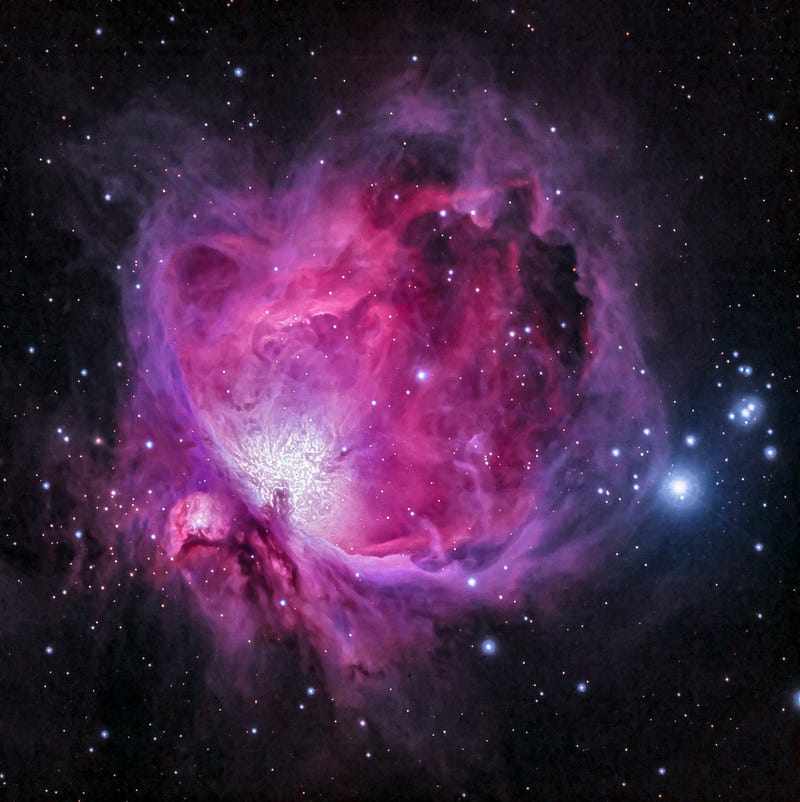
The Universe is bigger than us, but is it smarter?
We sometimes argue about whether there is a God, whether the creation itself assembled itself, and whether it has a kind of consciousness.
This question is somewhat meaningless.
There is no kind of consciousness that we can conceive of without our own.
That is, if we are only “consciousness” we know of, and we contemplate ourselves and compare ourselves to something so much greater, we miss on a very grand, and very cosmic scale.
We have no choice but to project that how we “think” is how another entity would think.
We know what we are, now how we are
Yes, we know that we are composed of the stuff of the stars. But, beyond that, our psychology is very limited.
One might say that our physics is far ahead of our neuroscience in this sense. We simply do not know how the matter in our brains assembles itself into an awareness. We can’t yet grasp what consciousness really is.
We know more about chemistry than we can prove, or know, about the mind. We know more about empirical things than we know about how our thoughts work. We even are beginning to know more about the stars and other worlds than we can know about our inner world as yet.
We even struggle, even in modernity, with belief systems. Why do we have such varying belief systems? Why are we so tribal in them?
Agency and acting as creators
There is a great division in theory about the existence of a free will. Whether we human beings even have free will is fiercely debated.
Yet, when we project, or we interpret, our most intense feelings to that of a god, or gods, we freely assume something greater than ourselves does have agency.
I think because we can create, we can imagine a creator.
Our primate perspective is necessarily from a place where we needed the idea of free will to survive.
In this, we need a lot more humility.
We as Earthlings
Some people think that the Earth is a living being. She is better at balance than we are, at homeostasis, and species preservation if we look at those creatures who have successfully thrived for millions of years (without fouling their own nest with pollution.)
If so, she is not a living being as we are. Then, it makes sense that the even greater intelligence of the universe does not have a consciousness as ours, either.
We need to look at the cosmic calendar, our teeny little time on this planet evolving our animal consciousness, and then compare that to how long it took the “smarter” creation to make just our own solar system.
Earth is a composite, but then, again, so are we. Many, many microcosms and macro events, plus space-time work together to make up what we now call ourselves, and our universe.
We evolved on a much more tiny scale than all these other worlds.
Consciousness is such a very tiny part of all we are, we have far to go before any definitive knowledge can be described.
In the meantime, it is part of our curious awareness to try to think about it.